
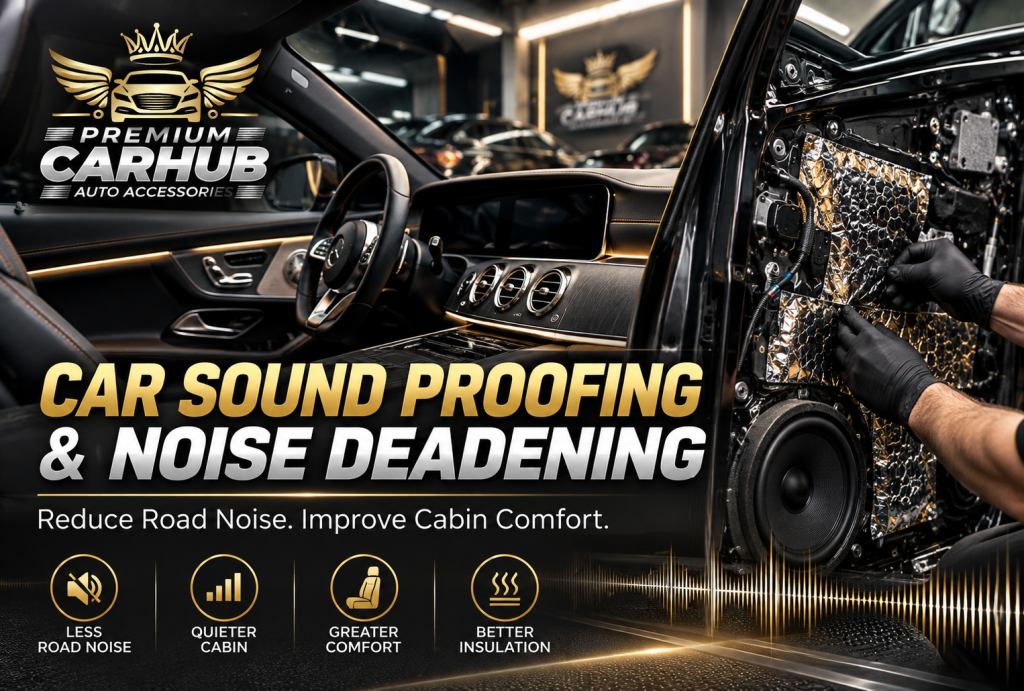
Car Sound Proofing & Noise Deadening: Complete Guide for UAE Drivers
Driving through Dubai should be comfortable, whether you are commuting along Sheikh Zayed Road, travelling between emirates or enjoying a weekend journey across the UAE. However, even a well-maintained vehicle can develop an irritating combination of road noise, wind turbulence, tyre hum and interior vibration.
These sounds may seem minor during a short drive. Over longer distances, they can interfere with conversations, reduce music clarity and make the cabin feel less refined.
Car Sound Proofing offers a practical solution by reducing unwanted noise and controlling vibrations that travel through a vehicle’s body panels.
Unlike simply increasing the stereo volume or replacing interior trim, professional noise deadening addresses specific sources of unwanted sound.
At Premium Car Hub, Dubai drivers can explore automotive customization and premium audio solutions designed to improve cabin comfort.
This guide explains how Car Sound Proofing works, which materials are effective, where they should be installed and what UAE vehicle owners should consider before investing in acoustic treatment.
Contact Premium Car Hub for Car Sound Proofing Services
What Is Car Sound Proofing and Noise Deadening?
Car Sound Proofing refers to the use of specialized materials and installation techniques to reduce the transmission of external and internal vehicle noise.
Noise deadening is a related process that focuses primarily on controlling vibration in metal panels.
The terms are often used interchangeably, but technically they address different acoustic problems.
For example, a vibrating door panel may produce a hollow buzzing sound when music plays. A vibration-damping mat can reduce that resonance.
However, if outside traffic noise enters through damaged door seals, additional damping material alone will not solve the problem.
Contact Premium Car Hub for Car Sound Proofing Services
A comprehensive automotive acoustic treatment may combine several approaches:
- Vibration damping to reduce metal panel resonance.
- Sound absorption to control reflected airborne noise.
- Sound barriers to reduce noise transmission.
- Acoustic sealing to limit sound entering through gaps.
- Thermal insulation where appropriate materials provide both benefits.
The objective is not absolute silence. It is a more controlled, comfortable cabin without compromising the vehicle’s original safety systems or functionality.
Why Are Cars Noisy on UAE Roads?
The UAE presents several driving conditions that influence cabin noise.
1. Highway Driving at Higher Speeds
During highway travel, airflow around mirrors, door frames and roof components creates aerodynamic noise.
At the same time, tyres continuously interact with road surfaces, producing a broadband sound commonly described as tyre roar.
Car Sound Proofing can help reduce some of the noise reaching the cabin, particularly through floors and body panels.
However, excessive wind whistling caused by damaged seals or poorly fitted exterior components requires mechanical correction.
2. Extreme Summer Temperatures
Dubai’s summer heat makes material selection especially important.
Vehicles parked outdoors experience substantial temperature changes, affecting adhesives, plastics and insulation products.
Low-quality damping sheets may soften, release unpleasant odours or lose adhesion when exposed to prolonged heat.
Automotive-grade materials should therefore have documented temperature-performance characteristics suitable for their installation location.
Contact Premium Car Hub for Car Sound Proofing Services
3. Large SUVs and Off-Road Vehicles
SUVs and four-wheel-drive vehicles often have larger body panels, substantial cargo areas and tyres designed for varied terrain.
All-terrain and mud-terrain tyres can generate noticeable road noise, especially on smooth highways.
In these vehicles, Car Sound Proofing may improve comfort by treating the floor, cargo compartment and wheel-arch areas.
However, it cannot completely remove the characteristic sound produced by aggressive tyres.
4. Urban Traffic and Construction Zones
Frequent braking, acceleration and uneven road surfaces can expose existing rattles in door trims, dashboards and cargo panels.
Construction traffic and nearby heavy vehicles also contribute to external noise.
A correctly designed acoustic treatment can help reduce some transmitted sound while eliminating certain panel vibrations.
How Does Car Sound Proofing Actually Work?
Understanding the science behind automotive noise control helps owners avoid ineffective products.
Step 1: Controlling Metal Panel Vibration
Vehicle doors, floors and roof panels are made from relatively thin metal sheets.
When road vibration or speaker energy reaches these surfaces, they can resonate like a drum.
A constrained-layer damping material, usually consisting of butyl rubber and an aluminium layer, reduces this movement.
As the metal flexes, the viscoelastic layer dissipates part of the vibration energy as a small amount of heat.
The result is less panel resonance and reduced secondary noise.
Contact Premium Car Hub for Car Sound Proofing Services
Step 2: Managing Airborne Sound
After panel vibration has been controlled, airborne sound can still enter through openings, thin panels and other transmission paths.
Suitable acoustic absorbers can reduce reflected sound within enclosed spaces.
Closed-cell foam is particularly useful as a decoupling and thermal-insulation layer, although it is not interchangeable with a dedicated porous sound absorber.
Step 3: Blocking Sound Transmission
Dense sound-barrier materials, including mass-loaded vinyl, can reduce sound passing through floors and other large areas.
For effective results, these barriers generally require proper coverage, decoupling and attention to gaps.
This layered approach is more effective than expecting one thin sheet to handle every acoustic problem.
Automotive material manufacturer Dynamat explains these distinctions in its technical guidance on sound deadening and vibration control.
Best Materials Used for Car Sound Proofing
Different acoustic products serve different functions. Choosing materials based on their intended purpose is essential.
| Material | Primary Function | Recommended Areas | Important Consideration |
|---|---|---|---|
| Butyl rubber damping mats | Reduce metal vibration | Doors, roof, floor, boot | Choose heat-stable automotive grades |
| Closed-cell foam | Decouple surfaces and provide insulation | Door trims, floors, roof linings | Limited airborne sound absorption on its own |
| Mass-loaded vinyl | Reduce sound transmission | Floor, firewall, cargo areas | Adds considerable weight |
| Automotive acoustic felt | Absorb or reduce reflected airborne sound | Behind trim and in suitable cavities | Must be moisture-appropriate |
| Anti-rattle foam tape | Prevent trim contact noise | Clips, dashboards, door trims | Does not block external road noise |
Why Butyl-Based Mats Are Often Preferred
Quality butyl-based products provide reliable vibration damping without depending on a thick asphalt-like coating.
Their performance still varies by formulation, aluminium constraining layer, adhesion and temperature rating.
For UAE conditions, installers should examine the manufacturer’s specifications rather than assuming that all similarly shaped mats offer identical performance.
Products intended for building insulation should not automatically be installed inside vehicles.
Contact Premium Car Hub for Car Sound Proofing Services
Which Car Areas Should Be Soundproofed First?
One of the most important decisions in Car Sound Proofing is choosing where to install the material.
Treating every interior surface is not automatically necessary.
Car Doors: A Practical Starting Point
Doors contain large metal sections that can resonate when speakers produce bass.
Applying suitable damping material to accessible metal surfaces can improve panel stability and reduce certain rattles.
Door treatment can be particularly beneficial when upgrading the vehicle’s sound system.
Installers must preserve drainage openings, window movement, wiring access and side-impact safety components.
Vehicle Floor: Reducing Road and Tyre Noise
The floor transmits a combination of tyre noise, drivetrain vibration and road impact sounds.
Effective floor treatment may include damping mats, decoupling layers and suitable sound barriers.
Because the interior carpet and seats may require removal, professional installation is particularly valuable.
Wheel Arches: Addressing Tyre Roar
Wheel-arch areas can be important sources of noise, particularly in SUVs.
Carefully selected interior wheel-arch treatments may reduce some transmitted noise.
Exterior products must be specifically designed for exposure to water, stones, dirt and road debris.
Car Roof: Rain Noise and Panel Resonance
Large roof panels can resonate during rainfall or when subjected to aerodynamic excitation.
Appropriate damping treatment may reduce this resonance.
However, vehicles with panoramic roofs, curtain airbags or complicated roof electronics require additional caution.
Boot and Cargo Area: Controlling Rear-Cabin Drone
Hatchbacks and SUVs can transmit road and exhaust-related noise through the rear cargo space.
Treating the boot floor, spare-wheel well and suitable side panels may help reduce unwanted resonance.
Practical recommendation: Begin with the area most closely associated with your actual noise complaint rather than purchasing a full-vehicle package immediately.
Contact Premium Car Hub for Car Sound Proofing Services
Car Sound Proofing vs Noise Deadening: Comparison
Although these services overlap, they should not be considered identical.
| Feature | Noise Deadening | Comprehensive Soundproofing |
|---|---|---|
| Main purpose | Control vibrations and resonance | Reduce multiple noise-transmission paths |
| Typical materials | Butyl damping sheets | Damping, absorption and barrier materials |
| Installation coverage | Selected vibrating panels | Multiple cabin areas |
| Effect on rattles | Often effective | Effective when source is properly treated |
| Effect on airborne noise | Limited when used alone | Potentially better with proper barriers and sealing |
| Added weight | Usually lower | Can be substantially higher |
| Complexity | Low to moderate | Moderate to high |
| Ideal application | Speaker and panel vibration | Wider road-noise reduction |
For many drivers, targeted noise deadening is a sensible initial investment.
A complete Car Sound Proofing package becomes more relevant when noise originates from several areas and a broader acoustic improvement is desired.
How Car Sound Proofing Improves Your Audio Experience
Audio quality depends on more than speaker size, amplifier power or touchscreen features.
A vehicle door is an imperfect speaker enclosure. Its metal panels and plastic trims can vibrate when low-frequency sound is reproduced.
These vibrations may introduce buzzing, rattling and unwanted resonance.
Professional door damping can provide a more stable mounting environment for speakers.
The possible benefits include clearer bass reproduction, less distracting trim vibration and improved perceived musical detail.
However, deadening material does not replace proper speaker installation, crossover configuration or digital signal processing.
For drivers planning audio upgrades, it may be more economical to complete necessary door damping while the door panels are already removed.
Premium Car Hub’s guide to DSP car audio tuning explains how professional calibration can further improve sound reproduction.
How Professional Car Sound Proofing Is Installed
The quality of installation can matter as much as the material itself.
Stage 1: Noise Diagnosis
Technicians should identify when the unwanted sound occurs.
Does it appear only above highway speeds? Does it increase on coarse asphalt? Does it occur when the speakers play bass-heavy music?
These details help distinguish tyre noise, panel resonance, air leakage and mechanical faults.
Stage 2: Interior Inspection
Relevant panels, carpets or trims are carefully removed.
Wiring harnesses, drainage channels, mounting points and safety equipment are identified before treatment begins.
Stage 3: Surface Preparation
Metal surfaces must be clean, dry and free from loose contamination.
Applying damping material over moisture or corrosion can cause future problems.
Stage 4: Acoustic Material Installation
Damping sheets are cut to suit the panel and pressed firmly into place using suitable installation tools.
Additional decoupling or barrier layers may be installed where space and vehicle design permit.
Simply applying more material is not always better.
Stage 5: Reassembly and Quality Checks
Door seals, clips, carpets and trims are refitted.
Technicians should check power windows, seat movement, electrical connectors, drainage routes and warning indicators.
A final road test helps identify any remaining rattles or noise sources.
Car Sound Proofing in Dubai: Important UAE Considerations
Dubai’s climate and driving environment introduce factors that should influence every installation.
Heat resistance: Materials must tolerate prolonged thermal exposure without losing adhesion or producing objectionable odours.
Moisture protection: Although rainfall is relatively limited, vehicle doors routinely encounter water. Drainage holes must remain functional, and moisture-sensitive materials should not be placed where they can become saturated.
Additional weight: Heavy barriers can improve noise isolation but also increase vehicle mass. Weight distribution and practicality should be considered, especially when treating large SUVs.
Safety equipment: Airbags, seatbelt mechanisms, high-voltage cables in hybrid and electric vehicles, and other safety-related components must remain unobstructed.
Vehicle condition: If tyre wear, wheel bearings or defective door seals are responsible for excessive noise, repairing those faults should take priority over acoustic treatment.
For drivers considering broader interior improvements, explore Premium Car Hub’s premium car accessories and interior customization services.
The Biggest Mistake: Soundproofing Before Finding the Noise Source
Consider two Dubai drivers who report the same problem: their cars become noisy at 100 km/h.
The first vehicle has worn, unevenly feathered tyres. The second has a floor panel that amplifies road vibration.
Both drivers hear a similar sound, but they require different solutions.
Adding insulation to the first vehicle may produce disappointing results because tyre replacement and suspension inspection could be the more appropriate remedy.
The second vehicle may benefit from targeted floor damping and an appropriate sound barrier.
This illustrates why Car Sound Proofing should begin with diagnosis rather than product selection.
A useful assessment separates noise into three categories:
- Speed-dependent noise: Often associated with tyres, airflow, wheel bearings or drivetrain components.
- Surface-dependent noise: Changes significantly between smooth and rough road surfaces.
- Music-dependent noise: Typically linked to speaker mounting, vibrating panels or loose interior components.
Identifying these patterns helps avoid unnecessary expenditure.
How to Measure Car Cabin Noise Before and After Installation
A common weakness in automotive soundproofing claims is the absence of comparable measurements.
Instead of relying entirely on statements such as “50% quieter,” request a consistent before-and-after assessment.
For a practical comparison, use the same vehicle, tyres, tyre pressures, route, cabin configuration and approximate driving speed.
Measure from the same microphone position with the air conditioning and audio configured consistently.
A phone application may provide a rough comparison, but a calibrated sound-level meter offers more reliable measurements.
For example, a hypothetical reading of 73 dB(A) before treatment and 70 dB(A) afterward represents a reduction of 3 dB.
That corresponds to approximately half the measured sound energy, but it does not mean the sound will be perceived as half as loud.
The US National Institute for Occupational Safety and Health explains the logarithmic nature of decibel measurements in its technical discussion of noise measurements.
For more informative testing, record not only the overall level but also whether low-frequency tyre drone, wind noise or panel rattles improved.
Expert Recommendations for Car Sound Proofing from Premium Car Hub
For a high-quality automotive customization project, the following technician-focused recommendations provide a practical framework.
Recommendation 1: Prioritize Your Primary Complaint
Do not automatically begin with the most expensive package.
If the main issue is vibrating door panels, targeted door treatment may offer better value than treating unrelated roof sections.
Recommendation 2: Select Materials for Dubai’s Climate
Always review adhesive quality, temperature ratings, moisture compatibility and suitability for automotive use.
Recommendation 3: Combine Sound Treatment With Audio Upgrades
When installing new component speakers, consider door damping and anti-rattle treatment as part of the same project.
This reduces repeated trim removal and helps create a more controlled acoustic environment.
Recommendation 4: Preserve Factory Fit and Safety
A premium installation should not leave visible adhesive, damaged wiring, blocked drainage holes, loose trim or restricted airbag deployment paths.
Recommendation 5: Set Realistic Expectations
Car Sound Proofing can reduce particular unwanted sounds, but cannot eliminate every source of engine, tyre, road or wind noise.
A vehicle-specific plan is more credible than a promise of complete silence.
For further insight into maintaining a factory-inspired cabin, see Premium Car Hub’s article about installing interior upgrades without damaging factory trim.
Pros and Cons of Car Sound Proofing
Advantages
- Reduces unwanted panel vibration and selected road-noise components.
- Can improve music clarity and reduce speaker-related rattles.
- Creates a more refined cabin experience.
- Makes ordinary conversations easier in some driving conditions.
- Can complement other luxury interior upgrades.
- May provide additional thermal benefits when suitable insulation materials are used.
Limitations
- Professional installation may require substantial interior disassembly.
- Comprehensive acoustic barriers can add considerable weight.
- Results vary with vehicle construction and existing insulation.
- Poor installation can create rattles, moisture problems or electrical issues.
- Not all tyre, engine and wind sounds can be addressed through insulation.
- Some vehicles already have extensive factory acoustic treatment, reducing the potential benefit of additional materials.
Is Car Sound Proofing Worth the Investment?
For many vehicle owners, the answer depends on the source and severity of the noise.
A compact sedan with persistent door rattles may benefit substantially from relatively limited treatment.
A large SUV used for regular highway journeys might justify additional attention to its floor, wheel arches and cargo area.
On the other hand, an already quiet luxury sedan with extensive factory insulation may experience smaller improvements.
Instead of selecting a package solely by vehicle size, consider your driving habits, current cabin noise, audio system and tolerance for added weight.
The best Car Sound Proofing investment is the one that addresses a verified problem with the least unnecessary complexity.
Frequently Asked Questions About Car Sound Proofing
1. Does Car Sound Proofing really reduce road noise?
Yes. Properly selected damping and acoustic barrier materials can reduce certain forms of road noise entering the vehicle cabin. However, the improvement depends on the source of the noise, installation coverage and vehicle construction. Tyre-related noise may require both mechanical and acoustic solutions.
2. What is the best material for Car Sound Proofing?
There is no universal best material. Butyl-based constrained-layer mats are well suited to reducing metal panel vibration. Acoustic absorbers help manage airborne sound, while mass-loaded barriers limit sound transmission. A suitable combination depends on the vehicle and the particular noise problem.
3. How much does Car Sound Proofing cost in Dubai?
Pricing depends on the vehicle model, treatment areas, material quality and labour involved. Four-door treatment is usually less extensive than a full cabin installation. Since packages vary significantly, request an itemized quotation identifying the actual materials and covered areas rather than relying on a generic advertised price.
4. Can sound deadening improve bass in my car?
Yes. Reducing door-panel resonance can decrease rattling and improve the perceived clarity of bass frequencies. However, speaker quality, installation, door sealing and audio tuning also affect results. Sound deadening should complement a properly configured audio system rather than replace it.
5. Will soundproofing make my car completely silent?
No. Vehicles require ventilation and contain moving mechanical components. Wind, tyres, engine systems and surrounding traffic will still produce sound. Effective treatment reduces selected noise sources and improves comfort rather than creating a completely silent environment.
6. How long does automotive sound deadening last?
High-quality automotive materials can remain effective for many years when correctly installed. Actual durability depends on adhesive formulation, temperature exposure, moisture and surface preparation. In Dubai, products should be selected with high-temperature performance in mind.
7. Is Car Sound Proofing suitable for luxury cars?
Yes, but the existing factory acoustic design must be considered. Many premium vehicles already include substantial insulation, laminated glass and engineered noise-control systems. Additional treatment should target identifiable weaknesses rather than duplicate factory materials unnecessarily.
8. Does Car Sound Proofing affect fuel efficiency?
Acoustic treatment adds weight. Small targeted installations may have little practical influence on everyday consumption, while extensive use of heavy barriers can increase vehicle mass more noticeably. Avoid unnecessary material coverage and ask the installer about the approximate weight being added.
9. Can I install sound-deadening sheets myself?
Some simple treatments are possible for experienced vehicle owners, but modern vehicles contain delicate trim clips, wiring, airbags and drainage systems. Incorrect disassembly or material placement can cause expensive problems. Professional installation is preferable when extensive interior removal is required.
10. Does Car Sound Proofing help electric vehicles?
Yes. Electric vehicles often have quieter propulsion systems, making tyre and wind noise relatively more noticeable. Targeted acoustic treatment can address these sounds, although installers must avoid disturbing high-voltage components, battery structures and manufacturer-defined safety zones.
Trusted Automotive Resources for Understanding Noise Control
For vehicle owners interested in the engineering behind automotive acoustic treatment, the following resources provide additional technical information:
1. Dynamat — Automotive Sound Deadening and Road Noise Reduction: Explains vibration damping, acoustic materials and installation approaches. https://dynamat.com/blogs/news/how-to-reduce-road-noise-in-your-car
2. 3M — Automotive Acoustic Management: Describes engineered automotive noise-control solutions, including sound absorption and barrier technologies. https://www.3m.com/3M/en_US/oem-tier-us/products/acoustic-management/
3. Dynamat — Vibration Damping Explained: Provides an explanation of constrained-layer damping and how it differs from sound absorption. https://dynamat.com/blogs/news/vibration-damping-explained
4. 3M — Lightweight Automotive Acoustic Materials: Discusses automotive noise, vibration and harshness management, including considerations for electric vehicles. https://www.3m.com/3M/en_US/oem-tier-us/resources/sustainability/lightweight-flexile-acoustic-material/
Conclusion: A Quieter Car Begins With the Right Acoustic Strategy
Unwanted cabin noise is not always an unavoidable part of driving. In many vehicles, a significant part of the problem comes from vibrating body panels, inadequate acoustic barriers, loose interior components or identifiable mechanical conditions.
Car Sound Proofing offers an opportunity to improve vehicle refinement when the treatment is properly matched to the source of the noise.
For UAE drivers, selecting materials that withstand local temperatures, protecting factory safety systems and avoiding unnecessary weight are especially important.
The goal should not be to fill every available surface with insulation. It should be to create a quieter, more controlled interior through thoughtful diagnosis and precise installation.
Whether you own a daily commuter, a family SUV or a luxury vehicle, carefully planned noise deadening can be a valuable part of improving your driving experience.
For professional automotive audio solutions and interior customization in Dubai, contact Premium Car Hub to discuss the most suitable treatment options for your vehicle.
Contact Premium Car Hub — Dubai
Premium Car Hub | Premium Automotive Customization & Sound Systems
Location: 20th St – Al Khabaisi – Dubai, United Arab Emirates
Phone: +971 4 570 0353
Email: info@premiumcarhub.com
Website: https://premiumcarhub.com/
Explore professional automotive accessories, car audio enhancements and vehicle interior customization solutions designed to improve everyday comfort and enjoyment on UAE roads.