
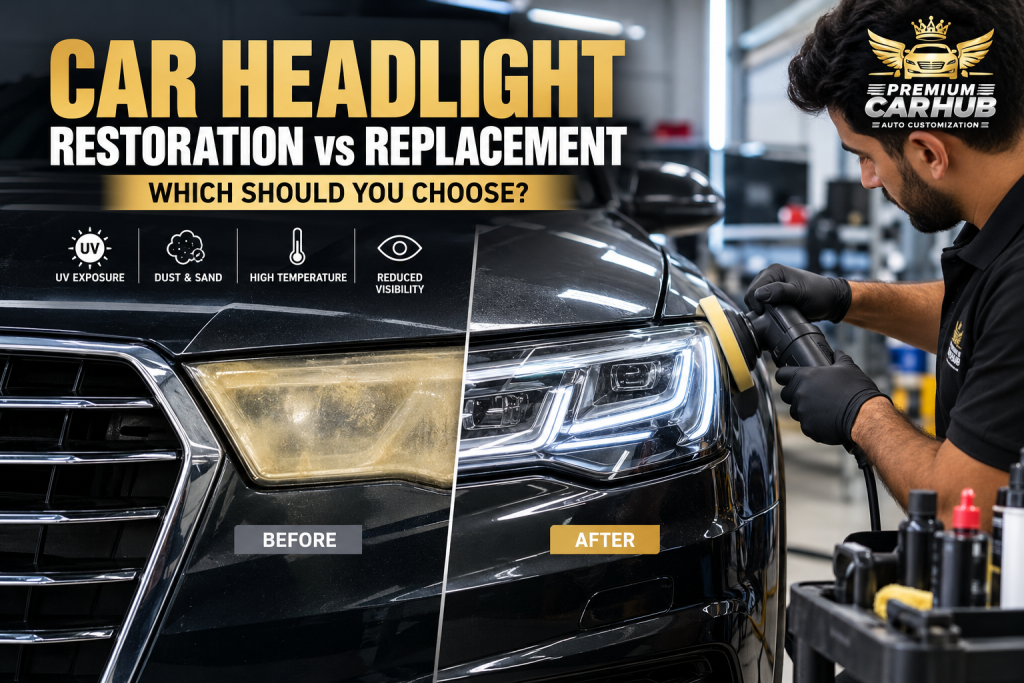
Car Headlight Restoration vs Replacement: Which Should You Choose?
A cloudy or yellow Car Headlight can make an otherwise well-maintained vehicle look considerably older. More importantly, deterioration of the lens can reduce useful illumination at night, scatter the beam and make it harder to identify lane markings, pedestrians and obstacles.
For drivers in Dubai and across the UAE, the problem deserves even more attention. Intense sunlight, UV exposure, airborne sand, road dust, high temperatures and frequent outdoor parking can accelerate deterioration of the clear protective coating covering modern polycarbonate headlamp lenses.
When this happens, owners usually face two options: restore the existing headlights or replace the headlight assemblies.
Restoration is usually less expensive and can produce an impressive cosmetic improvement. Replacement costs more but may be necessary when deterioration extends beyond the outer lens or when the lighting system itself has developed faults.
The correct choice depends on what has actually failed.
This guide explains how to tell the difference, what professional restoration can realistically achieve, when replacement becomes the safer investment, and how Premium Car Hub technicians recommend approaching the decision for UAE vehicles.
Contact Premium Car Hub for Car Headlight Services
Why Does a Car Headlight Become Cloudy or Yellow?
Most modern headlights use polycarbonate plastic rather than glass. Polycarbonate is lightweight, impact-resistant and can be moulded into complex shapes, making it ideal for modern vehicle designs.
The material itself, however, requires a protective surface coating.
Over time, ultraviolet radiation gradually degrades that coating. Once the protection weakens, the exposed plastic can begin to oxidise.
Typical signs include:
- Yellow discoloration
- Milky or cloudy appearance
- Rough surface texture
- Fine cracking
- Uneven transparency
- Reduced beam clarity
- Dullness on the upper section of the lens
Manufacturer technical information archived through the U.S. National Highway Traffic Safety Administration has also documented UV degradation of the original headlamp hard coating as a cause of yellowed or cloudy polycarbonate lenses.
Why UAE Cars Can Experience Faster Headlight Deterioration
Dubai creates a demanding environment for exterior plastics.
A Car Headlight may repeatedly experience strong sunlight during the day, very high surface temperatures while parked, abrasive dust during driving and frequent washing to remove sand and contamination.
The top section of the lens often deteriorates first because it receives the greatest direct solar exposure.
Cars permanently parked in basement parking can therefore have noticeably clearer headlights than identical vehicles of the same age that spend every working day outdoors.
That difference is useful when diagnosing the problem: deterioration is often environmental rather than electrical.
Does a Cloudy Car Headlight Actually Reduce Visibility?
Yes.
The appearance of the lens is not purely cosmetic.
AAA laboratory research found that severely deteriorated headlamp lenses in its test produced only about 22% of the light output measured from new replacement headlights on low beam. The exact deterioration of an individual vehicle will vary considerably, but the research demonstrates that badly degraded lenses can substantially affect usable illumination.
A damaged Car Headlight lens can affect illumination in two ways.
First, less light successfully passes through the plastic.
Second, microscopic surface damage can scatter light rather than allowing the optical system to direct it precisely onto the road.
That is why simply installing a brighter bulb behind a heavily oxidised lens does not necessarily solve poor visibility.
The lens must also be optically clear.
What Is Car Headlight Restoration?
Professional Car Headlight restoration removes the damaged outer layer of the lens and refinishes the underlying polycarbonate.
A proper procedure commonly involves several stages rather than simply applying polish.
Typical Headlight Restoration Process
1. Inspection
The technician determines whether the deterioration is actually on the outside surface.
This distinction is essential.
External oxidation can often be restored. Internal contamination, damaged reflectors or electronic faults cannot.
2. Cleaning and Preparation
Sand, road film, wax, silicone and contamination are removed before correction begins.
Adjacent painted surfaces should also be protected.
3. Controlled Sanding
The oxidised coating is progressively removed using suitable abrasive grades.
The objective is not aggressive material removal. It is creating a uniformly refined surface without deep sanding marks.
4. Surface Refinement
Successively finer abrasives reduce the previous sanding pattern.
5. Polishing
The lens is machine- or hand-polished until optical clarity returns.
6. UV Protection
This is one of the most important steps.
A restored Car Headlight that is polished but left completely unprotected can oxidise again relatively quickly.
A quality restoration therefore requires an appropriate protective treatment designed to limit renewed UV degradation.
Contact Premium Car Hub for Car Headlight Services
What Does Car Headlight Replacement Involve?
Replacement means installing another complete headlamp assembly or, on certain vehicles, replacing a serviceable lens or module where the manufacturer and component design permit it.
Modern headlights can contain far more than a bulb.
Depending on the vehicle, an assembly may include:
- LED modules
- HID components
- Projector optics
- Reflectors
- Daytime running lights
- Turn signals
- Adaptive lighting motors
- Levelling motors
- Cooling fans
- Control modules
- Matrix LED components
- Wiring and connectors
- Decorative light guides
That explains why replacing a Car Headlight on a modern luxury vehicle can be considerably more expensive than restoring the external lens.
Car Headlight Restoration vs Replacement: Quick Comparison
| Factor | Headlight Restoration | Headlight Replacement |
|---|---|---|
| Best for | External oxidation and yellowing | Physical, optical or internal damage |
| Initial cost | Lower | Higher |
| Original assembly retained | Yes | No |
| Cosmetic improvement | Often excellent | Essentially new appearance |
| Light-output improvement | Can be significant | Highest potential when correct OEM-quality assembly is used |
| Cracked housing repair | No | Yes |
| Internal moisture problem | Usually no | Often required if housing cannot be resealed |
| Failed LED module | No | Module/assembly repair or replacement required |
| Damaged reflector | No | Replacement normally required |
| Time required | Usually shorter | Depends on vehicle and parts |
| Suitable for expensive adaptive lights | Often attractive if only lens surface is damaged | Necessary if internal system has failed |
| Long-term result | Depends heavily on UV protection | Potentially longest-lasting |
The table illustrates why price alone should never determine the decision.
The fundamental question is whether the problem is surface deterioration or component failure.
Contact Premium Car Hub for Car Headlight Services
When Should You Restore a Car Headlight?
Restoration is normally the logical first option when the headlamp is mechanically and electrically healthy.
Restoration Makes Sense When:
The Lens Is Yellow but Not Cracked
Yellowing usually indicates oxidation rather than structural failure.
A professional resurfacing procedure can often produce a dramatic improvement.
The Cloudiness Is Clearly on the Outside
Run a clean fingertip lightly across the lens after washing it.
A rough or chalky exterior often points toward surface deterioration.
Both Headlights Have Aged Gradually
When both headlights have become progressively dull over several years, UV degradation is a likely cause.
The Beam Pattern Was Good Before the Lens Deteriorated
If the headlamp previously projected light correctly and the only visible issue is the outer plastic, replacing an expensive assembly may be unnecessary.
The Vehicle Uses Expensive Factory Adaptive Headlights
This is an important consideration on premium cars.
If an original adaptive LED assembly costs significantly more than restoration and all electronics remain healthy, preserving the factory unit can be financially sensible.
When Should You Replace a Car Headlight?
Some damage simply cannot be corrected through polishing.
Replacement Should Be Considered When:
The Lens Is Cracked
A crack compromises sealing and may eventually allow moisture or dust into the housing.
Cosmetic polishing cannot correct structural damage.
Moisture Keeps Returning Inside the Housing
Temporary condensation can occasionally occur, but recurring water accumulation deserves investigation.
Possible causes include:
- Damaged seals
- Cracked housing
- Broken ventilation system
- Poor previous repairs
- Impact damage
If the assembly cannot be resealed reliably, replacement may be the safest long-term solution.
The Reflector Has Deteriorated
The reflector directs light forward.
If its reflective coating has burned, peeled or become permanently dull, polishing the outer Car Headlight lens will not restore the original beam.
LED Modules Have Failed
Many modern vehicles use integrated LEDs rather than conventional replaceable bulbs.
Module repair may sometimes be possible, but restoration of the lens alone cannot fix an electrical failure.
Adaptive Lighting Has Malfunctioned
Modern premium vehicles may electronically swivel, level or reshape the beam.
If the motors, sensors or internal mechanisms have failed, the system requires diagnostic work rather than cosmetic restoration.
Mounting Tabs Are Broken
A lamp that cannot sit securely in its designed position may produce poor beam alignment.
Replacement or a professionally engineered repair may be necessary.
The Lens Has Severe Micro-Cracking
Fine surface oxidation is repairable.
Deep crazing throughout the polycarbonate is different.
Removing excessive material in an attempt to chase every crack can weaken the lens and still fail to produce a satisfactory result.
Pros and Cons of Car Headlight Restoration
Pros
- Considerably more economical than replacing many modern assemblies
- Keeps the original factory headlamp
- Can dramatically improve vehicle appearance
- Can improve usable light transmission
- Reduces unnecessary replacement of otherwise functional components
- Particularly attractive for expensive LED or adaptive units
- Usually requires less labour than full assembly replacement
Cons
- Cannot repair electrical faults
- Cannot correct badly damaged internal reflectors
- Cannot fix major cracks
- Final durability depends on UV protection
- Poor DIY sanding can create distortion
- Results vary according to how deeply the plastic has deteriorated
Pros and Cons of Car Headlight Replacement
Pros
- Can restore the entire assembly rather than only the lens
- Correct solution for severe structural damage
- New OEM units can restore factory optical performance
- Addresses damaged seals and housings
- Necessary for some integrated LED or adaptive-light failures
- Generally provides the longest reset of component condition
Cons
- Usually more expensive
- Luxury LED assemblies can be particularly costly
- Low-quality aftermarket units may not reproduce factory optics accurately
- Some vehicles require coding or calibration
- Replacement may be unnecessary when the only problem is mild surface oxidation
Cheap Aftermarket Headlights vs Original Factory Headlights
A replacement Car Headlight should not be judged only by how clear the new lens looks.
The optical design behind the lens matters.
Reflector geometry, projector design, cutoff characteristics, beam alignment and component quality all affect what the driver actually sees.
AAA’s comparison found OEM replacement headlights restored output to the benchmark used in its testing, while aftermarket replacements reached approximately 83–90% but some also failed certain light-intensity requirements and produced greater glare. This was a specific laboratory study rather than a judgment on every aftermarket product, but it demonstrates why optical quality matters.
For premium vehicles, Premium Car Hub technicians recommend checking the quality and compatibility of a replacement unit rather than selecting solely on price.
Contact Premium Car Hub for Car Headlight Services
UAE-Specific Car Headlight Considerations
1. Strong UV Exposure
UAE sunlight is perhaps the most obvious enemy of exposed polycarbonate.
After restoration, UV protection should therefore be treated as part of the service rather than an optional cosmetic extra.
2. Sand and Dust
Fine airborne particles can gradually create microscopic marks.
Avoid wiping a dusty Car Headlight with a dry cloth.
Rinse or wash the contamination away first.
Dragging dry sand across softened or heated plastic creates unnecessary scratching.
3. High-Speed Night Driving
Dubai and UAE highways involve sustained higher-speed driving.
At speed, your available reaction time decreases rapidly.
Weak illumination that seems acceptable on a slow residential street can become much more significant on an unlit or partially illuminated highway.
Premium Car Hub’s guide to choosing a suitable headlight upgrade for UAE night driving discusses beam control, temperature resistance and useful road illumination in greater detail. Read Premium Car Hub’s UAE headlight upgrade guide
4. Vehicle Inspection and Roadworthiness
Headlamps are safety equipment, not merely styling components.
UAE road-safety information lists poor vehicle-light condition among traffic violations, reinforcing the importance of keeping lighting systems operational.
5. Avoid Uncontrolled Lighting Modifications
Installing extremely bright bulbs in a housing not designed for them can create glare rather than useful visibility.
UAE legislation also regulates vehicle lighting and requires vehicle lights to conform to applicable specifications.
Correct beam control is more important than chasing the highest advertised lumen figure.
The Premium Car Hub Technician Decision Test
Premium Car Hub technicians recommend separating the diagnosis into four questions.
Question 1: Is the Damage Outside or Inside?
External oxidation suggests restoration.
Internal contamination suggests disassembly, repair or replacement.
Question 2: Is the Housing Structurally Sound?
Inspect:
- Lens
- Seams
- Rear housing
- Mounting brackets
- Ventilation points
Cracks or repeated moisture substantially change the decision.
Contact Premium Car Hub for Car Headlight Services
Question 3: Are the Optics and Electronics Working?
Check:
- Low beam
- High beam
- Daytime running light
- Indicators
- Adaptive functions
- Automatic levelling
- Error messages
A clear lens cannot compensate for failing electronics.
Question 4: Is Restoration Financially Sensible?
For a conventional halogen lamp with an inexpensive replacement assembly, replacing badly deteriorated headlights may make sense.
For a sophisticated adaptive LED assembly costing many times more, restoration can be excellent value when the factory internals remain healthy.
This four-question diagnosis prevents both unnecessary replacement and false-economy restoration.
A Practical Example: Two Identical Cloudy Headlights, Two Different Solutions
Consider two seven-year-old SUVs.
Vehicle A
The lenses are uniformly yellow. There are no cracks, no condensation and no dashboard errors. Both beams remain properly aligned.
The likely solution?
Professional restoration and renewed UV protection.
Vehicle B
One headlight looks cloudy, contains visible moisture and occasionally stops working. The beam also points lower than the opposite side.
Polishing the lens may make Vehicle B look better temporarily, but it does not solve the actual problem.
That assembly requires further diagnosis and may require replacement.
This demonstrates one of the most important lessons in Car Headlight maintenance:
Similar-looking headlights can have completely different faults.
Contact Premium Car Hub for Car Headlight Services
Can You Restore Headlights Yourself?
DIY kits can work, particularly for mild oxidation.
However, the result depends heavily on technique.
Common mistakes include:
- Using sandpaper that is too aggressive
- Sanding unevenly
- Failing to remove previous sanding marks
- Polishing without subsequent protection
- Applying household clear coating unsuitable for automotive plastics
- Allowing abrasive products to contact surrounding paint
- Restoring only one lamp and creating mismatched clarity
For an older daily-use vehicle, DIY restoration may be reasonable.
For a luxury vehicle with expensive adaptive headlights, professional correction is usually a safer choice.
How Long Does Car Headlight Restoration Last?
There is no responsible universal answer.
Durability depends on:
- UV exposure
- Parking environment
- Quality of surface preparation
- Type of protective finish
- Washing technique
- Vehicle usage
- Original lens condition
A vehicle stored under covered parking will generally age differently from a vehicle left outdoors in Dubai sunlight throughout the year.
The more useful question is therefore not simply, “How long will polishing last?”
Ask:
What UV protection will be applied after the damaged surface is removed?
That question reveals much more about the quality of the service.
Meaningful Internal Resources for Premium Car Hub Readers
Drivers maintaining older or premium vehicles can combine headlamp care with other UAE-focused exterior and visibility improvements.
Improve Night Visibility with the Correct Headlight Upgrade
Learn why beam pattern, glare control and compatibility matter more than simply installing the brightest available bulb.
Best Headlight Upgrade for UAE Night Driving
Restore Exterior Clarity with Professional Car Polishing
Headlights often deteriorate alongside paint exposed to the same UV, dust and washing conditions.
Car Polishing and Paint Correction Guide
Protect High-Impact Exterior Areas from UAE Road Conditions
For vehicles regularly driven on highways, paint protection can reduce damage from sand, stones and road debris.
Full Body PPF vs Partial PPF Guide
Reduce Heat and Glare Inside the Vehicle
Quality tinting can complement visibility-focused vehicle maintenance when legal limits and night clarity are considered.
Car Window Tinting in Dubai Guide
Authoritative Resources About Headlights and UAE Road Safety
AAA Research: Cloudy Headlights and Light Output
AAA laboratory testing provides useful evidence about how lens deterioration, restoration and replacement can affect headlamp performance. Read AAA’s cloudy-headlight research summary
UAE Government Road Safety Information
The UAE Government’s official road-safety portal provides information about traffic regulations, vehicle safety and compliance. UAE Government Road Safety Portal
UAE Vehicle Lighting Legislation
Official UAE legislation contains requirements governing vehicle lights and technical inspection. Review UAE traffic legislation on vehicle lights
NHTSA Technical Reference on Cloudy Headlights
A manufacturer technical bulletin archived by NHTSA discusses UV degradation of polycarbonate headlamp coatings and restoration procedures. View the NHTSA-hosted technical bulletin
Frequently Asked Questions About Car Headlight Restoration and Replacement
1. Is it better to restore headlights or replace them?
Restore them when the main problem is external yellowing, oxidation or light surface damage and the housing, optics and electronics remain healthy.
Replace the assembly when there are serious cracks, recurring internal moisture, damaged reflectors, broken mounting points or internal lighting-system failures.
2. Can badly yellow headlights really be restored?
Many heavily oxidised headlights can improve substantially through controlled sanding, polishing and protection.
However, deep cracking or deterioration extending through the plastic may prevent a perfect result.
A technician should inspect the lens before promising near-new clarity.
3. Does headlight restoration improve night visibility?
It can.
Removing oxidised material allows more light to pass through the lens and can reduce uncontrolled scattering.
AAA testing found meaningful improvement following restoration, although replacement with new OEM equipment produced greater restoration of output in its laboratory comparison.
Contact Premium Car Hub for Car Headlight Services
4. Why did my headlights turn yellow again after polishing?
The most common reason is that the damaged surface was polished but insufficiently protected afterward.
Once the original hard coating has degraded or been removed, exposed polycarbonate requires appropriate protection against renewed UV damage.
Dubai sunlight makes this particularly important.
5. Can toothpaste permanently restore a Car Headlight?
Toothpaste may temporarily improve very light surface haze because some formulations contain mild abrasives.
It is not equivalent to a professional multi-stage restoration and does not provide a durable replacement for proper UV protection.
It should not be considered a professional long-term repair.
6. Should I replace both headlights at the same time?
Not automatically.
If one Car Headlight is damaged by impact while the other remains in excellent condition, replacing only the damaged assembly may be reasonable.
However, on an older vehicle, a brand-new lamp beside a heavily aged lamp can create both cosmetic and illumination differences.
Both sides should therefore be evaluated together.
7. Why is there water inside my headlight?
Possible causes include damaged seals, cracked housing, faulty ventilation or previous collision repairs.
Small temporary condensation and persistent water accumulation are not necessarily the same issue.
Recurring moisture, droplets or visible standing water should be inspected before electrical components or reflectors are damaged.
8. Can I install brighter bulbs instead of restoring cloudy headlights?
That usually treats the wrong problem.
If the lens is severely oxidised, putting a brighter bulb behind it does not restore optical clarity.
It may also increase heat or glare if the bulb is incompatible with the housing.
Restore the lens and confirm beam performance before considering a lighting upgrade.
9. Are aftermarket replacement headlights as good as original headlights?
Quality varies substantially.
Some reputable replacement units perform well, while poorly engineered assemblies can have inaccurate beam patterns, weak sealing or inconsistent materials.
For modern luxury and adaptive-lighting vehicles, verify optical quality, electronic compatibility, coding requirements and warranty before choosing an alternative to the original unit.
10. How do I know whether my Car Headlight needs professional inspection?
Arrange an inspection if you notice:
- Severe yellowing
- Reduced night visibility
- Uneven beams
- Flickering
- Dashboard lighting warnings
- Water inside the lamp
- Cracks
- One headlight noticeably dimmer than the other
- Adaptive lighting errors
- A beam pointing unusually high or low
These symptoms can involve more than surface oxidation.
Final Verdict: Restoration or Replacement?
There is no universal winner.
A Car Headlight with a sound housing, functioning electronics and externally oxidised lens is often an excellent candidate for professional restoration.
Replacing that entire assembly may simply waste money.
A cracked, leaking or internally damaged headlamp is different. Making its lens shiny does not fix the underlying problem. In that situation, repair or replacement of the relevant components is the more responsible choice.
The smartest approach is therefore diagnosis before quotation.
Premium Car Hub technicians recommend assessing the lens, housing, sealing, beam pattern, electronics and original assembly quality together before deciding how much work is actually necessary.
For UAE drivers, one additional principle matters: protect whatever you restore.
Dubai’s combination of UV exposure, heat, sand and outdoor parking means long-term results depend not only on making the lens clear today but also on slowing the damage that would otherwise return tomorrow.
A clear Car Headlight improves the appearance of the vehicle, but its real value becomes obvious after sunset—when correctly controlled illumination gives you more useful information about the road ahead.
Contact Premium Car Hub for Car Headlight Services
Contact Premium Car Hub Dubai
For professional vehicle inspection, detailing, lighting upgrades and premium automotive customisation, contact Premium Car Hub.
Location: 20th St – Al Khabaisi – Dubai, United Arab Emirates
Phone: +971 4 570 0353
Email: info@premiumcarhub.com
Website: Premium Car Hub Dubai : Visit Premium Car Hub