
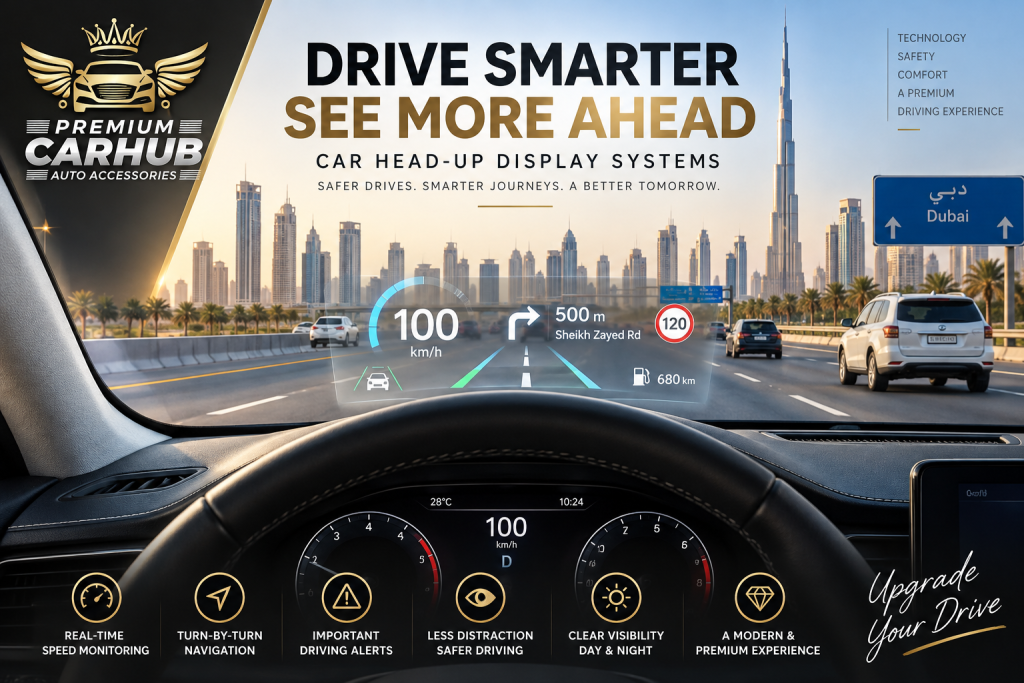
Benefits of Car Head-Up Display Systems
Modern cars provide drivers with more information than ever. Speed, navigation, vehicle warnings, driver-assistance notifications, incoming calls and infotainment functions may all compete for attention across the dashboard.
The challenge is not obtaining more information. It is presenting the right information in a place where the driver can understand it quickly.
That is where a Car Head-Up Display becomes useful.
A HUD projects selected information onto the windshield or a small transparent combiner panel positioned near the driver’s natural forward view. Instead of repeatedly looking down at the instrument cluster or across to an infotainment screen, the driver can check essential information with less eye movement.
For UAE motorists, the technology has particular relevance. Dubai driving can involve wide multi-lane roads, complex interchanges, changing speed limits, intensive navigation use, strong sunlight and long motorway journeys. A properly selected HUD can make essential information easier to reference.
However, installation quality matters. A poorly positioned, overly bright or information-heavy display can create another distraction instead of solving one.
This guide explains the practical benefits of Car Head-Up Display systems, the different types available, their advantages and limitations, UAE-specific considerations and the checks Premium Car Hub technicians recommend before installation.
What Is a Car Head-Up Display?
A Car Head-Up Display, commonly shortened to HUD, presents selected vehicle or navigation information closer to the driver’s forward field of view.
Depending on the system, it may display:
- Vehicle speed
- GPS navigation instructions
- Speed-limit information
- Engine RPM
- Cruise-control status
- Fuel or battery information
- Temperature or voltage data
- Driver-assistance alerts
- Gear position
- Incoming navigation notifications
The objective should not be to reproduce the entire instrument cluster on the windshield.
A well-configured Car Head-Up Display presents only the information that is useful at that particular moment.
Premium factory HUDs often use carefully designed optics to create a virtual image that appears ahead of the driver rather than directly on the glass. Aftermarket systems may instead use windshield reflection, a transparent combiner panel, GPS information or vehicle data accessed through an OBD connection.
1. Reduces the Need to Look Down at the Dashboard
The most obvious benefit of a Car Head-Up Display is positioning frequently checked information higher in the driver’s field of view.
Consider a driver travelling along Sheikh Zayed Road. Without a HUD, checking vehicle speed may involve moving the eyes down toward the instrument cluster. Navigation may require another glance toward the centre screen.
A HUD can position speed and the next navigation instruction closer together and closer to the forward view.
This does not mean drivers can stop scanning their mirrors, instruments or surroundings. It simply reduces unnecessary movement for specific information.
NHTSA describes driver distraction as visual, cognitive or manual diversion from the primary driving task and notes that navigation systems themselves can create distraction when poorly designed or used.
That distinction is important: a Car Head-Up Display should simplify information, not encourage drivers to spend more time reading screens.
2. Makes Speed Monitoring Easier
Speed is one of the most frequently referenced pieces of information during everyday driving.
Dubai and the wider UAE contain roads with different posted limits, and the driver remains responsible for observing current road signs and conditions.
With a Car Head-Up Display, current vehicle speed can remain visible without repeatedly looking down.
Some systems can additionally provide:
- Speed warnings
- Map-based speed limits
- Cruise-control settings
- Speed-limit recognition data
Drivers should treat electronic speed-limit information as assistance rather than an unquestionable source. Navigation databases can be outdated, and sign-recognition systems can occasionally misread or miss a sign.
The actual road sign remains the primary reference.
3. Improves Turn-by-Turn Navigation
Navigation is particularly valuable in Dubai, where major junctions may contain several exits, parallel lanes and closely spaced interchanges.
A conventional touchscreen may show an excellent map but still require the driver to shift attention toward the centre console.
A navigation-enabled Car Head-Up Display can show simplified information such as:
Next turn → distance → lane instruction
That is often more useful while moving than displaying an entire map.
For example, instead of repeatedly checking whether the next Sheikh Zayed Road exit is 300 metres or 800 metres away, a compatible HUD can present the next manoeuvre directly within the driver’s useful viewing area.
The benefit comes from simplification.
A HUD showing one directional arrow may be more effective than displaying a miniature map, three notifications and multiple engine readings simultaneously.
4. Can Provide Earlier Awareness of Selected Warnings
Higher-end HUD systems can integrate with compatible vehicle functions and display important warnings closer to the driver’s forward view.
Depending on vehicle support, these could include:
- Adaptive-cruise information
- Lane guidance
- Collision warnings
- Navigation alerts
- Speed-limit warnings
- Driver-assistance status
The exact capabilities depend heavily on the vehicle and installation.
An aftermarket Car Head-Up Display should never be advertised as adding safety systems that the vehicle does not actually possess. Displaying an icon is very different from having radar, cameras or other advanced driver-assistance hardware.
Professional installation therefore starts with understanding what data the car can genuinely provide.
5. Creates a More Modern Driving Environment
Older premium cars can remain mechanically excellent long after their original dashboard technology begins to look dated.
A Car Head-Up Display offers a way to modernise the driver’s environment without replacing the entire vehicle.
This can be particularly appealing in vehicles where owners want to preserve the original dashboard appearance.
Rather than installing an unnecessarily large screen, a subtle HUD can add selected digital information while keeping most factory controls unchanged.
Drivers planning a broader technology upgrade can also explore Premium Car Hub’s Car Android and Apple CarPlay screen installation service for navigation, wireless smartphone connectivity and multimedia integration.
6. Can Reduce Navigation Dependence on a Phone Mount
Many drivers use smartphones for navigation because the apps offer familiar interfaces and live traffic information.
The problem arises when the phone becomes something the driver repeatedly looks at or handles.
UAE traffic regulations list using a mobile phone while driving, as well as being distracted by anything while driving, as offences carrying AED 800 and four black points in the published traffic-violation schedule.
RTA’s safe-driving guidance similarly warns that handheld-device use takes attention away from the road.
A navigation-compatible Car Head-Up Display can therefore form part of a cleaner setup in which the phone connects before departure and remains untouched during the journey.
The HUD does not make phone use safe by itself. The benefit comes when technology helps eliminate unnecessary interaction.
7. Useful During Long-Distance UAE Driving
Long-distance driving between Dubai, Abu Dhabi, Al Ain, Sharjah and the Northern Emirates can involve extended periods at motorway speeds.
During these journeys, drivers frequently monitor speed, navigation and vehicle status.
A Car Head-Up Display can make this information easier to reference without repeatedly shifting attention around the cabin.
For drivers who regularly cover substantial distances, simplicity matters more than novelty.
A display containing only:
Speed + next navigation instruction + essential warning
may provide more day-to-day value than one containing RPM, fuel economy, altitude, voltage, engine load and multiple animated graphics.
Car Head-Up Display Types Compared
| HUD Type | How It Works | Main Advantage | Main Limitation | Suitable For |
|---|---|---|---|---|
| GPS HUD | Uses GPS-derived data | Simple and broadly compatible | Speed data may have slight delay | Older vehicles |
| OBD-II HUD | Reads compatible vehicle data | Can provide real-time vehicle information | Compatibility varies by model | Daily drivers |
| Combiner HUD | Projects onto a transparent panel | Less dependent on windshield optics | Visible panel remains on dashboard | Retrofit installations |
| Windshield HUD | Projects information onto windshield | Clean, premium appearance | Windshield compatibility is critical | Luxury sedans and SUVs |
| OEM/Integrated HUD | Works with factory vehicle systems | Best integration and appearance | More complex and vehicle-specific | Compatible premium vehicles |
OEM HUD vs Aftermarket HUD
Factory HUD systems usually offer the best integration because the optics, windshield, electronics, navigation and vehicle controls were engineered together.
An aftermarket Car Head-Up Display, however, can be practical for vehicles that were never supplied with HUD technology.
The quality difference between aftermarket products can be significant.
A premium retrofit should be evaluated according to:
brightness, viewing position, image sharpness, windshield compatibility, data accuracy, installation method and shutdown behaviour.
Choosing purely according to the number of advertised functions is rarely the best strategy.
UAE-Specific Driving Considerations
Strong Dubai Sunlight
A HUD that looks excellent inside a workshop may become almost invisible under direct UAE afternoon sunlight.
Daylight brightness and contrast should therefore be tested before finalising an installation.
Automatic brightness adjustment is particularly helpful when moving between underground parking, open roads and tunnels.
Night-Time Brightness
Maximum brightness is not always better.
During night driving, an excessively bright Car Head-Up Display can produce glare or reflections.
The display should dim sufficiently to remain readable without dominating the driver’s vision.
Cabin Heat
Dubai vehicles parked outside can experience extremely high cabin temperatures.
HUD hardware, mounting materials, wiring and display electronics therefore need to be suitable for the automotive environment rather than simply being consumer electronics placed on a dashboard.
Loose adhesive mounts and heat-sensitive materials are poor choices for long-term UAE use.
Windshield Compatibility
Windshield curvature and lamination influence reflected images.
An unsuitable combination may create:
- Double images
- Ghosting
- Blurred text
- Uneven focus
- Distracting reflections
For some vehicles, a combiner-style HUD may perform better than direct windshield projection.
Polarized Sunglasses
Some projected displays become weaker or change visibility when viewed through polarized sunglasses.
Dubai drivers commonly wear sunglasses because of intense daylight, making this an especially practical test.
Before committing to a Car Head-Up Display, check visibility while wearing the sunglasses you normally use for driving.
Pros and Cons of a Car Head-Up Display
Advantages
Less downward eye movement: Important information is positioned closer to the forward view.
Convenient speed monitoring: Current speed becomes easier to reference.
Simplified navigation: Turn instructions can appear without constantly checking the centre screen.
Modern interior experience: A quality installation can update an older vehicle.
Customisable information: Better systems allow drivers to disable unnecessary information.
Useful motorway companion: Particularly practical for frequent UAE highway drivers.
Limitations
Low-quality optics can create ghosting: Cheap projectors may produce multiple reflections.
Excessive information causes clutter: More data does not automatically mean a better HUD.
Windshield compatibility varies: Not every vehicle produces a clear reflected image.
Sunglasses may affect visibility: Polarized lenses can reduce readability on some systems.
Installation quality matters: Poor wiring can create electrical or battery problems.
Aftermarket integration varies: Not every vehicle exposes the same information through OBD or other interfaces.
Expert Recommendations from Premium Car Hub Technicians
Premium Car Hub technicians recommend treating HUD selection as a vehicle-specific technology decision rather than purchasing a universal device solely from an online specification sheet.
1. Decide What Information You Actually Need
For most drivers, speed and navigation provide the greatest everyday value.
Adding another ten information fields can make the display harder rather than easier to understand.
Think of the windshield as having an information budget. Every additional icon competes for attention.
2. Check Dashboard and Windshield Geometry
The viewing angle depends on seating position, dashboard shape and windshield angle.
Premium Car Hub recommends checking the vehicle before selecting the final hardware rather than assuming every Car Head-Up Display will fit correctly.
3. Test the Display Outdoors
A showroom or workshop demonstration does not reproduce UAE sunlight.
Test:
daylight readability, reflections, nighttime dimming and visibility through your usual sunglasses.
4. Preserve Factory Electronics
Installation should avoid unnecessary modifications to original wiring.
Cables should also remain clear of airbags, vents, steering components and service-access areas.
5. Check Vehicle Sleep Behaviour
After installation, lock the vehicle and confirm the Car Head-Up Display shuts down correctly after the vehicle’s electronics enter their normal sleep state.
A unit that stays powered unnecessarily can contribute to battery problems.
6. Keep the Screen Minimal
The objective of a HUD is not to create another entertainment screen.
Disable decorative animations and information that does not contribute to immediate driving decisions.
Premium Car Hub’s existing guide to choosing the best HUD for modern cars in Dubai explores these selection factors in greater detail.
Explore More Premium Car Hub Guides
Drivers researching a Car Head-Up Display can continue with these related Premium Car Hub resources.
Advanced Car Head-Up Display Installation
Read Premium Car Hub’s guide to Car Head-Up Display installation in Dubai for an overview of HUD functions, vehicle applications and professional installation considerations.
Features to Look for in a Premium HUD
The guide to the best Head-Up Display features for luxury cars covers brightness, navigation, projection positioning, windshield compatibility and information customisation.
Upgrade the Complete Infotainment System
Drivers wanting navigation, Apple CarPlay, Android Auto and multimedia functionality can explore Premium Car Hub’s Car Android Screen upgrade service.
Other Technology and Interior Upgrades
The Premium Car Hub guide to premium car accessories in Dubai discusses HUDs alongside other practical vehicle upgrades.
Authoritative Driving and Safety Resources
For drivers who want to understand the safety principles behind in-vehicle displays, these official resources provide useful further reading.
Dubai RTA – Safe Driving Guidance
The RTA Driving Safely in Dubai handbook covers speed management, distractions and safe-driving responsibilities in Dubai.
UAE Traffic Rules and Violations
The UAE Government’s published traffic and patrol violations information includes offences relating to mobile-phone use and being distracted while driving.
NHTSA Driver Distraction Guidelines
NHTSA provides visual-manual driver distraction guidance for in-vehicle electronic devices addressing design considerations intended to reduce unnecessary visual-manual demand.
NHTSA Human Factors Research
The NHTSA Human Factors Program explains visual, cognitive and manual distraction and provides research into in-vehicle driver interaction.
RTA Driving Without a Phone Campaign
RTA’s Driving Without a Phone road-safety initiative reinforces the importance of reducing phone-related distraction while driving.
Frequently Asked Questions About Car Head-Up Display Systems
1. Is a Car Head-Up Display actually useful?
Yes, when it presents a small amount of useful information clearly. Speed and turn-by-turn navigation are usually the functions drivers reference most often. A cluttered HUD with unnecessary information can reduce its practical benefit.
2. Can a head-up display be installed in any car?
Many cars can accept an aftermarket HUD, but compatibility is not universal. Dashboard design, windshield angle, OBD protocol, mounting space and power requirements should be checked first.
3. Does a Car Head-Up Display make driving safer?
A HUD can reduce the need to glance downward for specific information, but that does not automatically make every HUD safer. Poor positioning, glare or excessive information can itself become distracting. NHTSA guidance emphasises reducing unnecessary visual-manual demand from in-vehicle systems.
4. What information should I display on my HUD?
For most everyday drivers, speed, the next navigation instruction and selected safety warnings are sufficient. Performance information such as RPM or engine data may be useful for specific applications but does not need to remain visible during every journey.
5. Does a HUD work in Dubai sunlight?
Quality systems can, provided they offer adequate brightness and contrast. Because UAE sunlight is intense, outdoor testing is important. A display that appears bright indoors may become difficult to read outdoors.
6. Can polarized sunglasses affect HUD visibility?
Yes. Depending on the display technology and polarization angle, some HUD images can appear dimmer through polarized sunglasses. Test the unit while wearing your normal driving sunglasses before installation.
7. Is an OBD-II HUD safe for my vehicle?
A properly compatible device generally reads information available through the vehicle’s diagnostic interface. However, compatibility varies considerably between vehicle makes, models and model years. Professional assessment is recommended before connecting aftermarket equipment.
8. Will a Car Head-Up Display drain my battery?
A correctly installed system should shut down appropriately when the vehicle is switched off and enters its normal sleep state. Incorrect wiring or a device that remains continuously powered can contribute to battery drain, which is why post-installation shutdown testing is important.
9. Is an aftermarket HUD better than a factory HUD?
Factory systems normally provide superior vehicle integration because the windshield, projection optics, software and vehicle electronics were engineered together. A quality aftermarket HUD can nevertheless provide useful functionality in vehicles that were not originally equipped with one.
10. Where can I install a Car Head-Up Display in Dubai?
Professional installation is advisable when the system requires integration with vehicle power, OBD information, navigation or factory electronics. Premium Car Hub provides vehicle technology and customisation services from its workshop in Al Khabaisi, Dubai.
Is a Car Head-Up Display Worth It?
A Car Head-Up Display delivers its greatest value when it makes driving information simpler rather than adding another layer of technology.
The strongest applications are straightforward: show vehicle speed clearly, provide the next navigation instruction when required and present genuinely important warnings without filling the windshield with unnecessary graphics.
For UAE drivers, several factors make careful product selection especially important. Strong sunlight tests display brightness. High cabin temperatures test hardware durability. Polarized sunglasses may affect visibility, while complicated Dubai interchanges make clear navigation especially valuable.
The most sophisticated HUD is therefore not necessarily the one containing the most features.
It is the system that displays the right information, remains readable in UAE conditions, integrates safely with the vehicle and disappears into the driving experience when it is not needed.
That is the difference between installing another gadget and creating a genuinely useful driving upgrade.
Contact Premium Car Hub
For Car Head-Up Display installation and automotive technology upgrades in Dubai, contact Premium Car Hub.
Location: 20th St – Al Khabaisi – Dubai, United Arab Emirates
Phone: +971 4 570 0353
Email: info@premiumcarhub.com
Website: Premium Car Hub