
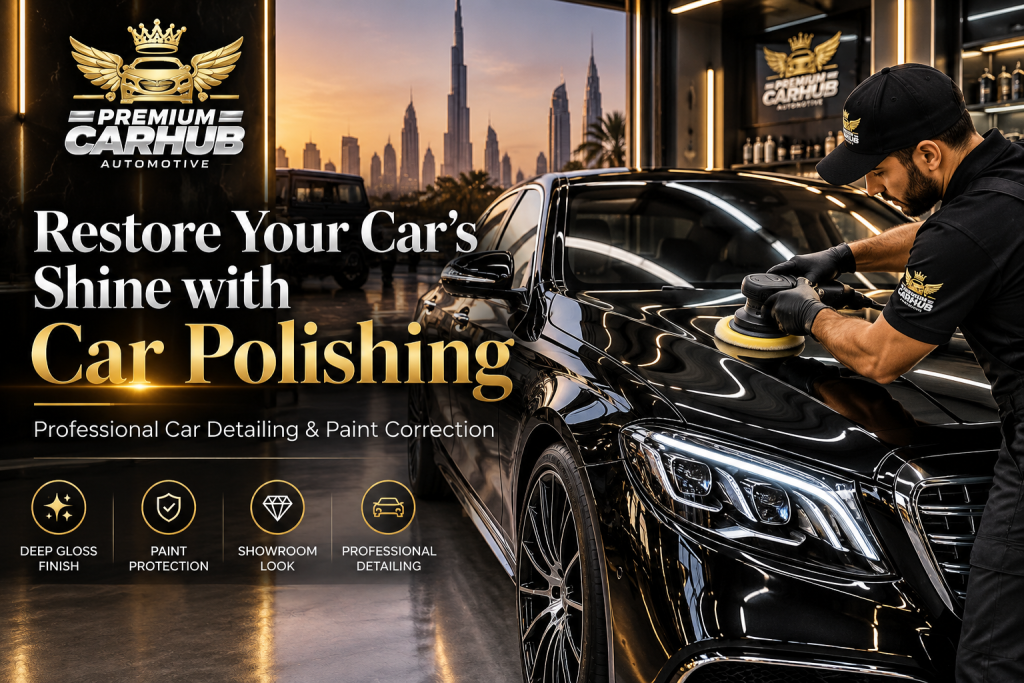
Restore Your Car’s Shine with Car Polishing
A car can be mechanically perfect and still look older than it really is.
You wash it regularly. The paint is technically clean. Yet when sunlight hits the bonnet, you see circular swirl marks. Under petrol-station lighting, fine scratches appear across the doors. Dark colours may look grey or cloudy instead of deep and reflective.
This is where Car Polishing becomes valuable.
Professional Car Polishing is not simply about making a vehicle shiny for a few days. When performed correctly, it refines the painted surface, reduces suitable defects and restores the clarity that allows the original colour to appear richer.
That distinction matters considerably in Dubai.
The UAE has a desert climate with hot summers, while dust and particulate matter are common environmental factors. The UAE Government also identifies dust and sandstorms among the country’s climate-related environmental challenges.
Combined with outdoor parking, frequent washing, intense sunlight and road contamination, these conditions can make even well-maintained vehicles gradually lose their showroom appearance.
At Premium Car Hub in Al Khabaisi, professional Car Polishing is approached as paint correction rather than simply applying something shiny over the surface.
The objective is straightforward: improve the paint itself before adding protection.
What Is Car Polishing?
Car Polishing is a controlled paint-refinement process in which suitable abrasives, polishing pads and machine techniques are used to reduce microscopic surface irregularities in automotive paint.
Modern vehicles generally have a protective clear coat over the colour layer. Many visual defects occur within this clear coat.
Typical examples include:
- Light swirl marks
- Fine wash scratches
- Mild oxidation
- Paint haze
- Water spotting
- Compound marks
- Minor surface imperfections
- Loss of gloss
A polishing compound contains microscopic abrasives that gradually refine these imperfections.
Professional automotive manufacturers such as 3M produce different categories of coarse compounds, fine polishing compounds, finishing products, buffing pads and related paint-repair systems.
This illustrates an important point: there is no universal polish or pad combination that should automatically be used on every car.
Different paint conditions require different correction methods.
Why Does Paint Lose Its Shine?
Paint rarely becomes dull overnight. Loss of gloss usually happens gradually through thousands of tiny surface defects.
Imagine a perfectly smooth mirror.
Light reflects from it in an organised direction, creating a clear image.
Now imagine covering the same mirror with thousands of microscopic scratches. It may still reflect light, but the reflection becomes scattered.
Automotive paint behaves similarly.
When the clear coat contains swirl marks, scratches, oxidation and contamination, incoming light scatters rather than reflecting cleanly.
That is why damaged paint can look:
- Grey
- Hazy
- Flat
- Chalky
- Less reflective
- Lighter than its original colour
Professional Car Polishing improves the surface so light reflects more evenly.
The result is often a noticeably deeper colour and sharper reflection without repainting the vehicle.
Why Car Polishing Matters More in Dubai
Vehicle paint experiences different environmental conditions depending on location.
Advice written for vehicles in mild European climates does not always translate perfectly to cars driven every day in Dubai.
The UAE officially has a desert climate, with hot and humid summer conditions. Air-quality monitoring in the country also specifically tracks dust and particulate matter.
For Dubai car owners, several conditions deserve particular attention.
Airborne Dust and Sand
Dust settling on paint is not automatically damaging.
The problem begins when owners wipe a dusty vehicle with a dry cloth.
Those particles can be dragged across the clear coat like extremely fine abrasives.
Repeat this several times every week and the result can be thousands of microscopic marks.
Black, navy blue and other dark paints reveal the damage especially clearly.
Strong Heat and Outdoor Parking
Vehicles regularly parked outdoors experience prolonged heat and environmental exposure.
Heat also creates another practical issue: washing or applying detailing chemicals to very hot body panels can make products dry too quickly.
Professional detailers therefore prefer controlled conditions whenever possible.
Frequent Car Washing
Dubai owners often wash vehicles frequently because visible dust returns quickly.
Frequent washing itself is not the problem.
Poor washing technique is.
Automatic brushes, dirty wash mitts, reused towels and aggressive dry wiping can progressively create swirl marks.
Ironically, some cars become scratched because owners are trying too hard to keep them clean.
Mineral Deposits and Water Spots
When water dries naturally on hot vehicle panels, dissolved minerals may remain behind.
Fresh deposits can sometimes be removed chemically.
When deposits have etched the surface, Car Polishing may be required to restore clarity.
How Professional Car Polishing Restores Shine
Professional polishing should be treated as a sequence rather than a single machine pass.
1. Paint Inspection
Technicians first examine the vehicle under suitable lighting.
They look for:
- Swirl marks
- Random scratches
- Oxidation
- Previous repair work
- Repainted panels
- Holograms
- Stone chips
- Clear-coat failure
- Water-spot etching
This assessment determines what can realistically be corrected.
2. Thorough Washing
Polishing a contaminated car would risk dragging dirt through the paint.
The vehicle therefore needs a thorough wash before correction begins.
3. Paint Decontamination
Regular washing cannot remove everything bonded to paint.
Depending on the condition, additional decontamination may be used to remove embedded particles and surface contamination.
4. A Test Area
Experienced technicians often begin with a small test area.
This reveals how the paint responds to a specific pad, machine and polishing liquid.
Different vehicles—and even different panels on the same car—can respond differently.
5. Machine Polishing
A polishing machine works the appropriate abrasive combination over the clear coat.
For relatively minor defects, one-stage Car Polishing may be sufficient.
More noticeable defects may require a cutting stage followed by a finishing stage.
6. Finishing and Inspection
A finishing polish can remove haze created during heavier correction and increase optical clarity.
High-quality polishing should then be checked under different lighting conditions.
This is particularly important on black cars, where holograms and faint polishing trails become obvious in direct sunlight.
3M describes automotive machine polish as suitable for reducing compound swirls, minor scratches and water spots while producing a high-gloss surface.
7. Paint Protection
Polishing corrects paint.
Protection helps preserve the corrected finish.
After Car Polishing, owners can consider wax, sealant, ceramic coating or paint protection film depending on their expectations.
Car Polishing vs Waxing vs Ceramic Coating vs PPF
Understanding these services prevents owners from purchasing the wrong treatment.
| Feature | Car Polishing | Wax | Ceramic Coating | Paint Protection Film |
|---|---|---|---|---|
| Removes light swirl marks | Yes | No | No | No |
| Corrects paint haze | Yes | No | No | No |
| Improves surface clarity | Excellent | Moderate visual enhancement | Enhances prepared paint | Enhances/protects prepared paint |
| Adds durable protection | Limited by itself | Short-term | Strong chemical/environmental protection | Strong physical protection |
| Helps against stone chips | No | No | Very limited | Yes |
| Requires paint preparation | It is the preparation/correction stage | Preferable | Yes | Yes |
| Best use | Restoring paint | Temporary protection/gloss | Long-term easier maintenance | Impact-prone areas |
The services therefore complement rather than replace one another.
A scratched car does not become corrected simply because ceramic coating is applied over it.
Likewise, polished paint does not automatically become resistant to future scratches.
One-Step vs Multi-Stage Car Polishing
Not every vehicle needs maximum correction.
In fact, repeatedly choosing the most aggressive process can be counterproductive because abrasive correction removes a tiny amount of clear coat.
One-Step Polishing
Best suited to vehicles with:
- Light swirl marks
- Mild haze
- Good overall paint condition
- Moderate gloss reduction
The objective is usually significant improvement while preserving maximum paint thickness.
Two-Step Paint Correction
Typically considered when the vehicle has:
- More noticeable swirls
- Moderate surface defects
- Previous poor detailing marks
- Greater oxidation or haze
The first stage performs stronger correction.
The second stage refines the finish.
Multi-Stage Correction
This should be selected based on paint condition rather than because a larger number sounds better.
Premium Car Hub’s paint-correction guidance similarly recommends choosing the least aggressive process capable of achieving the desired result rather than automatically selecting the longest correction package.
That is an important professional principle.
Preserving healthy paint should matter more than chasing an unrealistic percentage of defect removal.
What Can Car Polishing Remove?
Professional Car Polishing can considerably improve many common paint defects.
Swirl Marks
These fine circular scratches are often created by poor washing and drying techniques.
They are particularly noticeable in direct sunlight.
Light Scratches
If a scratch remains within a safely correctable part of the clear coat, polishing may substantially reduce or remove it.
Oxidation and Dullness
Suitable correction can restore clarity to mildly oxidised paint.
Water Spot Etching
Light to moderate water-spot damage may often be improved through proper polishing.
Holograms
Poor rotary polishing can leave distinctive trails across paint.
A proper finishing process can remove many of these marks.
What Car Polishing Cannot Fix
A trustworthy detailing workshop should also explain what polishing cannot accomplish.
Car Polishing cannot replace missing paint.
It will not properly repair:
- Deep scratches exposing primer or metal
- Stone chips
- Dents
- Cracked paint
- Peeling clear coat
- Severe clear-coat failure
- Rust
- Physical body damage
Try this simple observation.
If you can clearly see a different layer beneath a scratch, the defect may require paint repair rather than polishing.
Professional inspection should determine the safest solution.
Why Aggressive Polishing Is Not Always Better
This is one of the most overlooked aspects of Car Polishing.
Clear coat is finite.
Correction works by refining a very small amount of the upper paint surface.
Therefore, removing every visible scratch is not automatically the correct goal.
Suppose a deep scratch could technically be reduced further but doing so would require removing an unnecessary amount of healthy clear coat.
A professional technician may deliberately leave that scratch partially visible.
That decision preserves the long-term integrity of the paint.
Perfect-looking paint today is not worth compromising the finish for tomorrow.
Pros and Cons of Car Polishing
Advantages
Restores gloss
Proper correction can dramatically improve reflection and colour depth.
Reduces swirl marks
Wash-induced defects become far less visible.
Improves paint clarity
Metallic and pearl finishes often appear noticeably richer after correction.
Prepares paint for protection
Ceramic coatings and other protection systems perform best over properly prepared paint.
Enhances presentation
A professionally corrected car often looks considerably newer.
May support resale presentation
Buyers naturally respond better to vehicles that appear properly maintained.
Limitations
Cannot repair missing paint
Deep chips and scratches may need repainting.
Requires skill
Incorrect machine technique can produce haze, holograms or excessive clear-coat removal.
Does not prevent new scratches
Poor washing after polishing can quickly recreate swirl marks.
Should not be performed aggressively too often
Clear coat should be preserved wherever possible.
UAE-Specific Car Polishing Advice
Premium Car Hub technicians recommend adjusting maintenance habits to local conditions rather than following a generic schedule.
Never Dry-Wipe a Dusty Car
This is probably the simplest way to protect a polished vehicle in Dubai.
If the surface is dusty, wash it properly.
Do not drag the dust across the paint using a dry microfiber cloth.
Avoid Washing Extremely Hot Panels
Whenever practical, wash the car in shade or when the panels have cooled.
Products drying instantly on hot paint can make washing more difficult and contribute to spotting.
Use Separate Wash and Drying Materials
A towel used for wheels, door jambs or heavily contaminated areas should not then be used across delicate painted surfaces.
Inspect Paint Instead of Polishing Automatically
There is no universal rule that every car requires heavy Car Polishing every six months.
A carefully maintained ceramic-coated vehicle may require very little correction.
A black SUV repeatedly washed with brushes might require attention much sooner.
Base the decision on condition.
Premium Car Hub Technician Recommendations
Based on the way vehicles are used in the UAE, Premium Car Hub technicians recommend treating polishing as part of an overall paint-maintenance strategy.
For New Cars
Do not assume brand-new paint is flawless.
Transport, dealership preparation and washing can introduce fine marks.
Inspect the paint first.
If correction is necessary, use the mildest effective process before ceramic coating or PPF installation.
For Daily-Driven Cars
Focus on maintenance washing.
Good washing technique can extend the time between polishing sessions significantly.
For Black and Dark-Coloured Cars
Avoid automatic brush washes wherever possible.
Dark finishes reveal fine defects much more clearly than lighter colours.
For Outdoor-Parked Vehicles
Check regularly for water spots, bird contamination and deterioration in surface protection.
Before Ceramic Coating
Correct defects first.
Ceramic coating preserves and enhances the finish underneath it; it does not magically remove scratches.
Premium Car Hub’s ceramic-coating guidance similarly explains that coatings provide benefits such as hydrophobic behaviour, easier cleaning and contamination resistance, but do not make paint scratch-proof.
Helpful Premium Car Hub Guides
For vehicle owners planning complete exterior restoration, these related resources provide useful next steps.
Professional Car Polishing in Dubai
Learn more about paint correction, surface preparation and polishing options from Premium Car Hub.
Car Polishing and Paint Correction Explained
Understand how test spots, compounding, refining and paint protection work together.
Car Polishing vs Waxing
Learn why polishing corrects paint while wax primarily adds temporary protection and gloss enhancement.
Ceramic Coating for Dubai Vehicles
Explore how ceramic protection can help maintain a professionally corrected finish.
Authoritative Resources for Understanding Paint Care and UAE Conditions
UAE Government – UAE Climate Information
The official UAE portal explains the country’s desert climate and hot summer conditions. UAE Government Climate Information
UAE Government – Air Quality and Dust Monitoring
Learn how the UAE monitors airborne dust and particulate matter through its national air-quality systems. UAE National Air Quality Information
3M Automotive Compounds and Polishes
Explore professional automotive polishing, compounding and finishing products designed for paint repair applications. 3M Automotive Compounds and Polishes
3M Automotive Machine Polishing
See how professional finishing polish is used for reducing minor scratches, compound swirls and surface imperfections. 3M Machine Polish Information
Frequently Asked Questions About Car Polishing
1. Is Car Polishing good for my car?
Yes, when the paint condition requires correction and the work is performed correctly. Car Polishing can reduce swirl marks, mild oxidation, haze and appropriate surface scratches while improving overall gloss.
2. How often should I polish my car in Dubai?
There should not be a rigid schedule for every vehicle. Cars exposed to poor washing, outdoor parking and heavy use may need correction sooner than carefully maintained vehicles. Have the paint inspected and polish only when necessary.
3. Does Car Polishing remove scratches permanently?
If polishing safely removes the part of the clear coat containing a light scratch, the corrected defect does not simply reappear. However, new scratches can develop from future washing and use.
4. Can Car Polishing remove deep scratches?
Not always. Scratches extending through the clear coat or colour layer can require local paint repair or repainting.
5. Is Car Polishing the same as waxing?
No. Polishing corrects or refines the painted surface. Wax mainly adds temporary protection and visual enhancement over the paint.
6. Should I polish before ceramic coating?
Usually, paint should first be inspected and corrected where necessary. Ceramic coating can preserve and enhance the finish underneath, so applying it over visible swirl marks may simply preserve those defects beneath the coating.
7. Can polishing damage car paint?
Incorrect technique, excessive heat, unsuitable compounds or unnecessary aggressive correction can damage paint. This is why professional assessment and controlled machine technique are important.
8. Can Car Polishing remove water spots?
Many surface water spots and some mild etched deposits can be substantially improved. Severe etching needs inspection to determine how deeply it has affected the clear coat.
9. Can a brand-new car benefit from polishing?
Sometimes. New vehicles can acquire minor marks during transportation, washing or dealership preparation. However, polishing should only be performed if inspection shows that correction is actually necessary.
10. What should I do after Car Polishing?
Protect the corrected paint and improve your washing routine. Depending on your requirements, protection can include wax, sealant, ceramic coating or PPF. Most importantly, avoid dry wiping dusty paint and aggressive automatic brush washes.
Conclusion: Restore the Paint, Not Just the Shine
The biggest misconception about Car Polishing is that it is simply another way of making a car glossy.
Proper polishing works deeper than that.
It corrects suitable imperfections in the paint surface so the colour can reflect light more clearly again.
For Dubai vehicles, the difference is particularly relevant. Dust, airborne sand, repeated cleaning, outdoor exposure, water deposits and high temperatures all influence how a vehicle’s finish ages.
The solution is not necessarily more aggressive polishing.
The smarter approach is professional inspection, the least aggressive correction necessary, suitable paint protection and safer maintenance afterward.
A well-corrected car should not only look impressive when it leaves the detailing studio. The objective should be to preserve that clarity for as long as practical.
For owners dealing with swirl marks, fading, paint haze, minor scratches or a general loss of gloss, Premium Car Hub can inspect the finish and recommend the appropriate Car Polishing and protection process.
Contact Premium Car Hub
Location: 20th St – Al Khabaisi – Dubai, United Arab Emirates
Phone: +971 4 570 0353
Email: info@premiumcarhub.com
Website: https://premiumcarhub.com/
Premium Car Hub – Professional Car Polishing, paint correction and premium automotive detailing in Dubai.