
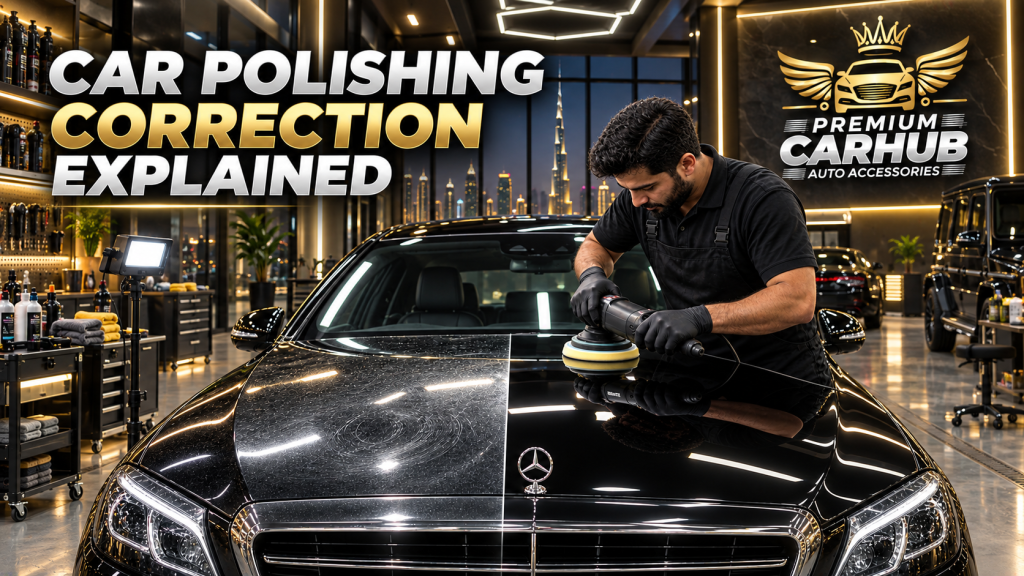
Car Polishing and Paint Correction Explained: A Practical Guide for UAE Car Owners
A vehicle can look clean immediately after washing yet still appear dull under sunlight. This usually happens because cleanliness and paint condition are two different things. Washing removes contamination sitting on the surface, while Car Polishing addresses microscopic defects within the upper paint layer.
These defects include circular wash marks, fine scratches, oxidation, mineral deposits and haziness. Individually, they may seem minor. Collectively, however, they scatter light and prevent the paint from producing a sharp reflection.
Professional paint correction is often marketed using terms such as “one-step polish,” “two-stage correction” and “full correction.” Unfortunately, these descriptions are not always explained clearly. Some vehicle owners consequently pay for aggressive correction when a light enhancement would have been sufficient. Others purchase an inexpensive polish that temporarily hides defects without actually correcting them.
This guide explains how Car Polishing and paint correction work, what each stage can realistically achieve and how UAE driving conditions should influence your decision. It also introduces a practical “correction budget” approach that helps preserve the clear coat instead of chasing an unrealistic defect-free finish.
What Is Car Polishing?
Car Polishing is a controlled abrasive process used to refine automotive paint. A polishing liquid, polishing pad and machine work together to remove an extremely small amount of the damaged upper surface. This levels the edges surrounding shallow defects so that light reflects more evenly.
Most modern vehicles have a layered finish consisting of:
- A primer that supports paint adhesion and corrosion resistance
- A colour or base coat that creates the vehicle’s appearance
- A transparent clear coat that provides gloss and environmental protection
In most cases, the visible swirl marks are in the clear coat rather than the colour coat. Professional Car Polishing therefore concentrates on refining the clear coat while retaining as much of it as possible.
Polishing does not simply “add shine.” True correction changes the condition of the surface. Oils or fillers can temporarily conceal scratches, but those defects may return after several washes. A trustworthy technician should be able to distinguish permanent correction from temporary masking.
Car Polishing vs Paint Correction
The terms are closely related but do not always describe the same level of work.
Basic Car Polishing usually refers to a light refinement intended to improve gloss and reduce minor wash marks. Paint correction is a more diagnostic and labour-intensive process in which the technician selects different combinations of compounds, pads and machine movements to remove a targeted percentage of defects.
What Is a Polishing Stage?
A “stage” is one complete machine-polishing step using a particular pad and product combination.
A one-step service normally uses a medium or finishing polish that balances defect removal and gloss. Two-stage correction generally begins with an abrasive compound before moving to a finer finishing polish. Multi-stage work may include localised sanding, compounding, intermediate refinement and final jewelling.
More stages do not automatically mean better workmanship. The correct service is the least aggressive process capable of delivering the agreed result.
Comparison of Paint-Correction Options
| Service | Best suited for | Typical improvement | Main limitation | Recommended protection |
|---|---|---|---|---|
| Gloss enhancement | New or well-maintained paint | Improved shine with limited defect removal | Deeper swirls remain | Wax or sealant |
| One-step Car Polishing | Light swirls, haze and minor oxidation | Approximately 40–70% visual improvement, depending on paint | Cannot safely remove every scratch | Sealant or ceramic coating |
| Two-stage correction | Moderate swirls, wash damage and visible scratches | Higher clarity and stronger defect reduction | Requires more time and clear-coat removal | Ceramic coating or PPF |
| Multi-stage correction | Heavily neglected, premium or presentation vehicles | Maximum safe improvement | Higher cost and not suitable for every panel | Ceramic coating and selective PPF |
| Repainting | Defects through the clear coat or colour layer | Repairs damage that polishing cannot correct | Changes paint originality and requires colour matching | Protection after paint cures |
The improvement percentages above are practical estimates rather than guarantees. Paint hardness, previous repairs, remaining clear-coat depth and scratch severity all affect the final result.
Which Defects Can Car Polishing Correct?
Swirl Marks
Swirls are fine scratches commonly created by automatic brushes, dirty drying towels and circular hand-washing methods. Under direct sunlight, they appear as a spider-web pattern around the reflection of the light.
These marks are among the best candidates for Car Polishing, provided sufficient clear coat remains.
Light Scratches
A shallow scratch that has not penetrated deeply into the finish can often be reduced or removed. A simple initial clue is the fingernail test: if a clean fingernail catches strongly in the scratch, complete removal may be unsafe or impossible.
This test is only a preliminary check. It does not replace professional lighting, magnification or paint-depth measurement.
Oxidation and Fading
Ultraviolet exposure can produce fading, chalkiness and reduced colour depth. Mild oxidation on clear-coated paint may respond well to polishing. Severe clear-coat failure—often visible as peeling, cracking or cloudy patches—cannot be repaired through Car Polishing and normally requires refinishing.
Water-Spot Etching
Dubai vehicles frequently develop mineral rings after water dries on hot panels. If the deposits are sitting above the surface, chemical decontamination may remove them. If minerals have etched the clear coat, mechanical correction may be required.
Polishing should not be the first response to every water spot. A technician should first identify whether the defect is deposited material, chemical etching or heat-related damage.
Sanding Marks and Paint Texture
Localised wet sanding can address certain deep imperfections, dust nibs or severe scratches. It is an advanced repair method, not a routine detailing step. Sanding removes considerably more material than ordinary polishing and should only be performed after evaluating the panel.
What Car Polishing Cannot Fix
Professional Car Polishing has clear limitations. It cannot safely repair:
- Stone chips that expose the base coat or primer
- Scratches that penetrate through the clear coat
- Peeling or delaminating clear coat
- Cracked paint
- Rust or corrosion
- Poorly matched repainting
- Deep dents and body damage
- Severe bird-dropping etching that has penetrated multiple layers
A reputable workshop should leave an isolated deep scratch partially visible if removing it would compromise paint integrity. Preserving the panel is more important than producing a dramatic photograph.
The Professional Car Polishing Process
1. Consultation and Paint Inspection
The technician should ask how the car is used, where it is parked, whether panels have been repainted and what result the owner expects. Paint is then inspected under directional lighting that reveals holograms, swirls and sanding marks.
A proper inspection also identifies vulnerable areas such as sharp edges, raised body lines, plastic-painted parts and previously repaired panels.
2. Safe Washing and Decontamination
Correction must never begin on a contaminated surface. The vehicle is pre-rinsed, washed and dried using paint-safe methods. Iron particles, road film, tar and bonded contamination are removed using suitable chemicals and, when necessary, a clay medium.
This stage matters because a polishing pad can pick up contamination and drag it across the paint, creating fresh defects.
3. Paint-Depth Assessment
A paint-thickness gauge helps technicians compare readings across metal panels and identify possible repainting or unusually thin areas. The instrument does not reveal the precise clear-coat thickness on every paint system, but it provides valuable comparative evidence.
Plastic bumpers and composite panels require additional caution because many conventional gauges cannot measure them.
4. Masking and Test Section
Rubber trims, sensitive edges, badges and textured plastics are protected. The technician then performs a small test section with a conservative combination of pad and polish.
This “test spot” answers three important questions:
- How hard or soft is the paint?
- How much correction can be achieved safely?
- Will a finer process deliver the desired result?
Good Car Polishing begins with testing, not assumptions based only on the vehicle brand.
5. Compounding
When deeper correction is needed, a cutting compound and suitable pad remove heavier defects. This stage may leave light haze, particularly on dark or soft finishes. That is expected and is addressed during refinement.
Machine movement, pad temperature, working time and residue removal must be controlled carefully. Excess heat or pressure can damage edges and create an inconsistent finish.
6. Refining and Finishing
A finishing polish and softer pad remove compound haze and restore optical clarity. Black and dark-coloured vehicles are especially demanding because even faint holograms become visible in direct sunlight.
Professional Car Polishing should be assessed under multiple light sources, not only the forgiving lights inside a workshop.
7. Panel Wipe and Honest Inspection
Some compounds contain lubricating oils that can temporarily fill micro-marring. A suitable panel wipe removes this residue and exposes the actual corrected finish.
This step prevents a common disappointment: a car that looks excellent at collection but reveals swirl marks after its first few washes.
8. Applying Paint Protection
Correction improves paint; it does not provide durable protection by itself. The refined finish should be protected with wax, a synthetic sealant, a ceramic coating or paint protection film.
Owners seeking long-term chemical resistance and easier cleaning can consider ceramic coating. High-impact areas such as the bumper, bonnet and mirrors may benefit from paint protection film.
The Clear-Coat “Correction Budget”
One of the most useful ways to understand Car Polishing is to treat the clear coat as a limited correction budget.
Each abrasive correction removes a small amount of material. The amount may be extremely small, but it is not renewable. A vehicle aggressively corrected every few months will eventually have less margin for future repairs.
The goal should therefore be maximum visual improvement with minimum responsible removal—not automatic pursuit of 100% defect elimination.
For example, imagine a five-year-old black SUV with moderate swirls and three deep scratches. A two-stage correction might safely remove most wash marks and dramatically improve gloss. Chasing the three remaining scratches could require disproportionate material removal. Leaving those scratches softened but visible may be the technically better decision.
This approach offers a more durable result and protects the owner’s ability to correct new defects later.
UAE-Specific Paint and Driving Considerations
Sand and Dust
Fine airborne particles settle quickly on cars in Dubai. Wiping a dusty vehicle with a dry cloth turns that dust into an abrasive. Even a soft-looking duster can create straight-line scratches.
Rinse or use proper lubrication before touching dusty paint. During heavy dust conditions, postponing a cosmetic wipe is usually safer than rubbing the surface dry.
Intense Sunlight and Panel Heat
High panel temperatures shorten product working times and make water spotting more likely. Washing or applying detailing products to hot paint can cause uneven drying and residue.
Whenever possible, wash the vehicle in shade and allow the panels to cool. The UAE’s National Center of Meteorology provides current weather information that can help owners avoid harsh washing conditions.
Hard-Water Marks
Sprinkler water and mineral-rich wash water can leave deposits that become more difficult to remove after baking onto hot paint. Drying the vehicle promptly with clean microfiber towels or filtered air reduces the risk.
Highway Sand Impact
Frequent motorway driving exposes the bumper, bonnet edge and mirrors to physical impact. Car Polishing can improve light surface marring, but it cannot replace missing paint caused by stone chips. PPF is the more relevant preventive solution for these areas.
Outdoor Parking
Vehicles parked outdoors accumulate more UV exposure, bird contamination and dust. They need more frequent inspections, but not necessarily more frequent aggressive correction. Better washing habits and suitable protection should be the first line of defence.
Pros and Cons of Car Polishing
Advantages
- Restores paint clarity and colour depth
- Reduces swirl marks, haze and shallow scratches
- Improves reflections on metallic and pearl finishes
- Creates a properly prepared surface for coatings
- Enhances the appearance of older vehicles
- Can improve presentation before resale
- Corrects defects rather than merely covering them
- Allows treatment to be customised panel by panel
Disadvantages
- Removes a measurable amount of the paint system
- Cannot repair chips, clear-coat failure or deep damage
- Poor technique can create holograms or burn-through
- Results depend heavily on maintenance after correction
- Multi-stage services require significant time and skill
- Unrealistic defect-removal targets may compromise paint
- Freshly polished paint still requires separate protection
Expert Recommendations from Premium Car Hub Technicians
Premium Car Hub technicians recommend choosing correction according to actual paint condition rather than vehicle age alone. A new dealership-delivered car can have transport marks or poor preparation, while a carefully maintained older vehicle may need only light refinement.
Ask for a Test Spot
Before approving aggressive correction, request a test section. It provides a realistic preview of defect removal and finish quality.
Agree on a Target, Not a Promise of Perfection
A practical objective might be “substantial swirl removal with preservation of deeper scratches.” This is more meaningful than a vague promise that the paint will become flawless.
Inspect the Vehicle in Strong Light
View the result under LED inspection lights and, when possible, natural sunlight. Look along body lines for holograms, compound residue and uneven refinement.
Protect the Finish Immediately
After Car Polishing, select protection based on how the vehicle is used. A garaged weekend car may suit a sealant. A daily-driven luxury vehicle may justify ceramic coating, while a motorway vehicle may benefit most from PPF on impact zones.
Correct the Washing Method
The best correction is quickly undone by a dirty sponge, roadside brush wash or dry dusting. Use a pre-rinse, clean wash media, separate wheel tools and soft microfiber drying towels.
Premium Car Hub offers dedicated professional car polishing and paint correction for owners who want the service matched to the actual condition of their vehicle.
Helpful Premium Car Hub Paint-Care Resources
Explore these related services and guides when planning a complete paint-restoration strategy:
- Professional Car Polishing in Dubai explains the value of regular paint refinement in local conditions.
- Multi-stage paint correction service is suitable when the finish requires more than basic gloss enhancement.
- Ceramic coating for long-term paint protection helps protect the corrected finish and simplifies maintenance.
- Paint protection film for high-impact panels provides physical protection that polishing or coatings cannot offer.
Authoritative Paint-Care and Detailing References
Owners who want to research professional processes can consult:
- 3M Compounds, Polishes and Glazes for information about compounding, swirl removal, abrasives and paint-finishing systems.
- 3M Perfect-It Paint Finishing System for an established professional finishing workflow.
- International Detailing Association Certification for information about professional detailing education and certification.
- Meguiar’s Professional Paint-Care Resources for clear-coat-safe swirl-removal and polishing information.
Frequently Asked Questions
1. Is car polishing the same as waxing?
No. Car Polishing uses controlled abrasion to reduce existing paint defects. Wax adds a temporary protective layer and can improve gloss, but it does not permanently level scratches. Polishing corrects the surface; waxing protects it.
2. Can car polishing remove every scratch?
No. Shallow clear-coat scratches may be removed or significantly reduced. Scratches reaching the colour coat or primer require touch-up or refinishing. A responsible technician will not sacrifice excessive clear coat to chase one deep defect.
3. How often should a car be polished in Dubai?
There is no universal schedule. A carefully maintained, protected vehicle may go several years without abrasive correction. A daily driver with visible wash marks may benefit from light Car Polishing after inspection. Paint condition—not a fixed calendar—should determine the timing.
4. How long does professional paint correction take?
A one-step enhancement may require several hours. Two-stage or multi-stage correction can take a full day or longer depending on vehicle size, paint hardness, contamination, body design and the agreed correction target.
5. Will polishing make thin paint worse?
It can if performed aggressively or without inspection. Repainted panels, edges and previously corrected areas may have less safe working material. Paint-depth readings, test sections and conservative product selection help reduce risk.
6. Should a new car receive paint correction?
Sometimes. New vehicles may have transport scuffs, dealership wash marks, adhesive residue or isolated sanding marks. However, a new car should not automatically receive heavy correction. It may only need decontamination and a light finishing polish before protection.
7. Does ceramic coating remove swirl marks?
No. Ceramic coating may slightly darken the paint and improve gloss, but it does not correct scratches. Defects remain underneath and may become more noticeable after coating. Complete the necessary Car Polishing before applying the coating.
8. Can I polish my car by hand?
Hand polishing may improve a small area or remove very light oxidation, but achieving consistent correction across an entire vehicle is difficult. Machine polishers provide more uniform movement and correction, although they require appropriate training and product knowledge.
9. Why do swirl marks return after polishing?
They may not have been fully removed, or polishing oils may have temporarily concealed them. New swirls can also be introduced through poor washing. A panel wipe, honest inspection and safe maintenance routine help distinguish incomplete correction from fresh damage.
10. Is paint correction worth it before selling a car?
It can be valuable when dull paint and visible swirls weaken the vehicle’s first impression. The service should be proportionate to the car’s condition and value. A one-step correction may offer a better return than expensive multi-stage work on an everyday vehicle.
Conclusion
Effective Car Polishing is not about using the strongest compound or removing every visible mark. It is about diagnosing the paint correctly, selecting the least aggressive process and producing a measurable visual improvement without wasting the clear-coat correction budget.
That distinction is especially important in the UAE. Sunlight, airborne dust, mineral deposits, outdoor parking and motorway debris create several different forms of damage. Each requires a different response. Some defects need chemical decontamination, others need machine correction, and deeper damage may require touch-up or refinishing.
The best result is therefore not necessarily a technically perfect surface. It is a clear, glossy and properly protected finish that remains serviceable for years. With careful inspection, skilled correction and better washing habits, professional Car Polishing can restore the character of the paint while protecting the long-term value of the vehicle.
Contact Premium Car Hub
Location: 20th St – Al Khabaisi – Dubai, United Arab Emirates
Phone: +971 4 570 0353
Email: info@premiumcarhub.com
Website: https://premiumcarhub.com/