
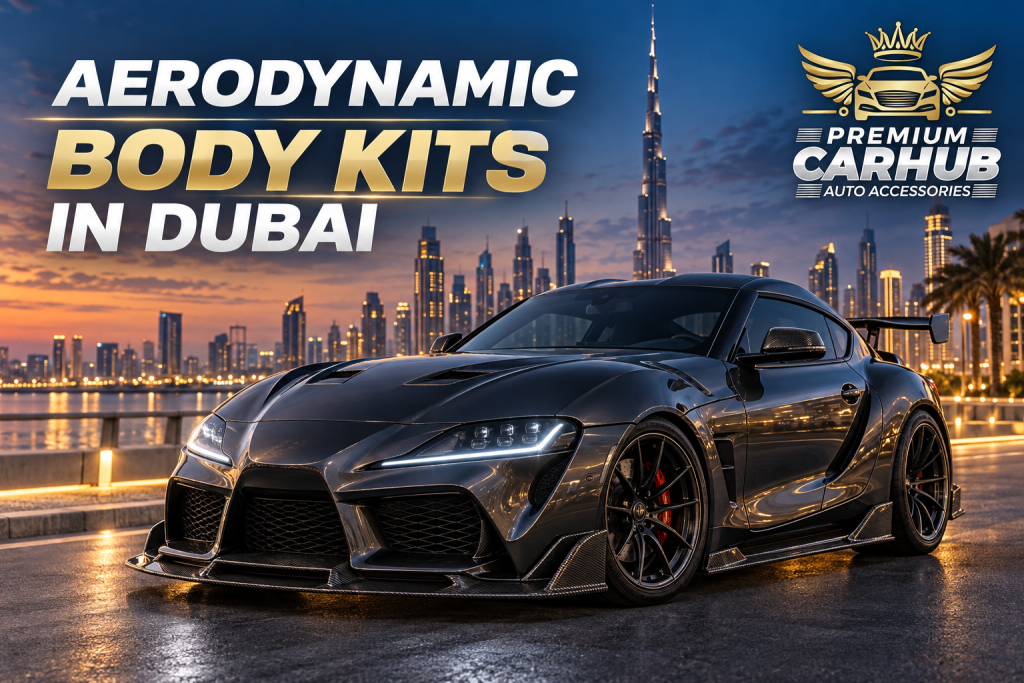
Aerodynamic Body Kits in Dubai: Design, Performance, Materials and Installation Guide
Dubai’s automotive scene has never been limited to factory specifications. From understated German luxury saloons to aggressively styled supercars and powerful SUVs, owners frequently look for ways to make their vehicles more distinctive. However, a successful exterior upgrade should do more than add visual drama. Properly selected Aerodynamic Body Kits can improve airflow management, enhance high-speed confidence and give a vehicle a cohesive, professionally engineered appearance.
The important word is “properly.” A collection of oversized panels does not automatically make a car aerodynamic. Poorly designed components may increase drag, reduce ground clearance, trap heat or become unstable at motorway speeds. Installation quality is equally important. Even an expensive carbon-fibre component can look cheap or become unsafe when its mounting points, alignment and finish are neglected.
This guide examines how Aerodynamic Body Kits work, which materials are suitable for Dubai, what UAE motorists should consider and how Premium Car Hub technicians approach selection and installation.
Contact Premium Car Hub for Car Body Kits
What Are Aerodynamic Body Kits?
Aerodynamic Body Kits are coordinated exterior components designed to influence how air travels around and beneath a moving vehicle. A complete package may include:
- A front lip or splitter
- Redesigned front and rear bumpers
- Side skirts
- Fender extensions
- An underbody panel
- A rear diffuser
- A boot spoiler or rear wing
- Air ducts and bonnet vents
Not every kit contains all these elements. Some owners choose a restrained lip, skirt and diffuser combination, while others commission a complete wide-body conversion.
A cosmetic kit concentrates primarily on appearance. A functional aerodynamic package is shaped and positioned to manage pressure, turbulence, cooling or lift. The distinction matters because a panel that resembles a race component may have received no meaningful aerodynamic development.
At road speeds, the benefits are generally more noticeable in stability, airflow consistency and visual integration than in dramatic lap-time improvements. Claims of enormous downforce from a simple adhesive accessory should therefore be treated cautiously.
Contact Premium Car Hub for Car Body Kits
How Automotive Aerodynamics Affect a Road Car
As a vehicle moves, it must push air aside. Its body shape determines where pressure builds, where airflow separates and how much turbulence develops behind it. Three concepts help explain the purpose of Aerodynamic Body Kits.
Drag
Aerodynamic drag resists forward motion. It increases significantly as speed rises, which is why poorly integrated modifications become more consequential during motorway driving. A large wing set at an unsuitable angle, exposed fasteners or a badly fitted bumper can add drag rather than improve performance.
Reducing drag can support high-speed efficiency, but creating downforce usually introduces some additional resistance. The objective is therefore not always the lowest possible drag. It is the best balance for the vehicle’s purpose.
Lift and downforce
Air-pressure differences can lighten a car’s front or rear axle at speed. Carefully designed splitters, spoilers, diffusers and underbody components can reduce lift or create downforce. This helps the tyres maintain more consistent contact with the road.
A splitter manages high-pressure air at the front and limits the amount entering beneath the car. A diffuser helps underbody airflow expand more progressively at the rear. A spoiler can reduce separation-related lift, while a properly engineered wing produces a more direct aerodynamic load.
Contact Premium Car Hub for Car Body Kits
Airflow balance
Aerodynamic changes must be considered as a system. Adding significant rear downforce without addressing front-axle lift may alter high-speed handling balance. Similarly, fitting an aggressive splitter without secure mounting can place unexpected stress on the bumper.
This systems approach separates functional Aerodynamic Body Kits from disconnected styling accessories.
Major Components and Their Functions
Front lips and splitters
A front lip extends the lower visual line of the bumper. It can reduce the volume of air passing underneath the vehicle, although its effectiveness depends on shape, position and underbody design.
A functional splitter projects farther and experiences meaningful aerodynamic force. It therefore requires strong mounting to structural or reinforced points not only screws driven into a thin bumper cover. For a daily-driven vehicle in Dubai, the projection and ground clearance must remain practical.
Contact Premium Car Hub for Car Body Kits
Side skirts
Side skirts visually lower the car and reduce airflow mixing between the body sides and underfloor region. Their practical value depends on how well they meet the front and rear sections. Gaps, abrupt transitions and poor alignment can create turbulence.
Because side skirts are exposed to kerbs, ramps and road debris, material choice and mounting flexibility are important.
Rear diffusers
A diffuser is more than a group of decorative vertical fins. A functioning unit creates a controlled expansion area for air exiting beneath the vehicle. Its angle, length and relationship with the underfloor strongly affect performance.
On road cars without a flat underbody, the improvement may be modest. Nevertheless, a well-shaped diffuser can organise rear airflow and provide a purposeful appearance without the visual weight of a large wing.
Spoilers and wings
A lip spoiler changes airflow near the trailing edge of the boot. It is generally subtle and suitable for luxury vehicles or daily drivers.
A wing operates in cleaner airflow above the body and can generate downforce. Its profile, height, angle and mounting strength all matter. Oversized universal wings may create excessive drag, obstruct rear visibility or transfer load into bodywork that was never designed to support it.
Wide-body panels and fender extensions
Wide-body Aerodynamic Body Kits increase visual presence and may create room for wider wheels and tyres. However, increasing track width or changing wheel offset affects more than appearance. Tyre clearance, steering movement, suspension compression, bearing load and alignment must all be checked.
Cutting original arches is a major, difficult-to-reverse decision. Owners should consider resale value, corrosion protection and the availability of replacement panels before authorising the work.
Contact Premium Car Hub for Car Body Kits
Comparison of Popular Body-Kit Materials
| Material | Weight | Flexibility | Heat resistance | Repairability | Best suited to |
|---|---|---|---|---|---|
| ABS plastic | Low | Good | Good when automotive-grade | Good | Daily drivers and OEM-style upgrades |
| Polyurethane | Moderate | Excellent | Generally good | Good | Low-mounted lips and impact-prone parts |
| Fibreglass | Moderate | Limited | Good | Relatively easy | Custom styling and budget-conscious projects |
| Carbon fibre | Very low | Limited | Excellent with quality resin | Specialist repair required | Performance and premium vehicles |
| Composite blends | Low to moderate | Varies | Varies by construction | Varies | Model-specific performance packages |
ABS plastic
Automotive-grade ABS offers a useful balance of weight, durability and finish. It works well for daily-use Aerodynamic Body Kits because it can tolerate moderate flex and typically provides predictable paint results.
Polyurethane
Polyurethane is valuable for front lips and lower components that may encounter ramps or parking stops. Its flexibility can prevent cracking from minor impacts, although a poorly manufactured panel may distort under heat or fit inconsistently.
Fibreglass
Fibreglass allows complex shapes and is comparatively straightforward to modify during custom fitting. Its disadvantage is brittleness. A hard strike against a kerb can crack it, and low-quality products frequently require substantial preparation to obtain even gaps.
Carbon fibre
Carbon fibre combines low weight, stiffness and premium appearance. Quality varies considerably, however. Buyers should distinguish genuine structural carbon fibre from a cosmetic carbon skin placed over fibreglass.
Dubai’s sunlight also makes UV-resistant clear coating essential. Without appropriate resin and protection, exposed carbon can yellow, haze or delaminate.
Contact Premium Car Hub for Car Body Kits
UAE-Specific Driving Considerations
Choosing Aerodynamic Body Kits in Dubai requires more than selecting a design from online photographs. Local roads, temperatures and vehicle-use patterns directly affect the result.
Heat and intense sunlight
Dubai’s summer temperatures place sustained stress on adhesives, resins, coatings and plastic components. Low-grade double-sided tape may soften, while poor clear coat can discolour. Materials and bonding systems should be rated for automotive exterior use and prolonged high-temperature exposure.
Dark carbon-fibre and painted surfaces can become extremely hot in direct sun. Quality preparation, paint systems and UV protection are therefore not optional finishing details.
Contact Premium Car Hub for Car Body Kits
Speed humps, ramps and basement entrances
A front splitter that works on a track may be impractical at a hotel entrance or multi-storey car park. The critical measurement is not only static ground clearance; front overhang and approach angle also determine whether a component will scrape.
Before installation, technicians should assess the owner’s routine routes, parking arrangements and suspension height. A slightly smaller front lip often provides a better real-world result than an aggressive component that needs replacement after several weeks.
Sand and road debris
Fine sand can enter joints and abrade painted lower surfaces. Gravel and motorway debris can chip splitters, skirts and diffusers. Paint-protection film may be worth considering for exposed leading edges, particularly on carbon fibre or colour-matched parts.
Mounting points should also allow sensible inspection and cleaning. Trapped sand and moisture around poorly prepared drilled areas can damage paint over time.
High-speed motorway travel
Dubai motorists regularly use roads where airflow loads are greater than in dense city traffic. A loose corner at 30 km/h can become a dangerous failure at motorway speed. Every major panel should have suitable mechanical retention, not just adhesive.
After installation, the vehicle should be checked for vibration, unexpected wind noise, tyre contact and movement of the component under load.
Vehicle cooling
Large bumper conversions can restrict airflow to radiators, intercoolers, oil coolers or brake ducts. This is particularly important in UAE heat. Air openings should be evaluated according to the vehicle’s cooling layout rather than appearance alone.
Mesh density also matters: an extremely fine decorative mesh may protect against stones but substantially reduce effective airflow.
Insurance, inspection and approvals
Approval requirements depend on the extent and design of the modification. Before purchasing a major conversion, owners should verify current requirements with the relevant authorities and notify their insurer. Dubai’s RTA provides official vehicle licensing and inspection services, while the UAE Ministry of Interior offers an online service for verifying vehicle-conversion certificates.
Regulations and inspection interpretations can change. Written confirmation is more reliable than assuming a modification is permitted because another car appears to use it.
Contact Premium Car Hub for Car Body Kits
Cosmetic Kits Versus Functional Aerodynamic Packages
| Consideration | Cosmetic body kit | Functional aerodynamic package |
|---|---|---|
| Primary objective | Visual transformation | Airflow and stability management |
| Development method | Styling and moulding | Testing, simulation or validated design |
| Typical installation | Adhesive and standard fasteners | Reinforced, load-aware mounting |
| Vehicle balance | Rarely measured | Front-to-rear balance considered |
| Cost | Usually lower | Usually higher |
| Best buyer | Style-focused road-car owner | Performance-focused enthusiast |
| Main risk | Poor fit and artificial appearance | Incorrect setup or excessive road compromise |
A cosmetic upgrade is not automatically inferior. For many owners, an OEM-plus appearance is the correct objective. The problem begins when decorative components are marketed using unsupported performance claims.
Buyers should ask whether the manufacturer has tested the product, whether it is model-specific and whether installation instructions identify load-bearing mounting points.
Contact Premium Car Hub for Car Body Kits
Choosing the Right Kit for Your Vehicle
Begin with how the car is actually used. A daily-driven Mercedes-Benz S-Class requires a different approach from a weekend Porsche or track-prepared BMW.
For luxury saloons, restrained Aerodynamic Body Kits often work best: a subtle front lip, integrated side extensions, a clean rear diffuser and a low boot spoiler. The factory character remains visible while the stance becomes more distinctive.
Performance coupés can support sharper shapes, but airflow balance remains important. SUVs may benefit aesthetically from wider arches and bumper extensions, yet off-road clearance and tyre articulation must not be compromised.
Before ordering, confirm:
- The exact model, production year and trim.
- Whether the car has an AMG, M Sport, S line or other factory bumper package.
- Parking sensors, cameras, radar modules and headlight washers.
- Exhaust-tip position and rear diffuser compatibility.
- Wheel width, offset, tyre size and suspension height.
- Whether installation requires cutting original panels.
- Replacement-part availability in the event of damage.
- The manufacturer’s material and fitting tolerances.
Small trim differences can make supposedly compatible Aerodynamic Body Kits difficult or impossible to align correctly.
Contact Premium Car Hub for Car Body Kits
Professional Installation Process
1. Vehicle inspection and consultation
Technicians inspect paint condition, previous repairs, bumper alignment, underbody mounting points and electronic-sensor locations. The owner’s preferred appearance and daily usage are discussed before parts are ordered.
2. Dry fitting
Every component should be test-fitted before painting or final bonding. Dry fitting exposes distorted panels, misplaced openings and uneven gaps. It also allows technicians to mark mounting locations without rushing.
3. Preparation and refinement
Some components require careful trimming, sanding or edge correction. Mounting surfaces must be cleaned, and any drilling should be measured and protected appropriately. Fibreglass parts may require more preparation than injection-moulded ABS.
4. Paint and finish matching
Colour matching should account for the age and condition of the existing paint, not merely the factory paint code. Metallic and pearl colours require particular care because orientation and application technique affect appearance.
Exposed carbon fibre should receive high-quality UV protection. Customers may choose gloss or satin finish, but it should complement the car’s other exterior surfaces.
Contact Premium Car Hub for Car Body Kits
5. Secure installation
Technicians combine appropriate clips, bolts, brackets, automotive adhesives or tape according to the part and expected load. Parking sensors, radar units and cameras must retain correct orientation and unobstructed operation.
6. Alignment and post-installation checks
Panel gaps, wheel clearance and ground clearance are verified. The vehicle should then be checked after a short driving period because fasteners and adhesive joints may settle.
Pros and Cons of Aerodynamic Body Kits
Advantages
- Creates a distinctive, model-specific appearance
- Can reduce lift and improve high-speed stability when properly engineered
- May improve airflow toward cooling or braking components
- Allows owners to personalise factory styling
- Carbon-fibre parts may reduce weight compared with heavier alternatives
- A coordinated package can look more refined than unrelated accessories
Disadvantages
- Reduced ground clearance can affect daily usability
- Functional components may increase drag or road noise
- Poor fitment can damage paint and reduce resale appeal
- Major conversions may require regulatory or insurance approval
- Genuine carbon fibre and professional fitting can be expensive
- Replacement components may have long lead times
- Incorrectly positioned parts can obstruct sensors or cooling airflow
Expert Recommendations from Premium Car Hub Technicians
Premium Car Hub technicians recommend treating Aerodynamic Body Kits as a complete vehicle project rather than a collection of accessories.
First, decide whether your priority is appearance, road stability, weight reduction or track use. This prevents spending heavily on features that do not serve the way the car is driven.
Second, prioritise fitment over the material badge. A precisely moulded ABS component can deliver a cleaner and more durable daily-driver result than low-grade carbon fibre with uneven edges.
Third, retain sensible ground clearance. Dubai contains excellent roads, but steep entrances and speed humps remain part of everyday driving. The most successful build is one the owner can use confidently.
Fourth, avoid permanent body cutting unless the complete wide-body design, wheel geometry, resale implications and repair plan have been evaluated. Reversing an arch-cutting conversion can be costly.
Fifth, protect the finish. Paint-protection film on leading surfaces and UV-resistant coating on carbon fibre can extend the visual life of the kit.
Finally, request a post-installation inspection. Technicians should check fastener security, adhesion, vibration marks and tyre clearance after the vehicle has experienced normal road conditions.
Explore Related Premium Car Hub Guides
Owners planning Aerodynamic Body Kits can continue their research with Premium Car Hub’s guide to the best car body kits in Dubai. It covers common styles, buying considerations and the difference between lower-cost and premium packages.
The detailed body-kit installation process in Dubai explains why test fitting, surface preparation, alignment and finishing affect long-term quality.
For consultations, customisation options and workshop information, visit the Premium Car Hub website.
Trusted Technical and Regulatory Resources
For current inspection, vehicle-registration and licensing information, refer directly to the Dubai Roads and Transport Authority.
Vehicle owners can use the UAE Ministry of Interior certificate-verification service when an applicable vehicle-conversion certificate needs to be checked.
Readers who want to understand the underlying relationship between lift and drag can consult the NASA Glenn Research Center’s aerodynamic guide.
Always confirm current requirements for a specific vehicle and modification before installation, as approval procedures may be updated.
Frequently Asked Questions
1. Do aerodynamic body kits actually improve performance?
Properly engineered Aerodynamic Body Kits can reduce lift, manage turbulence or improve airflow toward cooling systems. The effect depends on speed, vehicle shape and integration with the underbody. Decorative universal components may provide little measurable benefit and can sometimes increase drag.
2. Are aerodynamic body kits legal in Dubai?
Many exterior modifications may be acceptable when securely installed and compliant with applicable safety and inspection requirements. Major changes, wide-body conversions or parts that affect dimensions, visibility, structure or safety systems may require approval. Confirm requirements with the RTA and your insurer before installation.
3. What is the best body-kit material for Dubai weather?
Automotive-grade ABS and polyurethane are practical for daily-driven cars because they provide durability and some flexibility. Quality carbon fibre suits premium or performance builds, provided it has heat-stable resin and UV-resistant clear coating. Material quality matters more than the label alone.
4. Will a body kit reduce my car’s ground clearance?
Front lips, side skirts and diffusers commonly reduce effective clearance and approach angles. Before installation, measure the vehicle at its normal suspension height and consider the ramps, parking entrances and speed humps used regularly.
5. Can a body kit interfere with parking sensors or driver-assistance systems?
Yes. Redesigned bumpers can obstruct ultrasonic sensors, cameras or radar modules. Sensor brackets must preserve the correct height and angle. Some vehicles may require calibration after removal or repositioning of advanced driver-assistance components.
6. How long does body-kit installation take?
A simple lip or spoiler may be installed relatively quickly, while complete Aerodynamic Body Kits requiring preparation, paint matching and sensor integration can take several days. Custom wide-body projects may take longer because of fabrication, wheel fitment and finishing work.
7. Is carbon fibre better than ABS?
Carbon fibre is lighter and stiffer, but it costs more and requires specialist repair. ABS is generally more forgiving for daily use and often provides excellent OEM-style fitment. Carbon fibre is the better choice only when its weight, appearance and rigidity justify the additional expense.
8. Will installing a body kit affect my vehicle warranty or insurance?
It can. Effects vary according to the modification, manufacturer and insurance policy. Owners should contact the dealer and insurer before making major changes. Keep invoices, component specifications, approval records and installation photographs.
9. Can I take an aerodynamically modified car through an automatic wash?
It depends on the kit. Low splitters, projecting wings and delicate carbon components can be damaged by guide rails or rotating brushes. Hand washing is generally safer, especially after a recent installation or paint-protection treatment.
10. How should aerodynamic body kits be maintained?
Inspect low-mounted parts regularly for cracks, loose fasteners and separation. Remove sand from joints, avoid harsh chemicals, protect painted surfaces and use suitable UV protection for exposed carbon fibre. Arrange an inspection immediately if a component vibrates or produces new wind noise.
Conclusion
The best Aerodynamic Body Kits do not look like pieces added after the car left the factory. Their lines follow the original body, their mounting remains secure, and their proportions suit the vehicle’s purpose. Functional packages also manage airflow without creating an unacceptable compromise in cooling, balance or daily usability.
Dubai provides an exciting environment for automotive personalisation, but it also demands careful material selection. Heat, ultraviolet exposure, sand, motorway speeds and steep parking entrances expose weak products and rushed workmanship quickly.
Start with a clear objective, select components developed for the exact vehicle and insist on dry fitting before paint. Check sensors, cooling openings, tyre clearance, ground clearance and approval requirements. With these details handled professionally, Aerodynamic Body Kits can deliver a distinctive finish that remains practical, durable and appropriate for UAE roads.
Contact Premium Car Hub
For professional advice, product selection and body-kit installation in Dubai, contact Premium Car Hub.
Location: 20th St – Al Khabaisi – Dubai, United Arab Emirates
Phone: +971 4 570 0353
Email: info@premiumcarhub.com
Website: https://premiumcarhub.com/