
Car Window Tinting Laws in UAE: What Every Driver Should Know
Car Window Tinting is almost a necessity for many drivers in the UAE. When a vehicle spends hours under intense Dubai sunlight, its windows become one of the main paths through which solar heat enters the cabin. Quality window film can improve comfort, reduce glare, protect interior materials and provide additional privacy.
However, installing the darkest film available is not necessarily the best decision.
Drivers must consider UAE traffic regulations, nighttime visibility, film quality, vehicle type and how a tint performs in real conditions rather than judging it only by its appearance.
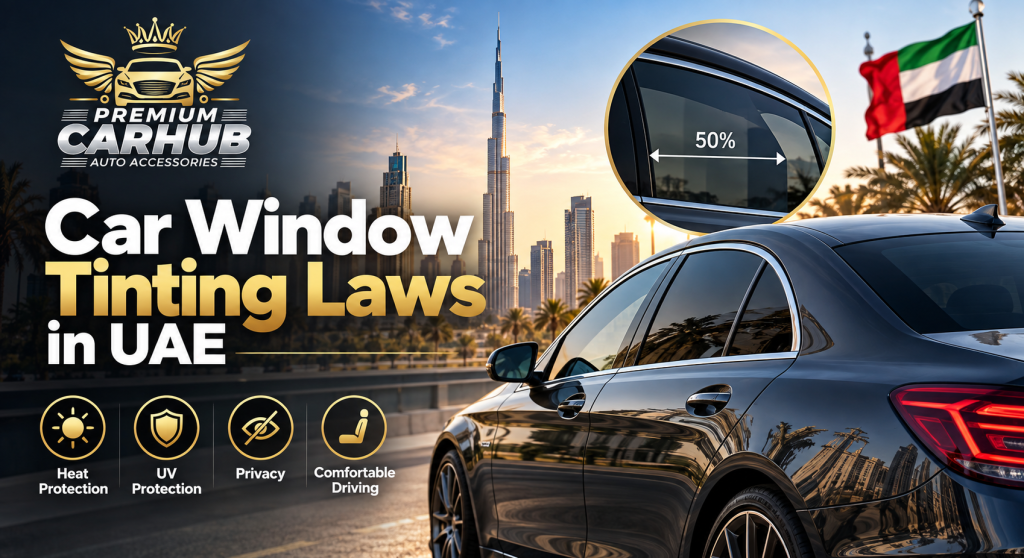
Under UAE traffic regulations, window tinting of up to 50% is permitted on applicable side and rear windows, while the front windscreen is not included in that permission. Abu Dhabi Police’s explanation of the federal traffic amendments specifically states that the 50% allowance applies to side and rear glass rather than the front windscreen.
For a Dubai vehicle owner, understanding this distinction is important before choosing Car Window Tinting.
This guide explains the legal framework, different types of tint film, heat rejection, privacy, visibility, common mistakes and the factors Premium Car Hub technicians recommend checking before an installation.
What Is Car Window Tinting?
Car Window Tinting involves applying a thin specialised film to vehicle glass.
Depending on the film technology, it may help reduce:
- Solar heat entering the cabin
- Ultraviolet exposure
- Visible glare
- Interior fading
- Passenger discomfort
- Visibility into the vehicle
Modern Car Window Tinting can use dyed, metallic, carbon, ceramic or other advanced film technologies.
A common misconception is that darker film automatically provides better heat rejection.
That is not always true.
Premium ceramic films can sometimes reject significant infrared heat while maintaining a comparatively lighter visual appearance. Cheap dark films, on the other hand, may make the glass look heavily shaded while providing disappointing thermal performance.
The performance specification therefore matters as much as the shade.
What Is the Legal Car Window Tinting Limit in the UAE?
UAE rules permit window tinting up to 50% of the level of internal visibility on applicable vehicle windows. The provision covers the side and rear windows and excludes the front windscreen.
This is one of the most important points to understand before requesting Car Window Tinting in Dubai.
The legal allowance should not be interpreted as permission to make every piece of glass extremely dark.
General UAE Tinting Framework
| Window Area | General Tinting Position | Practical Advice |
|---|---|---|
| Front windscreen | Tinting generally prohibited under the standard allowance | Keep the windscreen compliant and unobstructed |
| Front side windows | Tint permitted within applicable legal limit | Prioritise visibility at night |
| Rear side windows | Tint permitted within applicable legal limit | Heat rejection and privacy can be balanced |
| Rear window | Tint permitted within applicable legal limit | Ensure safe rearward visibility |
| Heavy vehicles | Additional restrictions apply | Verify vehicle-specific requirements |
| Taxi/public-use categories | Additional restrictions may apply | Confirm current authority requirements |
The federal traffic amendments described by Abu Dhabi Police also state that heavy vehicles and vehicles carrying taxi plates cannot use the same tinting permission applicable to ordinary private vehicles.
Owners of commercial, taxi or specialist vehicles should therefore verify the rules applicable to their exact registration category before installation.
What Does “50% Tint” Actually Mean?
This is where Car Window Tinting conversations frequently become confusing.
Consumers, installers and film manufacturers do not always describe darkness using the same terminology.
One manufacturer may describe a film according to the amount of visible light it allows through, while a customer may use “50% tint” to describe how dark they want the glass.
These are not necessarily identical measurements.
VLT Explained
VLT means Visible Light Transmission.
A high VLT allows more visible light through.
A low VLT means darker glass.
For example, a film with low VLT may look considerably darker than a film with high VLT.
The complication is that factory glass may already contain some shading. The finished window performance is therefore influenced by both:
factory glass + installed film
For that reason, Premium Car Hub technicians recommend selecting Car Window Tinting according to the completed installation rather than assuming that the percentage printed on a film sample automatically represents the final window.
Why Car Window Tinting Is Popular in Dubai
Dubai’s climate makes automotive tinting considerably more practical than it might be in a cooler country.
1. Reducing Solar Heat
A parked vehicle can absorb substantial heat through its glazing.
Quality Car Window Tinting can reduce part of the solar energy entering through the glass and make the cabin more manageable after the vehicle has been parked outdoors.
Tinting will not turn a parked vehicle into an air-conditioned environment, but good film can significantly improve comfort.
2. Protecting the Interior
Repeated sunlight exposure can affect:
- Leather upholstery
- Dashboard materials
- Door panels
- Plastic trim
- Screens
- Decorative stitching
- Wood-effect trim
UV-resistant Car Window Tinting adds another layer of protection against long-term sun exposure.
3. Reducing Glare
Strong UAE sunlight, particularly during morning and late-afternoon driving, can create uncomfortable glare.
Correctly selected tint can reduce the intensity reaching occupants while still preserving sufficient visibility.
4. Improving Privacy
Privacy is another reason many owners choose Car Window Tinting.
Passengers and personal items are less visible from outside when compared with completely clear glass.
However, privacy should never come at the expense of safe nighttime visibility.
Dark Tint vs High-Performance Tint
A visually dark film and a high-performance film are not necessarily the same thing.
This distinction is particularly important in the UAE.
Consider two vehicles.
Vehicle A uses a cheap, very dark film.
Vehicle B uses a premium ceramic Car Window Tinting film with a lighter appearance but stronger infrared rejection.
On a sunny afternoon, Vehicle B may provide better thermal comfort even though its windows appear lighter.
That is why choosing a tint only by looking at a sample card can be misleading.
Car Window Tinting Film Comparison
| Film Type | Heat Rejection | Clarity | Signal Interference | Typical Position |
|---|---|---|---|---|
| Dyed Film | Basic to moderate | Moderate | Low | Budget option |
| Metallic Film | Good | Good | Possible | Performance-focused |
| Carbon Film | Good | Good | Usually low | Mid-range upgrade |
| Ceramic Film | Very good to excellent | Excellent | Minimal | Premium UAE choice |
| High-Performance Ceramic | Excellent | Excellent | Minimal | Luxury and high-heat applications |
Actual performance varies between manufacturers, film ranges and installation specifications.
Ceramic Car Window Tinting for UAE Conditions
For many UAE drivers, ceramic Car Window Tinting offers an attractive balance between appearance and performance.
Ceramic films are designed to manage solar energy without relying primarily on making the window extremely dark.
Advantages may include:
- Strong infrared heat rejection
- High UV rejection
- Good optical clarity
- Reduced glare
- No metallic appearance
- Minimal interference with common electronic signals
- Premium finish
This can be particularly useful in modern vehicles containing:
- GPS systems
- Mobile connectivity
- Toll-related equipment
- Bluetooth systems
- Advanced driver-assistance technology
- Multiple vehicle antennas
Film compatibility and installation quality should nevertheless be checked for the individual vehicle.
UAE-Specific Driving Considerations
Car Window Tinting should perform well not just at midday but under every condition in which the vehicle is driven.
Night Driving
A film that feels comfortable under Dubai’s midday sun may feel much darker at 11 PM.
Consider visibility when:
- Entering poorly lit streets
- Parking underground
- Changing lanes
- Checking side mirrors
- Driving through residential areas
- Reversing in dim locations
This is why the darkest legal appearance is not automatically the most practical setup.
Sand and Dust
Fine dust accumulates quickly on UAE vehicles.
Dirty glass already reduces clarity. Combine that with extremely dark Car Window Tinting and nighttime visibility may deteriorate further.
Regular glass maintenance therefore becomes important.
Extreme Cabin Temperatures
UAE summer temperatures also test the quality of adhesives.
Poor-quality film can develop:
- Bubbles
- Distortion
- Peeling edges
- Purple colouring
- Adhesive marks
- Separation
Premium automotive-grade film and professional preparation are particularly important in this climate.
Premium Car Hub Technician Recommendations
Based on practical vehicle-customisation considerations, Premium Car Hub technicians recommend evaluating more than just shade before choosing Car Window Tinting.
1. Ask About Heat Rejection
Don’t ask only:
“How dark is this tint?”
Also ask:
- What is its infrared rejection?
- What UV protection does it provide?
- What is the visible-light transmission?
- Is the film designed for automotive use?
- What warranty covers the material?
2. Check Visibility From Inside
Inspect the film from the driver’s seat.
Look through it toward:
- Side mirrors
- Dark objects
- Shadowed parking areas
- Rear traffic
- Pedestrians
Good Car Window Tinting should make the cabin more comfortable without making routine observation difficult.
3. Don’t Tint Only for Appearance
A blacked-out vehicle can look attractive, particularly when combined with dark exterior trim.
But performance should come first.
For drivers interested in creating a coordinated darker exterior, Premium Car Hub’s guide to Car Dechroming in Dubai explains how chrome-delete treatments can change the exterior without depending on excessively dark windows. Read the Car Dechroming Guide
4. Consider the Vehicle’s Factory Glass
SUVs, luxury sedans and imported vehicles can have different factory glass specifications.
Do not assume that the same film will produce the same finished appearance on two different vehicles.
5. Choose Professional Installation
Even premium film can look poor when badly installed.
Professional Car Window Tinting requires:
- Thorough glass cleaning
- Accurate film cutting
- Dust control
- Edge finishing
- Correct shrinking
- Careful installation around seals
- Bubble-free application
Pros and Cons of Car Window Tinting
Advantages
Better Heat Management
Quality films reduce part of the solar energy entering through the windows.
UV Protection
High-quality film can block a significant proportion of ultraviolet radiation, helping protect occupants and interior materials.
Reduced Glare
Car Window Tinting can make bright daytime driving more comfortable.
Increased Privacy
Tinted windows reduce visibility into the cabin.
Premium Appearance
A well-selected film gives many vehicles a cleaner, more sophisticated appearance.
Interior Preservation
Reduced solar exposure can help protect leather, dashboards and trim.
Disadvantages
Reduced Night Visibility
Films that are too dark can make side and rearward observation harder.
Low-Quality Film Can Fail
Cheap material may fade, bubble or turn purple under UAE heat.
Incorrect Tint Can Create Legal Problems
Using tint outside applicable regulations may lead to enforcement issues.
Installation Quality Varies
Dust particles, uneven edges or contamination can spoil otherwise good film.
Darker Does Not Guarantee Better Heat Rejection
This is perhaps the most important disadvantage of choosing purely by appearance.
Smart Interior Upgrades to Combine With Tinting
Car Window Tinting can be part of a broader interior-comfort upgrade rather than an isolated modification.
For example, a modern infotainment upgrade can refresh an older vehicle while retaining practical daily functionality. Premium Car Hub’s Android-screen guide explains what drivers should consider before changing the factory display. Explore Android Screen Upgrades
Drivers looking to transform the cabin visually can also consider professionally integrated illumination. See the Complete Car Ambient Lighting Guide
For owners planning several cabin changes together, the guide to Car Interior Modification in Dubai covers upholstery, lighting and other interior decisions in one place. Read Car Interior Modification Ideas
Authoritative UAE Resources to Check Before Tinting
Traffic regulations can be amended, and vehicle-specific circumstances may differ. Before making an unusual modification, verify current requirements directly with UAE authorities.
Abu Dhabi Police – Federal traffic amendments and 50% tint provision: the authority’s explanation states that side and rear window tinting may reach 50% while excluding the front windscreen.
UAE Ministry of Interior: federal traffic and vehicle regulations are published through the Ministry’s official resources. Earlier federal regulations also establish that vehicle additions such as reflective glass must be approved by the licensing authority.
Dubai Roads and Transport Authority: Dubai vehicle owners can consult RTA licensing, registration and technical-inspection requirements. RTA’s current licensing resources include Dubai’s vehicle-related legislation and inspection framework.
Common Car Window Tinting Mistakes
Choosing the Darkest Film Without Testing It
A sample viewed inside an air-conditioned shop does not represent nighttime driving.
Check visibility first.
Ignoring the Factory Glass
Factory shading changes the final result.
Buying Only on Price
Car Window Tinting is exposed to extreme heat every day. Saving a small amount upfront can become expensive if the film needs replacement after bubbling or discolouration.
Rolling Windows Down Too Soon
Freshly installed tint requires time for the adhesive to stabilise.
Follow your installer’s aftercare instructions before lowering the windows.
Cleaning With Aggressive Products
Avoid abrasive cleaning tools or products that may damage the film.
Use suitable glass-cleaning products and soft microfibre cloths.
How to Choose the Right Tint for Your Car
A useful decision process is:
Step 1: Establish Your Priority
Are you primarily seeking:
- Heat rejection?
- Privacy?
- UV protection?
- Appearance?
- Glare reduction?
Most UAE owners want a combination.
Step 2: Confirm Legal Compatibility
Verify that the proposed Car Window Tinting specification complies with regulations applicable to your vehicle type.
Step 3: Compare Technical Performance
Look beyond darkness.
Ask about infrared, UV and visible-light performance.
Step 4: Test Interior Visibility
Check how the film appears from inside.
Step 5: Check Warranty
Quality film should be supported by clear warranty terms.
Step 6: Use an Experienced Installer
Material and installation quality work together.
Trusted UAE Resources Before Tinting Your Car
Drivers who want to verify legal or vehicle-related requirements should check authoritative sources before making unusual modifications.
Dubai Roads and Transport Authority
The Dubai Roads and Transport Authority publishes current information about vehicle registration, testing, licensing and related services. RTA documentation also confirms that vehicle technical inspection and compliance form part of Dubai’s regulatory framework.
Dubai Legislation Portal
The Dubai Legislation Portal provides official Dubai legislation. Current vehicle-impoundment legislation specifically refers to exceeding the permitted tint percentage or tinting the windscreen without a permit.
UAE Ministry of Interior
The UAE Ministry of Interior provides road-safety and traffic-related information for motorists.
Gulf News UAE Traffic Coverage
Gulf News has documented official police clarifications regarding the 50% tint provision, applicable windows and associated penalties.
Frequently Asked Questions About Car Window Tinting in the UAE
1. What is the legal Car Window Tinting percentage in the UAE?
UAE traffic amendments allow tinting up to 50% on applicable side and rear windows of ordinary vehicles. The front windscreen is excluded from this tinting permission.
Because rules can be updated and some vehicle categories have additional restrictions, confirm current requirements for your exact vehicle when necessary.
2. Can I tint the front windshield in Dubai?
The standard tint allowance described in UAE traffic regulations applies to side and rear windows and not the front windscreen.
Drivers should avoid applying ordinary dark tint across the windscreen.
3. Is 50% tint legal in Dubai?
The UAE framework permits up to 50% tinting for applicable side and rear glass on ordinary vehicles. Vehicle type and any special circumstances should still be checked before installation.
4. Is ceramic Car Window Tinting worth it in Dubai?
For many drivers, yes. Ceramic film can offer strong heat rejection, UV protection and optical clarity without depending solely on extremely dark colouring.
Its suitability depends on the particular film specification and budget.
5. Does darker tint block more heat?
Not necessarily.
Heat rejection depends on film technology and solar-energy performance. A premium ceramic film can outperform some darker low-quality films.
6. How long does Car Window Tinting last in UAE weather?
The lifespan depends heavily on film quality, installation quality, parking conditions and maintenance.
Premium automotive films installed correctly can last for years, while inexpensive materials may deteriorate considerably sooner in extreme heat.
7. Can tint interfere with GPS or mobile reception?
Some metallic films may affect certain radio-frequency signals.
Modern non-metallic or ceramic Car Window Tinting is commonly chosen when minimising signal interference is important.
8. How soon can I roll down my windows after tinting?
Follow the installer’s curing instructions.
The adhesive needs time to stabilise, and lowering the windows too soon can disturb the edges of fresh film.
9. Why do bubbles appear after installation?
A small amount of temporary moisture may sometimes remain during the curing process, but persistent bubbles can result from poor installation, contamination or adhesive failure.
If bubbles remain or increase, have the film inspected.
10. What tint is best for UAE summer driving?
For many vehicles, high-quality heat-rejecting ceramic Car Window Tinting provides a strong balance of thermal performance, UV protection and visibility.
The best specification, however, depends on the vehicle’s factory glass, driver preference, legal limits and nighttime use.
Final Thoughts
Car Window Tinting in the UAE should be approached as a comfort and visibility upgrade rather than simply a way to make the glass darker.
The legal framework allows significant tinting on applicable side and rear windows, but the front windscreen remains outside the standard tint allowance.
For everyday Dubai driving, the better question is not:
“What is the darkest tint I can install?”
It is:
“What tint gives me the best combination of legal compliance, heat rejection, UV protection, clarity and privacy?”
Premium film with excellent thermal properties can provide greater real-world value than an inexpensive dark film. Correct installation is equally important because UAE heat quickly exposes weak adhesives, low-grade materials and poor workmanship.
For owners who drive frequently at night, visibility deserves particular attention. For vehicles parked outdoors, heat rejection and UV resistance become higher priorities. For premium cars, optical clarity and clean installation edges are especially important.
The right Car Window Tinting should make the vehicle cooler, more comfortable and more refined while allowing the driver to maintain clear awareness of surrounding traffic.
Contact Premium Car Hub
For professional vehicle customisation and advice on choosing upgrades suitable for Dubai driving conditions, contact Premium Car Hub.
Location: 20th St – Al Khabaisi – Dubai, United Arab Emirates
Phone: +971 4 570 0353
Email: info@premiumcarhub.com
Website: Premium Car Hub
Important: Traffic rules and technical requirements can change. Drivers should confirm current requirements with the relevant UAE licensing or police authority before installing an unusual tint specification or modifying a vehicle in a way that may affect compliance.