
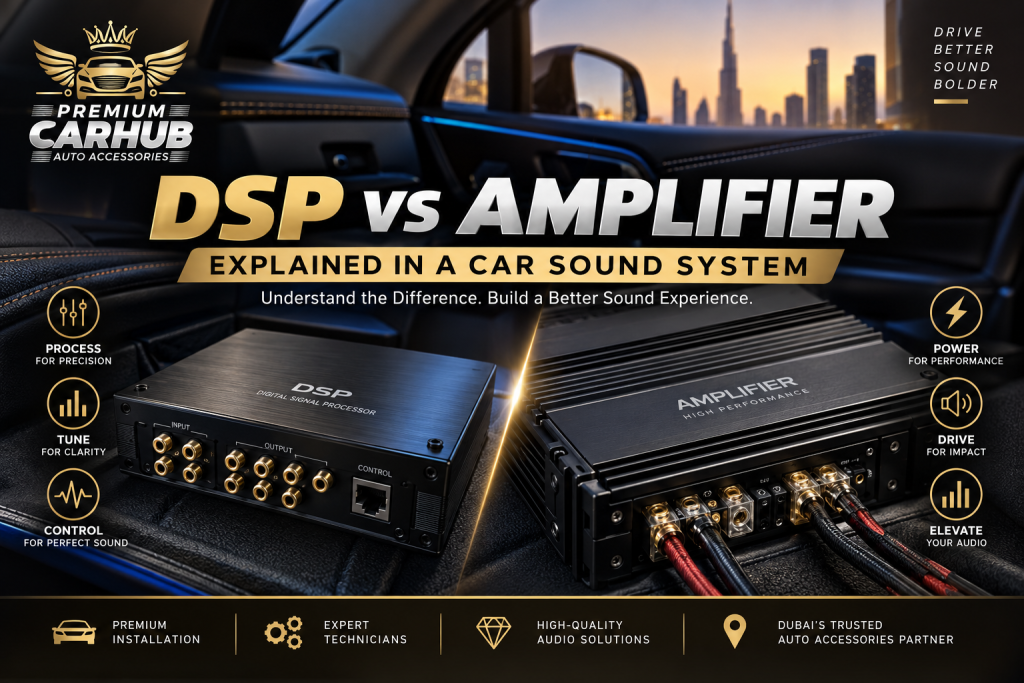
DSP vs Amplifier Explained in a Car Sound System
A customer can spend heavily on premium speakers and still end up disappointed with the audio. The system may become louder, yet vocals remain stuck near one door, bass sounds disconnected, treble becomes sharp, or music starts losing clarity as road speed increases.
In many cases, the real problem is not the quality of the speakers. It is how the Car Sound System is powered, processed and tuned.
Two components create more confusion than almost anything else in modern automotive audio: the amplifier and the digital signal processor, normally shortened to DSP. They often appear together in upgrade quotations, and some modern products combine both functions in one chassis. That can make them appear interchangeable.
They are not.
An amplifier supplies the electrical power required to drive speakers and subwoofers properly. A DSP reshapes and coordinates the audio signal before amplification. It can control equalisation, crossover points, time alignment, individual channel levels, signal routing and, depending on the processor, phase and factory-audio correction.
A well-designed Car Sound System may need an amplifier, a DSP, or both. The correct answer depends on what is actually wrong with the existing audio.
Contact Premium Car Hub for Car Sound System Installation
DSP vs Amplifier: The Simple Explanation
Think of an amplifier as the engine and a DSP as the calibration system.
The amplifier provides energy. The DSP determines how the audio signal should be distributed, corrected and timed.
If upgraded speakers are underpowered, a DSP cannot magically create the missing wattage. On the other hand, if a powerful amplifier receives poorly equalised, badly timed or heavily processed audio, additional power may simply make those problems louder.
That is why a professionally planned Car Sound System starts with diagnosis rather than immediately choosing equipment.
What Does a Car Amplifier Actually Do?
An amplifier takes the incoming audio signal and increases it to a level capable of properly driving speakers.
Correctly matched amplification can provide:
- More clean output before audible distortion
- Better control of upgraded speakers
- Greater dynamic headroom
- Dedicated power for a subwoofer
- Improved performance at motorway listening levels
- Better results from speakers that need more power than a factory head unit supplies
One important point is frequently misunderstood: amplifier gain is not simply another volume control.
Gain primarily matches the amplifier’s input sensitivity with the signal coming from the head unit or DSP. Incorrect gain settings can contribute to clipping, noise and distortion. KICKER similarly describes amplifier gain as an input-level matching control rather than a normal volume adjustment.
In a properly configured Car Sound System, clean power matters more than chasing an impressive peak-watt number.
Contact Premium Car Hub for Car Sound System Installation
What Does a DSP Actually Do?
A Digital Signal Processor works on the audio signal rather than directly supplying speaker power.
Depending on the hardware and software, DSP functions can include:
- Parametric or graphic equalisation
- High-pass filters
- Low-pass filters
- Band-pass crossovers
- Per-channel time delay
- Individual speaker level adjustment
- Input signal summing
- Factory EQ correction
- Signal routing
- Phase or polarity adjustment
- Subwoofer integration
- Multiple tuning presets
Time alignment is particularly important inside a vehicle.
The driver is not sitting exactly between the left and right speakers. One speaker may be less than a metre away while another is much farther across the dashboard.
Without correction, sound from the closer speaker reaches the listener earlier.
A DSP can apply carefully calculated delay so individual channels reach the listening position more coherently. This can move vocals away from the nearest door and create the impression that the singer is positioned across the dashboard.
Modern processors can also provide detailed crossover, EQ, routing and phase controls. AudioControl, for example, documents features including equalisation, time alignment, input delay, phase adjustment and configurable crossovers on its automotive DSP systems.
This is where DSP tuning can turn an otherwise powerful Car Sound System into a genuinely balanced listening environment.
Contact Premium Car Hub for Car Sound System Installation
DSP vs Amplifier Comparison
| Feature | DSP | Amplifier |
|---|---|---|
| Primary purpose | Processes and corrects audio | Supplies power to speakers |
| Increases clean volume | Not by itself | Yes |
| Time alignment | Yes, on capable DSPs | Usually no |
| Detailed EQ | Yes | Usually limited |
| Crossover control | Advanced | Often basic |
| Factory-system integration | Very useful | Depends on amplifier inputs |
| Powers a passive subwoofer | No | Yes |
| Corrects sound-stage position | Yes | Not through power alone |
| Individual channel tuning | Yes | Limited unless DSP equipped |
| Setup requirements | Professional tuning recommended | Correct gain and crossover setup essential |
The easiest distinction is this: a DSP makes a Car Sound System more controllable and precise, while an amplifier gives it the power necessary to perform.
When Your Car Sound System Needs an Amplifier First
Upgraded Speakers Sound Weak at Higher Volume
Many aftermarket component speakers perform better with significantly more continuous power than a factory head unit can provide.
If music sounds acceptable at low volume but becomes strained, compressed or harsh as the volume increases, insufficient clean amplifier power may be part of the problem.
You Are Installing a Subwoofer
A passive aftermarket subwoofer requires dedicated amplification.
The amplifier must be matched to the subwoofer’s impedance and realistic RMS power requirements rather than relying only on peak-power specifications.
You Need More Headroom
Headroom is different from simply wanting extreme loudness.
It describes the reserve capacity available for short musical peaks such as:
- Kick drums
- Bass transients
- Strong vocal passages
- Orchestral peaks
- Electronic-music impacts
A well-powered Car Sound System reproduces these moments naturally rather than flattening or distorting them.
The Factory Amplifier Is Holding Back Better Speakers
Installing high-quality speakers does not automatically improve everything.
Better speakers can expose the limitations of a weak factory amplifier. If the drivers require substantially more controlled power than the original electronics provide, additional equalisation will not solve the underlying issue.
Amplifier choice should consider RMS output, impedance, number of channels, electrical demand, mounting space and listening habits.
When Your Car Sound System Needs a DSP First
Vocals Pull Toward One Side
This is one of the clearest situations where processing can help.
Unequal distances between the driver’s ears and individual speakers affect arrival time. Appropriate DSP delay can improve the apparent position of vocals and instruments.
The Factory Stereo Uses Heavy Processing
Many modern vehicles apply factory equalisation, filtering and channel-specific processing.
Simply adding a large amplifier may amplify these characteristics along with the music.
A suitable DSP can help integrate the factory electronics with the upgraded Car Sound System. Crutchfield likewise notes that DSPs are often useful when retaining integrated factory stereos while adding aftermarket amplifiers and speakers.
The Subwoofer Sounds Like It Is in the Boot
Strong bass is not automatically good bass.
A poorly integrated subwoofer can sound noticeably separate from the front speakers.
Variables including crossover frequency, crossover slope, phase, delay and output level influence whether the bass appears connected to the music.
DSP tuning provides much finer control over these relationships.
You Want an Active Front Stage
An active system sends dedicated amplifier channels to individual tweeters, midrange speakers and mid-bass drivers.
In this type of Car Sound System, the DSP effectively becomes the electronic crossover and central tuning platform.
Do You Need Both a DSP and Amplifier?
For many premium installations, yes.
The DSP prepares and controls the signal.
The amplifier supplies the power.
They solve different problems and work extremely well together.
Another option is a DSP amplifier, which combines digital signal processing and amplification within one chassis.
This is particularly attractive in luxury vehicles where owners want improved sound without filling the boot with multiple large components.
Advantages include:
- Less installation space
- Fewer separate devices
- Cleaner wiring
- Factory-style installation possibilities
- Easier packaging under seats or behind trim
However, channel count and amplifier output must still match the intended Car Sound System.
A compact four-channel DSP amplifier may work beautifully for a relatively simple installation but may not have enough outputs for an active three-way front stage, rear speakers and subwoofer.
The Entire Signal Chain Matters
One of the biggest mistakes in car audio is focusing on a single expensive component.
Instead, follow the complete signal:
Source unit → DSP/interface → amplifier → speakers/subwoofer → vehicle cabin
Every stage affects the result.
A premium amplifier cannot restore audio information that was already clipped or distorted earlier in the signal chain.
A DSP cannot repair a physically damaged speaker.
Expensive speakers cannot create accurate imaging when their crossover and timing relationships are wrong.
This is why professional Car Sound System installation should begin by mapping the vehicle’s existing audio architecture.
The installer should identify:
- Factory source unit
- Original amplifier
- Factory speaker count
- Speaker impedance
- Existing signal processing
- Available mounting areas
- Electrical limitations
- Integration with infotainment functions
DSP and Amplifier Pros and Cons
DSP Advantages
- Precise equalisation
- Detailed crossover control
- Improved sound-stage positioning
- Better subwoofer integration
- Factory-audio integration
- Vehicle-specific calibration
- Independent channel adjustment
DSP Disadvantages
- Requires knowledge and measurement
- Poor tuning can make audio worse
- Adds cost
- Increases installation complexity
- Cannot replace insufficient amplifier power
Amplifier Advantages
- Provides clean power
- Adds dynamic headroom
- Supports demanding aftermarket speakers
- Essential for most passive subwoofers
- Helps retain clarity at higher listening levels
- Available in compact multi-channel configurations
Amplifier Disadvantages
- Cannot correct speaker arrival time on its own
- Incorrect gain can introduce clipping
- Requires correct wiring and grounding
- Requires adequate fuse protection
- Needs sensible ventilation
- More power can reveal weaknesses elsewhere in the Car Sound System
DSP Amplifier: Advantages and Trade-Offs
A DSP amplifier combines the strongest functions of both devices while reducing installation space.
For a discreet luxury Car Sound System, it can be an excellent solution.
However, power output, channel count and future expansion options become tied to a single device. Drivers planning a larger future upgrade should therefore consider scalability before installation.
Practical Example: Why More Power Does Not Always Fix Sound
Imagine a luxury SUV fitted with premium component speakers and a five-channel amplifier.
The system plays loudly, but the singer still appears near the driver’s A-pillar. The subwoofer produces plenty of bass, yet every bass note seems to originate from the luggage area.
Replacing the amplifier with an even larger model probably will not solve either complaint.
The logical next step is DSP tuning:
- Time-align the front channels.
- Establish suitable crossover frequencies.
- Balance individual channel levels.
- Adjust subwoofer timing or phase.
- Make measured EQ corrections.
Now imagine the opposite situation.
The SUV has excellent DSP calibration but the amplifier cannot supply adequate clean power to a demanding front speaker set.
The Car Sound System sounds balanced at low volume yet becomes compressed when turned up.
That situation calls for stronger amplification rather than additional processing.
Understanding which problem you actually have prevents expensive trial-and-error upgrades.
UAE-Specific Considerations for a Car Sound System
Car-audio installation in Dubai has requirements that should not be ignored.
Heat and Amplifier Placement
Amplifiers naturally produce heat while operating.
Dubai’s climate makes installation location particularly important. Equipment should have appropriate ventilation, and heatsinks should not simply be buried under thick carpeting, luggage or tightly enclosed trim.
A compact amplifier still needs sensible thermal management.
Dust and Sand
Fine dust can reach under-seat areas, boots and interior cavities.
Secure connectors, protected wiring looms and careful equipment placement improve long-term reliability.
Premium installations should look tidy while also protecting the electrical connections behind the visible trim.
Highway and Air-Conditioning Noise
Powerful air-conditioning, tyre noise and wind noise can mask low-level musical detail.
Increasing the volume of the Car Sound System is not always the ideal answer.
Door damping, vibration control and strategic soundproofing can lower the amount of unwanted noise competing with the speakers. Premium Car Hub’s Dubai soundproofing guidance similarly discusses tyre, wind and vibration noise as important cabin factors.
Long UAE Journeys
Drivers frequently travelling between Dubai, Abu Dhabi, Sharjah and other emirates may listen to audio for long periods.
For this type of driving, controlled bass, smooth treble and stable imaging are generally more useful than an aggressively tuned system intended only to impress during a five-minute demonstration.
A comfortable Car Sound System should remain enjoyable for the entire journey.
Electrical Demand
Large amplifiers can create substantial electrical demand.
Before installing a high-output system, technicians should inspect:
- Battery condition
- Power cable gauge
- Fuse protection
- Grounding points
- Charging architecture
- Overall amplifier demand
Good electrical design supports both performance and reliability.
Expert Recommendations from Premium Car Hub Technicians
Premium Car Hub’s own audio guidance emphasises treating speakers, amplification, DSP, acoustic treatment and tuning as one integrated system rather than unrelated upgrades.
1. Diagnose Before Buying Equipment
Start by identifying the actual complaint.
Is the audio:
- Too quiet?
- Weak in bass?
- Harsh?
- Distorted?
- Off-centre?
- Rattling?
- Poorly integrated with the factory system?
The answer helps determine which part of the Car Sound System deserves attention first.
2. Match RMS Power and Impedance Correctly
Choose amplification using realistic continuous-power specifications and the speakers’ impedance.
Do not build the system around exaggerated peak-power numbers.
3. Set Amplifier Gain Correctly
Gain should match signal levels.
Turning gain fully clockwise does not give you “free power.” It can increase the risk of clipping and unwanted noise.
4. Establish Crossovers Before Aggressive EQ
Each speaker should reproduce a frequency range that suits its physical capabilities.
Once the crossover structure is sensible, equalisation becomes much more effective.
5. Measure, Then Confirm by Listening
Test signals and measurement equipment can reveal frequency-response and level problems.
Final calibration should then be checked with familiar music from the driver’s actual seating position.
6. Treat the Vehicle Cabin as Part of the Audio System
Door vibration, speaker mounting, trim resonance and external noise all influence what reaches your ears.
Sometimes improving installation and acoustic treatment makes a larger difference to the Car Sound System than replacing another electronic component.
Recommended Premium Car Hub Guides
For drivers planning a larger audio upgrade, these Premium Car Hub resources offer useful next steps:
DSP Car Audio Tuning Explained — Learn more about time alignment, crossover adjustment, frequency response and professional DSP calibration.
How to Upgrade Your Car Audio System in Dubai — A system-level overview covering speakers, amplification, DSP, subwoofers and tuning.
High-End Car Audio & Sound Systems in Dubai — Useful guidance for luxury-car owners planning an integrated premium installation.
Car Sound Proofing: A Practical Guide to Quieter Driving in Dubai — Helpful when road noise and panel vibration are limiting audio quality.
Authoritative Technical Resources for Better Car Audio
For readers interested in the technical principles behind a premium Car Sound System, these resources provide useful additional information:
Crutchfield Digital Signal Processor Buying Guide — Covers DSP integration, factory systems and important processing features.
Crutchfield Car Amplifier Buying Guide — Explains amplifier channels, power requirements and installation considerations.
KICKER Amplifier Gain Setting Test Tones — Manufacturer guidance covering gain matching and clipping control.
AudioControl DM-810 DSP Reference — A practical example of modern EQ, time alignment, routing, crossover and phase-control capabilities.
Frequently Asked Questions
1. Is a DSP better than an amplifier for a Car Sound System?
Neither component is universally better because they perform different jobs.
An amplifier supplies power to the speakers. A DSP modifies and coordinates the signal.
If the system lacks clean output, an amplifier may be the priority. If the problem involves imaging, tonal balance or factory processing, DSP tuning may produce the more noticeable improvement.
2. Do I Need Both a DSP and an Amplifier?
Many premium systems benefit from both.
The DSP processes the signal while the amplifier drives the speakers. A combined DSP amplifier can perform both functions and may be particularly useful when installation space is limited.
3. Will a DSP Make My Car Sound System Louder?
Not in the same way an amplifier will.
A DSP may make audio seem clearer and better organised because the channels, frequencies and timing are properly calibrated. It does not, however, replace the electrical power required for substantially greater clean output.
4. Can a DSP Fix Poor Factory Speakers?
A DSP can improve the signal feeding those speakers, but it cannot overcome all of their physical limitations.
A damaged, distorted or very limited factory speaker may still require replacement.
5. Does Every Subwoofer Need an Amplifier?
A passive aftermarket subwoofer requires amplification.
A powered subwoofer is different because an amplifier is already integrated into its enclosure.
6. What Is the Advantage of a DSP Amplifier?
A DSP amplifier combines processing and power amplification inside one housing.
It can reduce installation space, wiring complexity and component count while providing sophisticated tuning. This makes it particularly attractive for discreet luxury-vehicle installations.
7. Can DSP Remove Road Noise?
No.
DSP calibration can help the Car Sound System maintain better clarity under real driving conditions, but it cannot physically stop tyre roar, wind noise or panel vibration.
Soundproofing and acoustic treatment address those problems more directly.
8. How Many Amplifier Channels Do I Need?
It depends on the system architecture.
A four-channel amplifier may power a straightforward front-and-rear speaker setup.
A five-channel amplifier can typically handle four cabin channels plus a subwoofer.
Active multi-way systems may require six, eight or even more amplifier channels.
9. Why Does My Upgraded Car Sound System Still Sound Harsh?
Possible causes include:
- Amplifier clipping
- Excessive treble EQ
- Incorrect crossover settings
- Glass reflections
- Insufficient amplifier headroom
- Poor speaker positioning
- Uncorrected factory processing
The cause should be diagnosed before additional equipment is purchased.
10. Is Professional DSP Tuning Worth It in Dubai?
For complex factory systems, luxury vehicles and multi-channel upgrades, professional DSP calibration can be one of the most valuable parts of the installation.
The objective is not simply adding more bass or treble. Good tuning improves timing, tonal balance, integration, imaging and consistency under realistic UAE driving conditions.
Conclusion: DSP Controls the Sound, Amplifier Delivers the Power
The DSP-versus-amplifier question should not be approached as a competition between two products.
They perform fundamentally different jobs.
The amplifier gives the speakers the clean electrical power they need.
The DSP controls how the signal is divided, timed, equalised and balanced.
In a professionally designed Car Sound System, the best result often comes from selecting both components as parts of one coordinated signal chain rather than purchasing them as isolated upgrades.
Dubai drivers should also consider factors beyond specifications on the box. Heat, dust, highway noise, factory electronics, electrical demand and available installation space can all influence the final design.
The best Car Sound System is therefore not necessarily the one with the biggest amplifier or the greatest number of EQ bands. It is the system that solves the vehicle’s actual acoustic and electrical limitations while remaining reliable, properly integrated and enjoyable during everyday driving.
If your existing audio is loud but unfocused, DSP tuning may be the missing piece.
If it sounds clean but lacks authority, better amplification may deserve priority.
If it suffers from both problems, a professionally matched DSP-and-amplifier installation can transform the entire listening experience.
Contact Premium Car Hub
Location: 20th St – Al Khabaisi – Dubai, United Arab Emirates
Phone: +971 4 570 0353
Email: info@premiumcarhub.com
Website: https://premiumcarhub.com/