
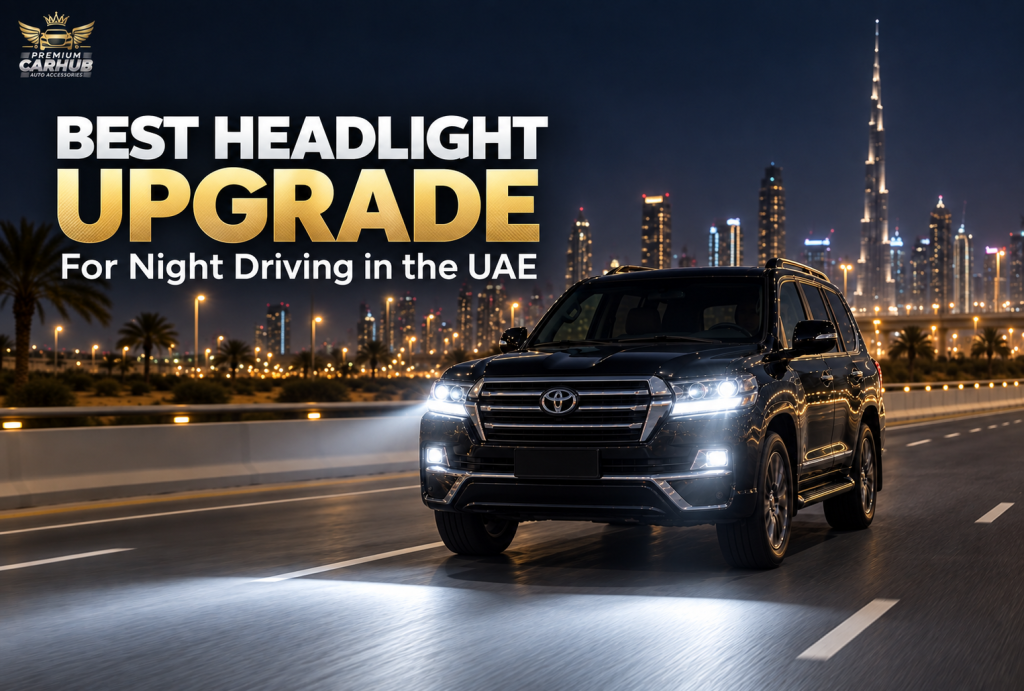
Best Headlight Upgrade for Night Driving in the UAE
Driving after sunset in the UAE presents a surprisingly varied set of visibility challenges. A journey may begin under the bright streetlights of central Dubai, continue along a fast-moving motorway and end on a poorly illuminated road near a desert camp, construction zone or developing residential community. The lighting system that feels adequate in the city can suddenly seem weak once the surroundings become completely dark.
Choosing the Best Headlight Upgrade is therefore about much more than purchasing the brightest bulb available. A genuinely effective upgrade must deliver a controlled beam, illuminate useful areas of the road, withstand UAE temperatures, work correctly with the vehicle’s electronics and avoid dazzling other motorists.
LED bulbs, HID conversions, projector retrofits and complete OEM-style headlamp assemblies can all improve visibility, but they do not perform equally in every vehicle. The design of the existing reflector, lens condition, electrical system and mounting height can matter as much as the bulb technology itself.
This guide explains how UAE drivers can select a safe, durable and practical lighting solution rather than judging products by exaggerated lumen figures.
Why Factory Headlights May Become Inadequate
A vehicle’s original headlights can lose effectiveness gradually, making the decline difficult for its owner to notice. Halogen bulbs become dimmer as they age. Polycarbonate lenses develop oxidation, fine scratches and yellowing. Reflective surfaces inside the lamp can deteriorate, while previous accident repairs may leave the headlamps incorrectly aligned.
Dust is another important UAE-specific factor. Even a thin layer on the external lens scatters light and reduces the amount reaching the road. Repeated exposure to strong sunlight and heat can accelerate lens deterioration, especially when a vehicle is parked outdoors.
Common signs that an upgrade or repair is required include:
- Difficulty seeing lane markings on unlit roads
- A short or uneven low-beam pattern
- One headlight appearing dimmer than the other
- Yellow, cloudy or scratched lenses
- Dark spots within the illuminated area
- Frequent flashing from oncoming drivers
- Bulbs that fail repeatedly
- A dashboard bulb-error warning after replacement
Before selecting the Best Headlight Upgrade, the complete system should be inspected. Installing high-output bulbs behind a cloudy lens will not correct the underlying problem.
Understanding the Main Headlight Technologies
Halogen Headlights
Halogen bulbs remain common in older vehicles and entry-level models. They are affordable, widely available and generally easy to replace. Their warm-white output can work reasonably well in dust or haze because it creates less perceived backscatter than extremely blue light.
Their disadvantages are lower efficiency, shorter service life and limited illumination compared with well-designed LED or xenon systems. High-wattage halogen bulbs may also generate excessive heat and damage connectors, wiring or plastic reflector bowls.
Premium replacement halogens are suitable when a driver wants a simple improvement without altering the original headlamp design. They are not normally the Best Headlight Upgrade for drivers who regularly use dark highways or rural roads.
LED Headlights
LED technology offers fast illumination, low power consumption, compact packaging and a long potential service life. A properly engineered LED headlight can produce clear white light with excellent road coverage.
The critical phrase is “properly engineered.” A generic LED bulb placed inside a halogen reflector may position its light-emitting chips differently from the original filament. The result can be a bright foreground, weak distance illumination and uncontrolled glare.
The Best Headlight Upgrade using LEDs must replicate the original light-source position or use a complete LED optical system. It should also have effective heat management. Although LEDs emit less forward heat than halogens, their electronic chips and drivers still require cooling. Products with inadequate heat sinks or fans can fail quickly in a hot engine bay.
HID or Xenon Headlights
High-intensity discharge lamps create light through an electrical arc rather than a heated filament. They can deliver strong distance illumination and were widely used in premium vehicles before modern LEDs became dominant.
HID systems need ballasts and require a short warm-up period. They work best in projector housings designed specifically for xenon light. Installing an HID capsule in an unsuitable reflector can cause severe glare and an irregular beam.
A correctly designed OEM-style xenon projector remains an effective choice for certain vehicles. However, for many modern cars, a quality LED projector provides simpler integration and quicker response.
Bi-LED Projector Retrofits
A bi-LED projector produces both low and high beams from one optical module. Its internal shield creates a sharp low-beam cutoff, while a solenoid moves the shield when the high beam is activated.
For many older reflector-headlight vehicles, a professional bi-LED projector retrofit can be the Best Headlight Upgrade because it improves the optics rather than merely increasing bulb output. A well-installed projector provides controlled width, a defined cutoff and usable long-distance illumination.
Installation quality is essential. The housing must be opened and resealed properly, the projector must be securely mounted, and the beam must be aligned after installation. Poor sealing can allow moisture or dust into the lamp.
Complete OEM-Style LED Assemblies
Replacing the complete headlight assembly may be the most integrated solution for compatible models. A quality assembly can include projectors, daytime running lights, indicators, cooling systems and vehicle-specific electronics.
This option usually costs more, but it avoids many optical compromises associated with bulb-only conversions. It can also preserve a factory-style appearance. Compatibility with adaptive lighting, self-leveling, CAN bus communication and dashboard diagnostics must be confirmed before installation.
Headlight Upgrade Comparison
| Upgrade type | Visibility improvement | Beam control | Heat suitability | Installation complexity | Best application |
|---|---|---|---|---|---|
| Premium halogen bulb | Moderate | Good in original housing | Generally good | Low | Simple replacement on older cars |
| LED replacement bulb | Moderate to high | Depends heavily on housing | Varies by cooling design | Low to medium | Compatible reflector or projector systems |
| HID conversion | High | Poor without HID projector | Good with quality ballast | Medium | Vehicles with compatible xenon projectors |
| Bi-LED projector retrofit | Very high | Excellent when aligned | Good with premium components | High | Older cars needing a complete optical improvement |
| Complete LED assembly | High to very high | Usually excellent | Vehicle-dependent | Medium to high | Premium, modern and model-specific upgrades |
| Headlight restoration only | Restores lost performance | Retains factory pattern | Excellent | Low to medium | Cloudy or oxidised lenses |
For most vehicles with outdated reflector lamps, a professionally fitted bi-LED projector is usually the Best Headlight Upgrade for balanced width, distance and glare control. For vehicles already equipped with sound projector optics, a compatible premium bulb may provide sufficient improvement at a lower cost.
Brightness Is Not the Same as Visibility
Online product listings often advertise extremely high lumen figures. These numbers may represent theoretical chip output rather than the amount of controlled light reaching the road. Some sellers combine the output of both bulbs or quote peak performance before heat causes the system to reduce power.
Useful night visibility depends on several factors:
- Intensity at important points in the beam
- Width of illumination
- Distance reach
- Uniformity without distracting bright spots
- A defined cutoff on low beam
- Correct vertical and horizontal alignment
- Appropriate colour temperature
- Clean, transparent lenses
A poorly focused bulb can appear bright when viewed from outside the car while giving the driver limited distance vision. It may light the road immediately in front of the bumper so strongly that the driver’s pupils constrict, making darker areas farther ahead harder to identify.
This is why the Best Headlight Upgrade should be evaluated through its beam pattern, not by packaging claims alone.
Choosing the Right Colour Temperature
Colour temperature is measured in Kelvin. Standard halogen lighting is usually warm, while many automotive LED systems produce a whiter appearance.
For practical UAE road use, approximately 4300K to 5500K is generally a sensible range. It offers a clean appearance without becoming excessively blue. Very high colour temperatures may look stylish, but they do not automatically improve visibility. Blue-rich light can produce more visual discomfort and reflection from dust, haze or wet surfaces.
A neutral-white system around 5000K is often the Best Headlight Upgrade for drivers who want a modern appearance and useful contrast. Drivers frequently travelling through dusty areas may prefer the slightly warmer end of the range.
The correct choice must also comply with applicable inspection and road-use requirements. Confirm the permitted specification for your vehicle and emirate before installing any non-standard lighting.
UAE-Specific Night-Driving Considerations
Extreme Heat and Component Durability
Under-bonnet temperatures in the UAE can be demanding. An LED bulb with a small decorative fan may work during a workshop demonstration but lose brightness or fail after prolonged summer use.
Reliable systems need metal heat sinks, stable drivers, temperature protection and adequate clearance around the cooling components. Wiring should use automotive-grade connectors rather than improvised joints or household electrical tape.
Dust, Sand and Lens Contamination
Dust reduces headlight output and makes scattered glare more noticeable. Clean the lenses regularly with a soft cloth and an appropriate automotive cleaner. Avoid wiping dry sand across the plastic, as it can create fine scratches.
Any opened headlamp must be resealed with proper automotive sealant. A small sealing gap can admit fine dust or cause condensation.
Dark Desert and Rural Roads
On completely unlit roads, distance illumination becomes more important than dramatic foreground brightness. The Best Headlight Upgrade for these conditions normally combines a wide low beam with a strong, precisely aimed high beam.
Auxiliary off-road lights should not be treated as substitutes for road-legal headlights. Their use on public roads may distract or blind other drivers, and installation requirements should be checked with the relevant authority.
High-Speed Motorways
At motorway speeds, a vehicle covers a substantial distance before the driver can identify a hazard, react and brake. Long-range illumination is therefore important, but raising the low beam excessively is not a safe solution. Proper optics should send useful light farther ahead while maintaining a controlled cutoff.
Glare From Reflective Signs
Very cool or poorly controlled lights can create harsh reflections from road signs. This may temporarily reduce the driver’s ability to see beyond the sign. Balanced intensity and a clean beam distribution are more comfortable during long trips between emirates.
Vehicle Height and Load
SUVs and pickup trucks have higher-mounted headlamps and can create significant glare when incorrectly adjusted. A heavily loaded boot can also raise the front beam. Vehicles with manual headlight leveling should be adjusted according to the load, while automatic leveling systems must remain operational after an upgrade.
Legal and Inspection Considerations
Vehicle-lighting rules are intended to preserve visibility without creating a hazard for other road users. Dubai RTA inspection information identifies incorrect headlight colour, damaged lenses, tinted lamp covers and incorrect aim as lighting defects in its published testing parameters.
Because requirements can differ by vehicle type, modification and registration jurisdiction, owners should verify their proposed installation before authorising it. Avoid assuming that a product is approved merely because it is sold locally.
The Best Headlight Upgrade should:
- Produce an acceptable white road-lighting colour
- Maintain a controlled low-beam cutoff
- Avoid glare for approaching traffic
- Preserve required leveling functions
- Use secure automotive wiring
- Retain functional high beams and indicators
- Avoid tinted covers that reduce output
- Be professionally aimed after installation
Rules and approval procedures may change, so consult the UAE Government’s road-safety information and the relevant licensing authority for the latest requirements.
Why Headlight Alignment Matters
Even premium lighting performs badly when incorrectly aimed. A low beam directed too far downward creates an intensely illuminated foreground but insufficient distance. A beam aimed upward produces glare and reduces other drivers’ ability to see.
Alignment can change following suspension modifications, accident repairs, headlamp removal or projector installation. It should be measured on a calibrated beam setter or a properly prepared aiming surface—not estimated on an uneven workshop floor.
Professional alignment examines:
- Vehicle position and tyre pressure
- Suspension height
- Headlight leveling control
- Vertical cutoff
- Horizontal aim
- Left-right beam symmetry
- High-beam centre position
Aiming is the final step that turns good hardware into the Best Headlight Upgrade for real-world driving.
Premium Car Hub Technicians’ Recommendations
Premium Car Hub technicians recommend beginning with a lighting inspection rather than selecting a bulb from an online specification sheet.
Restore Before You Replace
If the lenses are oxidised, restoration may recover much of the lost output. The process should include sanding where necessary, polishing and applying UV protection. Polishing without protection may make the lens clear temporarily but allow yellowing to return.
Match the Light Source to the Housing
A reflector engineered for halogen light should not automatically receive an HID capsule or incorrectly designed LED bulb. Technicians should check the hotspot, cutoff, glare and distance performance before considering the conversion complete.
Select Components for UAE Temperatures
Choose proven drivers, ballasts, cooling fans and connectors. A slightly less powerful premium system is often more dependable than a high-output product that overheats.
Protect the Vehicle’s Electronics
Modern vehicles monitor bulb resistance and communicate through CAN bus networks. Incorrect products can produce warning lights, flickering, radio interference or premature shutdown. Vehicle-specific decoders may be necessary, but they must be safely mounted because load resistors can become hot.
Test the Upgrade at Night
A wall pattern is helpful for alignment, but a controlled road test reveals whether the driver can see lane edges, signs and distant objects without excessive foreground glare. This practical evaluation is essential when choosing the Best Headlight Upgrade.
Pros and Cons of Upgrading Car Headlights
Advantages
- Improved recognition of pedestrians, debris and lane boundaries
- Better visibility on unlit UAE roads
- Modern appearance
- Lower power consumption with efficient LEDs
- Longer potential service life
- Better beam width with quality projectors
- Faster high-beam response with LED systems
- Reduced fatigue when the beam is uniform and properly aimed
Disadvantages
- Poor conversions can create dangerous glare
- Premium projector retrofits cost more than bulb replacements
- Some installations require headlamp opening
- Low-quality fans, drivers and ballasts may fail in high temperatures
- Incorrect wiring can cause warning lights or electrical problems
- Non-compliant modifications may create inspection or insurance concerns
- Very cool light can perform poorly in dust or haze
- Modification may affect manufacturer warranty coverage
These drawbacks do not mean upgrades should be avoided. They show why component compatibility and professional fitting are central to the Best Headlight Upgrade.
Related Premium Car Hub Guides and Services
Drivers comparing lighting solutions can explore these relevant Premium Car Hub resources:
- Learn about vehicle-specific options in the Car LED Headlights Installation Dubai guide.
- If weak output is caused by yellowed lenses, review the Headlight Restoration in Dubai guide.
- Explore complementary vehicle improvements through Premium Car Accessories Dubai.
- Before making wider alterations, understand the considerations covered in the Car Modification in Dubai guide.
- For cabin illumination that does not replace road lighting, see Car Ambient Lighting Dubai.
Authoritative Resources for Safer Automotive Lighting
For additional technical and safety context, consult:
- UAE Government Road Safety Guidance
- Dubai RTA Vehicle Testing Parameters
- UNECE Regulation No. 48 on Vehicle Lighting Installation
- NHTSA Research on Headlamp Performance and Glare
- AAA Guidance on Headlight Glare and Night Visibility
Frequently Asked Questions
1. What is the best headlight upgrade for a car with factory halogen lamps?
For a vehicle with basic reflector headlights, a premium halogen bulb is the simplest option. If a substantial improvement is required, a professionally installed bi-LED projector may provide superior beam control, width and distance. A technician should inspect the housing before recommending a conversion.
2. Are LED headlights better than HID headlights for UAE driving?
Quality LEDs illuminate instantly, consume less energy and avoid separate HID ballasts. HID projectors can still provide excellent distance illumination. The Best Headlight Upgrade depends more on optical compatibility and installation quality than on whether the source is LED or HID.
3. Can I put an LED bulb directly into a halogen headlight?
Physical fitment does not guarantee optical compatibility. If the LED chips do not match the original filament position, the reflector may produce glare, dark areas or weak distance vision. The beam pattern should be tested before road use.
4. What colour temperature is best for night driving?
Approximately 4300K to 5500K usually provides a useful balance of contrast, white appearance and comfort. Extremely blue bulbs may appear brighter but can produce more distracting reflection in dust and haze.
5. Will brighter headlights damage my wiring?
They can if the product draws excessive current, uses poor connectors or requires improvised wiring. High-wattage halogens are particularly capable of overheating sockets. A professional should verify current draw, fuse protection and compatibility.
6. Why are my new LED headlights flickering?
Flickering may result from CAN bus monitoring, pulse-width-modulated power, loose connectors, an incompatible driver or overheating. A vehicle-specific diagnostic check is preferable to repeatedly adding unverified resistors or adapters.
7. Do cloudy lenses really reduce headlight performance?
Yes. Oxidation and surface damage scatter light before it reaches the road. Restoration can sometimes provide a greater improvement than fitting a more powerful bulb behind the damaged lens.
8. How long should quality LED headlights last in Dubai?
Service life varies with component quality, engine-bay temperature, cooling, operating time and installation. Advertised laboratory lifespans do not necessarily represent UAE conditions. Heat-managed products from established manufacturers are the safer choice.
9. Do headlights need alignment after bulb replacement?
A simple like-for-like bulb change may not always disturb alignment, but it should still be checked if the beam looks uneven. Alignment is essential after projector retrofits, complete assembly replacement, suspension changes or accident repair.
10. Can upgraded headlights affect vehicle inspection or warranty?
Yes. Incorrect colour, aim, wiring or incompatible modifications may create inspection problems. Electrical alterations may also affect warranty coverage if they damage related systems. Confirm current authority requirements and manufacturer terms before proceeding.
Conclusion
The Best Headlight Upgrade for UAE night driving is not necessarily the product with the highest advertised output. It is the system that sends a controlled, uniform beam to the areas where the driver needs it, operates reliably in high temperatures, integrates safely with the vehicle and limits glare for everyone else.
For some cars, restoring the lenses and installing premium halogen bulbs will be sufficient. Others will benefit from a compatible LED replacement, while older reflector systems may require a properly engineered bi-LED projector retrofit. Modern luxury vehicles may be better served by an OEM-style complete assembly that preserves electronic and adaptive functions.
The safest decision begins with an inspection of the lenses, reflectors, wiring, voltage, leveling equipment and existing beam pattern. With appropriate components, professional installation and precise alignment, upgraded headlights can make night journeys across Dubai and the wider UAE clearer, more comfortable and considerably safer.
Contact Premium Car Hub
Location: 20th St – Al Khabaisi – Dubai, United Arab Emirates
Phone: +971 4 570 0353
Email: info@premiumcarhub.com
Website: https://premiumcarhub.com/