
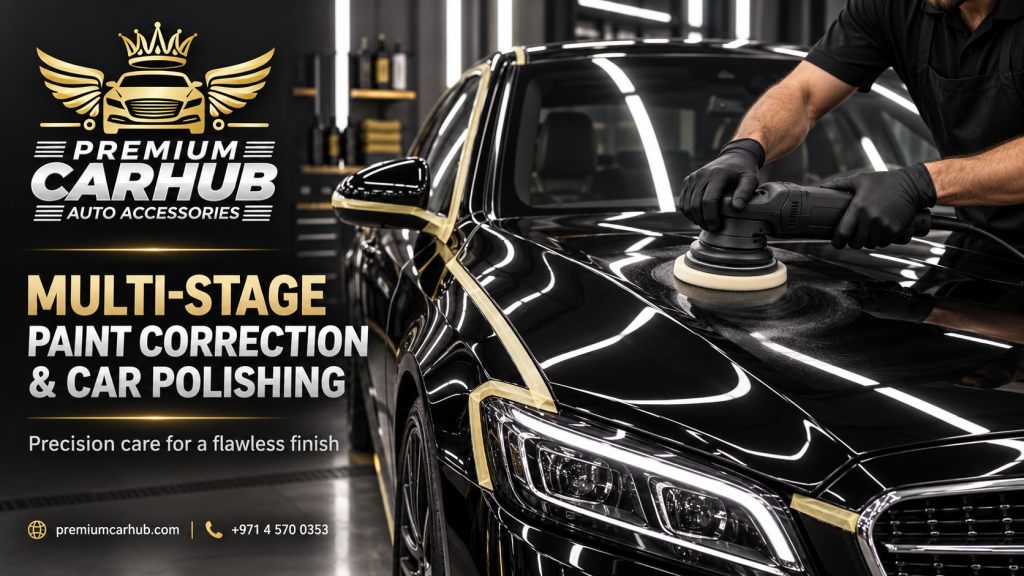
Multi-Stage Paint Correction and Car Polishing in Dubai
A black bonnet can look flawless beneath a petrol station canopy and covered in fine circular scratches the next morning. Those marks were probably already there. Different lighting simply makes them easier to see.
Car Polishing improves that appearance by refining defects in the paint surface. Done properly, it produces clearer reflections while preserving as much usable paint as possible. The important decision is how much correction your particular vehicle can safely accept.
For UAE drivers, that decision should also account for outdoor parking, dusty journeys, highway mileage and washing habits. An immaculate finish has limited value if the next dry wipe puts the scratches straight back.
What multi-stage Car Polishing actually means
Most modern glossy automotive finishes have a colour layer beneath a transparent clear coat. Abrasive correction removes a small amount of surface material to reduce suitable defects. It cannot replace missing paint.
Multi-stage Car Polishing uses successive abrasive combinations: a cutting step addresses more noticeable defects, while a finer step improves the finish left behind. Some vehicles benefit from additional refinement; others need only a gentle enhancement.
A stage describes a distinct correction operation. Washing, claying and applying protection are separate preparation or finishing tasks. Ask what a workshop includes when advertising a three-stage package: package names alone do not establish the amount or quality of correction.
Wax, glaze and abrasive polish also perform different jobs. Some products temporarily disguise fine marks. Genuine correction should remain visible after compatible residue removal, before any gloss-enhancing protection is applied.
Choose the treatment by paint condition
Car Polishing should begin with a diagnosis. Light wash marks across otherwise healthy paint suggest a different approach from isolated deep scratches, peeling clear coat or a recently repainted door.
| Treatment | Appropriate starting condition | Main objective | Important limitation |
| Single-stage enhancement | Light swirls and mild dullness | Improve gloss with one polishing combination | Deeper marks remain |
| Two-stage correction | More visible swirls and suitable moderate defects | Cut defects, then refine clarity | Requires sound paint and careful assessment |
| Additional finishing stage | Residual haze on demanding glossy finishes | Improve final optical clarity | Adds value only when the finish needs it |
| Localised paint repair | Chips, exposed colour damage or failed clear coat | Restore damaged coating through repair | Polishing alone cannot rebuild paint |
Do not buy the longest process automatically. The appropriate Car Polishing package is the least aggressive treatment that meets an agreed visual target without taking unnecessary risks.
How a careful correction process works
Inspect the history and map the panels
Tell the technician about previous polishing, resprays, accident repairs, ceramic coatings and paint protection film. An apparently uniform car may contain several different paint systems.
A Car Polishing inspection records visible defects and compares readings across suitable panels using an appropriate paint thickness gauge. Conventional gauges on metal generally report total coating thickness, not the remaining clear coat alone. A thick reading therefore does not automatically authorise aggressive correction.
Plastic bumpers need different measurement equipment from metal panels. Where useful measurements are unavailable, the technician should acknowledge the uncertainty and take a conservative approach. No universal gauge reading guarantees that every panel is safe to compound.
Wash and decontaminate before judging defects
Loose grit must be removed before contact work. Suitable chemical decontamination can address bonded contamination; mechanical claying is used when necessary, with lubrication and care because it can introduce marring.
Car Polishing should not be the first response to every rough patch or water mark. A removable deposit and an etched depression can look similar, yet require different treatment. Cleaning first prevents unnecessary abrasion.
Establish the result on a test area
A small test area shows how the paint responds to the selected pad, liquid and machine technique. Start conservatively, inspect the result and increase aggression only when justified.
Ask to see this area under concentrated inspection lighting and broader light. A combination that removes obvious swirls may leave faint haze. Car Polishing succeeds when the final surface looks clear across useful viewing conditions, rather than from one flattering angle.
Cut where needed and refine the finish
During correction, pad condition, pressure, machine movement and product behaviour all affect the result. Dirty or overloaded pads can compromise consistency. Edges, creases, thin areas and previously repaired panels need particular care.
The final Car Polishing operation addresses suitable micro-marring left by the cutting step. More passes are not automatically better. Stop when additional work offers too little visible improvement for the material being removed.
Wet sanding is a separate, more invasive decision. It should never appear as an unexplained extra in an ordinary correction package.
Inspect before adding protection
After compatible residue removal, inspect for remaining scratches, haze, polishing residue and uneven clarity. Record defects deliberately retained for paint preservation.
Car Polishing and protection solve different problems. A suitable wax, sealant or ceramic coating can follow the correction, subject to product preparation requirements. Protection does not undo excessive abrasion or make existing deep damage disappear.
A practical way to decide when to stop
Consider an illustrative dark SUV used between Dubai and Abu Dhabi. The bonnet has wash swirls, the front bumper has stone chips, and one repainted door has an uncertain correction history.
Treat these as separate decisions. The bonnet may justify cutting and refinement after testing. The bumper chips need repair assessment. The door may receive only light enhancement, or no abrasion, depending on inspection.
For your Car Polishing consultation, divide defects into three groups:
Correct: suitable shallow defects on paint that responds safely to testing.
Improve: defects that can become less noticeable without pursuing complete removal.
Retain or repair: deep damage, vulnerable areas and coating failure.
This approach makes the quotation more useful than an unsupported promise of “95% scratch removal”. Ask which defects the percentage refers to, how they are counted and which panels are excluded.
A second useful check is ownership horizon. If you plan to keep the car for years, preserving options for future maintenance matters. Spending the paint’s remaining correction capacity on one stubborn scratch may be a poor trade.
UAE driving conditions that change the care plan
Dust and sand make washing technique decisive
Fine grit left on the paint can scratch when dragged across it. Avoid dry wiping after outdoor parking or a dusty drive. Remove loose contamination with an appropriate prewash and rinse before careful contact washing.
For Car Polishing results to last, the person washing the vehicle needs the aftercare instructions too. Request clean wash media, separate wheel tools and clean drying towels. A coating cannot compensate for a contaminated cloth.
Hot panels complicate cleaning and correction
A vehicle arriving from sunny parking should cool before treatment. Surface heat can change product behaviour and shorten working time. Controlled indoor conditions help technicians manage the process more consistently.
Wash in suitable shade on cool surfaces and prevent cleaning products from drying on the car. Follow the specific product directions rather than assuming every shampoo, polish or coating tolerates the same conditions.
Highway chips need a different solution
Regular inter-emirate driving exposes front-facing panels to road debris. Car Polishing cannot fill stone chips. Consider whether front-end film protection better addresses your usage after the paint has been assessed and any necessary repairs completed.
Ceramic coatings should not be sold as equivalent impact protection. Likewise, a coated car still needs inspection and maintenance after dusty journeys.
Parking habits can outweigh package upgrades
Avoid sprinkler overspray where practical and remove bird droppings promptly using a suitable gentle cleaning method. Do not scrape dried contamination from the surface.
If outdoor parking and frequent washing are unavoidable, prioritise a maintainable finish. Repeated aggressive correction is an expensive way to compensate for preventable wash damage.
Pros and cons of multi-stage Car Polishing
Advantages
Improves reflection clarity and reduces suitable swirl marks and surface defects.
Allows cutting and finishing combinations to be selected separately.
Creates an opportunity to assess paint condition before applying protection.
Can improve presentation without repainting panels that remain fundamentally sound.
Limitations
Abrasive work removes material, so repeat treatments require restraint.
Extra stages increase labour without guaranteeing a better practical result.
Deep scratches, chips and failing clear coat may remain or need repair.
Poor washing can introduce new marks soon after collection.
Choose Car Polishing because the improvement matters to you. A glossier vehicle may present better to a buyer, but a specific increase in resale value cannot be guaranteed.
Recommendations to review with Premium Car Hub technicians
The following proposed expert recommendations should be confirmed by the workshop against your vehicle:
Agree on the finish before authorising work. Use a test area to establish acceptable improvement and retained defects.
Request a panel-specific plan. Different paint histories can justify different treatments on the same car.
Ask for comparable photographs. Match lighting, distance and angle; inspect before protection where practical.
Get a written scope. Confirm preparation, abrasive stages, exclusions, protection and collection requirements.
Leave with a maintenance plan. Record product-specific curing instructions and the next inspection trigger.
The most useful question is: “Which marks would you leave, and why?” A clear explanation reveals more about the proposed Car Polishing approach than a promise of perfection.
Explore correction and protection at Premium Car Hub
Start with the multi-stage paint correction service when discussing paint defects and your preferred finish.
If easier maintenance is your next priority, review ceramic coating options and ask which preparation and aftercare requirements apply to the proposed product.
For frequent highway driving, explore paint protection film and discuss coverage for vulnerable front-facing panels.
Technical guidance behind responsible paint care
Measuring before removing material
DeFelsko’s automotive paint measurement guidance explains coating measurement methods and the limitations associated with different substrates. This supports using measurements as part of an assessment rather than treating a single number as permission to polish aggressively.
Matching abrasives to finishing stages
3M’s Perfect-It paint finishing guidance distinguishes compounding, polishing and ultrafine finishing products. It also stresses evaluating the specific repair and relevant vehicle guidance. This supports selecting stages according to the actual finish.
Separating correction from impact protection
XPEL’s paint protection film guide describes film protection against hazards including rock chips and surface scratches. That is a different function from abrasive defect removal; neither treatment makes a vehicle immune to damage.
Frequently asked questions about Car Polishing
How much does Car Polishing cost in Dubai
The price depends on vehicle size, contamination, defect severity, paint behaviour and the correction scope. Ask Premium Car Hub for an inspection-based quotation with preparation, correction and protection listed separately. A quick gloss enhancement should not be compared directly with extensive multi-stage work.
How long does multi-stage paint correction take
Duration depends on the amount of preparation, panel complexity, correction difficulty and staffing. Added protection may introduce separate curing requirements. Ask for both working time and collection time; the number of advertised stages alone cannot establish a reliable delivery schedule.
Can Car Polishing remove deep scratches
It can reduce suitable scratches within the surface coating, but complete removal may require excessive material removal. Damage through the colour layer needs repair assessment. A fingernail catching in a scratch is a warning sign, not a precise measurement of its depth or repairability.
Is two-stage correction better than a single-stage polish
Two stages offer separate cutting and refinement when the paint needs both. A lightly marked vehicle may look excellent after one stage. Choose the process demonstrated by a test area. Paying for additional steps makes sense only when they deliver worthwhile, safe improvement.
How often should I book Car Polishing in the UAE
Base repeat correction on inspected condition and previous treatment history. Avoid automatically booking aggressive work every few months. Routine washing, appropriate protection and occasional assessment may maintain the finish without further abrasion. New swirl marks should also trigger a review of washing technique.
Does Car Polishing remove ceramic coating
Abrasive polishing can compromise or remove a ceramic coating, depending on the process and product. Tell the technician what was applied and when. Agree whether the job involves maintaining the existing protection, correcting selected areas or preparing the vehicle for a fresh application.
Is Car Polishing safe for matte paint and wrapped cars
Conventional gloss correction is unsuitable for matte or satin paint because it can create shiny patches. Vinyl wraps and paint protection films have their own care requirements. Confirm the surface material and follow its manufacturer’s instructions before allowing any abrasive treatment.
How long will Car Polishing results last
A genuinely removed defect does not return by itself, but new scratches, contamination and environmental damage can change the appearance. Temporary fillers can also wash away and expose retained marks. Durability therefore depends on the treatment performed and subsequent care, rather than one universal lifespan.
Should I choose ceramic coating or PPF after correction
Choose according to the problem you want to address. Ceramic coating can support easier cleaning, while PPF provides a physical film barrier against certain impacts and abrasion. Coverage, product limitations, installation quality and maintenance all matter. Ask whether combining selected film coverage with compatible coating suits your use.
Can a new car need Car Polishing
Yes, a new vehicle can arrive with transport or handling marks, but it should not automatically receive heavy correction. Inspect first and use the gentlest justified treatment. Where the finish is already satisfactory, appropriate preparation and protection may be enough without additional abrasive work.
Better paint care leaves room for the future
Successful Car Polishing produces a finish you enjoy while respecting the material that makes future care possible. The strongest result may include a few deliberately retained defects, an honest explanation and a washing routine that prevents unnecessary rework.
Before choosing a package, ask for an assessment, a test area and a clear account of what should remain untouched. That gives you a practical basis for spending wisely on a car that lives in real UAE conditions.
Discuss your vehicle with Premium Car Hub
Location: 20th St – Al Khabaisi – Dubai, United Arab Emirates
Phone: +971 4 570 0353
Email: info@premiumcarhub.com
Website: Premium Car Hub