
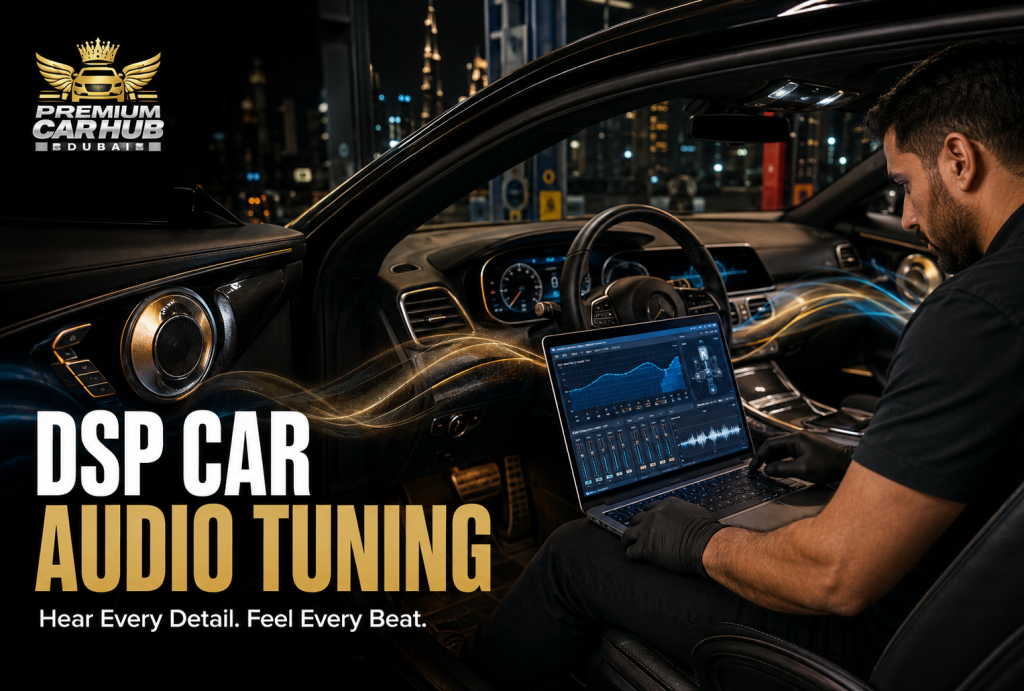
DSP Car Audio Tuning Explained: Why It Makes a Huge Difference
Replacing factory speakers can make a car sound louder and more detailed, but it does not automatically make the system sound accurate. Even high-end speakers may produce disappointing results when their timing, frequency response, crossover points and output levels are not calibrated for the vehicle.
This is where Car Audio Tuning becomes decisive.
A modern vehicle is one of the most difficult listening environments to manage. The driver sits much closer to the right or left speaker, depending on the vehicle configuration. Glass reflects high frequencies, carpets absorb parts of the midrange, door panels resonate and road noise masks quieter musical details. Each speaker is also installed at a different distance and angle from the listener.
Contact Premium Car Hub for Car Audio Tuning
A digital signal processor, commonly called a DSP, gives a trained technician the tools to correct these problems. It does not simply add bass or treble. Proper DSP calibration controls how every speaker works within the complete system.
At Premium Car Hub in Dubai, technicians approach Car Audio Tuning as acoustic system calibration—not as a collection of random equalizer adjustments. The objective is to make vocals appear naturally in front of the listener, integrate the subwoofer with the front speakers and reproduce music cleanly at realistic driving volumes.
Contact Premium Car Hub for Car Audio Tuning
What Is a DSP in a Car Audio System?
A DSP is an electronic processor placed between the audio source and the amplifiers or speakers. It receives the incoming audio signal, processes it according to a programmed configuration and sends a separately controlled signal to each output channel.
Depending on the processor and system design, a DSP can control:
- Channel routing and signal summing
- Input correction for factory head units
- High-pass and low-pass crossovers
- Equalization for individual speakers
- Time delay and time alignment
- Output level matching
- Speaker phase and polarity
- Subwoofer integration
- Presets for different listening preferences
Modern processors can offer dozens of equalization bands, precise signal delay and phase correction. For example, AudioControl lists time alignment, input delay, equalization, signal summing and phase correction among the capabilities of its automotive processors. Audison’s current tuning system similarly uses measurements to adjust speaker arrival times, output levels and cabin-related frequency-response problems.
The hardware provides the capability, but successful Car Audio Tuning still depends on system design, accurate measurements and the technician’s judgment.
Contact Premium Car Hub for Car Audio Tuning
Why a Car Cabin Is Acoustically Difficult
A home audio system can position two speakers at approximately equal distances from the listener. A car rarely offers that advantage.
Unequal speaker distances
In a left-hand-drive car, the driver is close to the front-left speaker and considerably farther from the front-right speaker. Sound from the closer speaker arrives first, pulling vocals and instruments toward the door.
Contact Premium Car Hub for Car Audio Tuning
DSP time alignment delays the nearer channels by tiny amounts so that sound from the principal speakers reaches the chosen listening position together. When correctly calibrated, the presentation moves away from the door and forms a coherent stage across the dashboard.
Reflective and absorbent surfaces
Windscreens, windows and hard dashboards reflect sound. Seats, carpets and roof lining absorb it. These surfaces do not affect every frequency equally, creating peaks and dips that cannot be predicted from a speaker specification sheet.
Speaker position and angle
Door speakers often play toward passengers’ legs rather than their ears. Tweeters may be mounted in sail panels, dashboards or pillars at completely different angles. A capable Car Audio Tuning process accounts for the actual installation instead of using generic settings copied from another car.
Contact Premium Car Hub for Car Audio Tuning
Road, tyre and air-conditioning noise
Cabin noise masks low-level information, particularly at lower frequencies. In Dubai, strong air-conditioning airflow, high-speed motorway travel and coarse road surfaces can change how a system is perceived. The tune therefore needs to work under real driving conditions, not only in a silent workshop.
The DSP Functions That Create the Biggest Improvement
1. Time alignment
Time alignment compensates for unequal speaker distances. The technician measures or acoustically determines the arrival time of each channel and adds delay where required.
The purpose is not to create an exaggerated effect. It is to establish believable placement. A properly aligned vocal should appear ahead of the listener, normally near the centre of the dashboard, rather than coming distinctly from the nearest door.
Contact Premium Car Hub for Car Audio Tuning
Time alignment is one of the reasons professional Car Audio Tuning can make the same speakers sound dramatically more focused.
2. Individual-channel equalization
A basic head-unit equalizer changes the entire system. A DSP can adjust individual channels, allowing the technician to address a reflection or resonance affecting one speaker without unnecessarily changing every other channel.
Equalization should generally reduce genuine acoustic problems rather than force every measurement into a perfectly flat line. Excessive boosting can consume amplifier headroom, increase distortion and place unnecessary demand on a speaker.
A measured target curve will also not be ruler-flat. In a car, a modest rise through the bass and a controlled high-frequency response often sound more natural than mathematically flat output.
3. Active crossover control
Crossovers decide which frequencies each speaker reproduces. A tweeter should not receive deep bass, while a subwoofer should not reproduce vocals.
DSP crossovers allow the technician to choose:
- The crossover frequency
- High-pass or low-pass operation
- Filter slope
- Filter type
- Separate settings for individual drivers
Appropriate filters protect speakers, reduce distortion and create a smoother handover between the tweeter, midrange, midbass and subwoofer.
4. Output-level matching
A technically impressive system can still sound tiring if the tweeters are several decibels too loud or if the rear speakers overwhelm the front stage. Level matching establishes the contribution of every channel.
Rear speakers are often used for subtle ambience rather than as the dominant source. Meanwhile, the subwoofer should support the music without becoming easy to locate in the boot.
5. Phase and polarity correction
Speakers can partially cancel one another when their acoustic phase relationship is wrong. This is particularly noticeable near crossover frequencies and during subwoofer integration.
A technician may test polarity, delay and filter settings to achieve stronger, more consistent summation. Simply reversing a speaker’s wires without measurement is not a substitute for complete Car Audio Tuning.
Contact Premium Car Hub for Car Audio Tuning
6. Factory signal correction
Many modern OEM head units send an already processed signal. The factory system may reduce bass as volume rises, apply equalization for original speakers or divide the frequency range across several amplified outputs.
A suitable DSP can combine necessary signals and correct some factory processing before creating the new output configuration. This is especially useful when retaining an original infotainment system that controls navigation, vehicle settings, cameras and steering-wheel functions.
Contact Premium Car Hub for Car Audio Tuning
DSP Tuning vs Basic Audio Adjustment
| Area | Basic Bass/Treble Adjustment | Professional DSP Car Audio Tuning |
|---|---|---|
| Control | Usually affects the whole system | Individual input and output channels |
| Timing | No arrival-time correction | Precise delay for each speaker |
| Equalization | Typically 2–10 broad controls | Detailed, channel-specific equalization |
| Crossovers | Fixed or limited | Adjustable frequency, slope and filter type |
| Factory integration | Limited | Signal summing and OEM correction where supported |
| Subwoofer integration | Mainly volume control | Level, crossover, delay and phase calibration |
| Measurement | Usually adjusted by ear | Microphone measurements plus critical listening |
| Soundstage | Often remains door-focused | Can form a focused stage across the dashboard |
| Speaker protection | Limited | Controlled frequency range and gain structure |
| Presets | Rare or basic | Multiple configurations where the DSP supports them |
What Professional Car Audio Tuning Involves
A responsible tuning session begins before the software is opened.
System inspection and customer consultation
The technician identifies the source unit, amplifier channels, speaker locations, impedance, power capability and factory processing. The customer’s priorities also matter. A driver who mainly listens to acoustic music may want different tonal balance from someone who prefers bass-heavy electronic music.
Premium Car Hub technicians recommend discussing whether the vehicle is usually occupied by the driver alone, a front passenger or an entire family. That choice affects the listening position and calibration strategy.
Contact Premium Car Hub for Car Audio Tuning
Input and gain verification
The incoming signal is checked for clipping, noise and unusual factory equalization. Amplifier gains must be set to create a healthy signal-to-noise ratio without exceeding the clean operating range of the source or amplifier.
DSP software cannot repair a signal that is already heavily distorted.
Speaker-by-speaker testing
Each driver is tested individually. This helps identify wiring errors, reversed polarity, rattles, weak output or an incorrect channel assignment before those problems are hidden inside a full-system measurement.
Acoustic measurement
A calibrated microphone and analysis software reveal frequency-response and timing behaviour at the listening position. Multiple measurements around the driver’s head area may provide a more useful result than relying on one tiny point in space.
Professional Car Audio Tuning uses measurements as evidence, while trained listening confirms whether the result is musically convincing.
Crossover, timing, level and EQ calibration
The technician normally establishes safe crossover points first, followed by timing, levels, phase relationships and equalization. The exact sequence can vary with the system, but each adjustment should have a defined purpose.
Verification with varied music
A tune should be evaluated with clean, familiar recordings covering vocals, percussion, bass, acoustic instruments and dense musical passages. Navigation prompts, Bluetooth calls and different source inputs should also be checked.
Contact Premium Car Hub for Car Audio Tuning
A Practical Before-and-After Example
Consider a luxury SUV with factory infotainment, upgraded front component speakers, an amplifier and a boot-mounted subwoofer.
Before calibration, the system may be loud but disconnected. Vocals lean toward the driver’s door, cymbals sound sharp, midbass feels weak and the subwoofer seems to play from behind the seats.
Contact Premium Car Hub for Car Audio Tuning
After measured Car Audio Tuning:
- Time alignment positions vocals higher and closer to the dashboard centre.
- Crossover adjustments stop the door speakers from attempting deep bass.
- Phase and delay changes blend the subwoofer with the front midbass.
- Channel-specific EQ reduces a harsh reflection near the windscreen.
- Level matching keeps the tweeters detailed without becoming tiring.
- Rear-speaker output is lowered so that it no longer pulls the stage backwards.
No single adjustment creates the improvement. The difference comes from making all components operate as one system.
Contact Premium Car Hub for Car Audio Tuning
Pros and Cons of DSP Car Audio Tuning
Advantages
- Creates more accurate vocal and instrument placement
- Improves clarity without relying on excessive volume
- Integrates factory infotainment with upgraded components
- Provides better subwoofer-to-midbass transition
- Allows individual control of multiple speakers
- Helps protect speakers through appropriate crossovers
- Offers presets for different users or music preferences
- Can reveal the full performance of existing quality equipment
- Reduces harsh peaks and uncontrolled bass
Potential disadvantages
- Professional processors and calibration add to the project cost
- Incorrect settings can make the system worse or damage speakers
- Complex systems require more installation and testing time
- A driver-focused tune may be less precise for other seats
- Poor recordings become easier to identify
- Settings should be reviewed after major component or installation changes
The most important limitation is that a DSP cannot compensate for every physical problem. A rattling door panel, badly positioned speaker, weak amplifier or damaged driver must be corrected at its source.
Contact Premium Car Hub for Car Audio Tuning
UAE-Specific Car Audio Considerations
Heat and component placement
A parked vehicle in the UAE can become extremely hot. DSP units and amplifiers should be installed where they receive appropriate ventilation and are protected from direct heat exposure. Mounting powerful equipment loosely under carpeting or inside an unventilated enclosure may reduce reliability.
Air-conditioning noise
Strong air-conditioning is essential for much of the year, but fan and vent noise can mask musical detail. Premium Car Hub technicians recommend assessing the final tune with the climate-control system operating at a realistic setting.
Contact Premium Car Hub for Car Audio Tuning
Motorway driving
At speed on Sheikh Zayed Road, tyre and wind noise can alter perceived tonal balance. A system tuned only inside a silent workshop may sound lean on the road. Some processors allow separate presets, making it possible to have a refined critical-listening setup and a road-oriented configuration.
SUVs and large cabins
Dubai has a substantial SUV and 4×4 market. These vehicles may have longer cabins, larger door cavities and more distant rear speakers. Their subwoofer integration and channel delays require vehicle-specific calibration rather than settings intended for a compact sedan.
Dust and installation quality
Connectors, wiring routes and mounting locations should be selected carefully for long-term reliability. Factory-style cable management and secure terminations are as important as the software configuration.
Responsible sound levels and legal compliance
Clean sound often feels less aggressive than distorted output, encouraging some users to listen louder than expected. Excessive sound pressure can damage hearing and distract the driver.
The UAE’s federal traffic legislation requires vehicles used on public roads to remain in suitable technical condition and prohibits driving a vehicle that generates excessive noise. Owners considering substantial vehicle changes should confirm current requirements with the relevant licensing authority. Audio work must never interfere with airbags, driver-assistance equipment or other safety systems.
Contact Premium Car Hub for Car Audio Tuning
Recommendations from Premium Car Hub Technicians
Tune the system after installation is complete
Do not finalize the DSP while door treatment, speakers or amplifier wiring are still being changed. Physical changes alter acoustic behaviour and can invalidate the earlier measurements.
Prioritise the front stage
For most music systems, the front speakers determine imaging and tonal realism. Spending the entire budget on a very large subwoofer while retaining weak front speakers rarely creates a balanced result.
Retain factory functions intelligently
Modern screens may control cameras, parking sensors, climate functions and vehicle settings. An experienced installer should integrate the DSP without sacrificing normal functionality or creating warning messages.
Ask for more than an automatic preset
Automatic calibration can provide a useful starting point, but the final result should be checked by an experienced listener. Audison itself describes automated control of time alignment, equalization and channel levels, yet fine adjustment remains important for personal preference and vehicle-specific behaviour.
Contact Premium Car Hub for Car Audio Tuning
Keep a protected baseline file
The technician should save the original configuration and the completed tuning file. If settings are accidentally changed, the verified configuration can be restored without starting again.
Allow speakers to settle, then review
New speakers and door treatments can change slightly after regular use. For a detailed premium system, a follow-up check may help refine levels and tonal balance after the owner has spent time listening.
Contact Premium Car Hub for Car Audio Tuning
Continue Planning Your Premium Car Audio Upgrade
These Premium Car Hub resources help you select the surrounding equipment and integration approach:
- Learn how speakers, amplifiers and subwoofers work together in this car audio system upgrade guide.
- Explore vehicle-specific system planning in the guide to the best audio setup for SUVs in Dubai.
- Compare suitable replacement options in Best Car Speakers in Dubai.
- See how source-unit integration affects audio quality in this Android screen upgrade guide.
- Review broader technology and interior options in Luxury Car Interior Upgrades in Dubai.
Trusted Technical and Safety Resources
For readers who want to examine the underlying technology and UAE requirements:
- Audison’s automated tuning system explains measured time alignment, output-level calibration and cabin-response correction.
- AudioControl DSP technology demonstrates how automotive processors use signal delay and other tuning controls.
- Focal’s FSP-8 processor documentation explains the role of a DSP between a vehicle’s source unit and amplified audio system.
- UAE legislation on modified-vehicle safety requirements provides an official regulatory reference.
- The World Health Organization’s safe-listening guidance explains why listening level and exposure time matter.
Frequently Asked Questions
1. What does DSP mean in car audio?
DSP means digital signal processor. It modifies and routes the audio signal before it reaches the relevant amplifiers or speakers. Depending on the model, it can control equalization, crossover filters, time delay, phase, level and factory-system integration.
2. Does DSP improve sound quality with factory speakers?
It can improve balance, timing and frequency response, but it cannot change the physical limits of an original speaker. Car Audio Tuning may produce a worthwhile improvement with healthy factory speakers, although replacing weak drivers may be necessary for higher output, lower distortion or stronger bass.
3. Is a DSP better than replacing the head unit?
They solve different problems. A head-unit upgrade can add connectivity, navigation or improved source options. A DSP provides detailed acoustic control. In many modern vehicles, keeping the factory screen and integrating a DSP is preferable because the original unit controls important vehicle functions.
4. How long does professional DSP tuning take?
The time depends on channel count, factory integration, installation quality and system complexity. A simple system may be calibrated within a few hours, while an active multi-way luxury installation can require considerably more measurement, troubleshooting and listening time.
5. Can DSP tuning fix weak bass?
It can improve crossover selection, phase, delay and level integration, which may make bass substantially tighter and more convincing. It cannot create unlimited low-frequency output from a small factory speaker or compensate safely for an underpowered or poorly installed subwoofer.
6. Will DSP tuning make my system louder?
Its main purpose is accuracy, not volume. Correct gain structure and frequency distribution may produce cleaner usable output because speakers are no longer reproducing unsuitable frequencies. Maximum volume still depends on the source, amplification, speaker capability, electrical supply and installation.
7. Can one tune sound perfect for every seat?
Not completely. Optimising timing for the driver creates the most precise driver-seat image, while a broader two-seat or all-seat configuration trades some focus for more consistent passenger coverage. Some DSP units store multiple presets, allowing owners to switch between listening priorities.
8. Do I need to retune the DSP after replacing speakers?
Yes. A different speaker may have new sensitivity, frequency response, crossover needs and phase behaviour. Changes to amplifiers, subwoofers, speaker positions or acoustic treatment can also require fresh Car Audio Tuning.
9. Can I tune a car DSP myself?
Basic adjustments are possible if you understand gain structure, filters, phase and measurement. However, extreme EQ boosts, incorrect crossovers or excessive gain can damage equipment. Professional calibration is recommended for active systems, factory integration and premium multi-channel installations.
10. How can I tell whether the tuning has been done properly?
Listen for centred and stable vocals, natural tonal balance, smooth bass integration and detail that remains clear without harshness. The system should not produce obvious rattles, hiss or distortion. Ask whether the technician used acoustic measurements, verified each channel and saved the completed configuration.
Contact Premium Car Hub for Car Audio Tuning
Conclusion: The Difference Is in System Integration
Premium speakers, amplifiers and subwoofers are only the raw materials of a good audio system. Their real performance depends on how accurately they are integrated inside the vehicle.
Expert Car Audio Tuning corrects arrival-time differences, assigns suitable frequency ranges, balances output levels and reduces cabin-related problems. More importantly, it gives the system coherence. Instead of hearing separate door speakers and a subwoofer in the boot, the listener hears a unified musical presentation positioned ahead of them.
For Dubai drivers, the most effective solution also considers heat, motorway noise, strong air-conditioning, vehicle electronics and long-term installation reliability. That combination of measurement, practical experience and critical listening is why professional DSP work can produce a greater improvement than simply purchasing more expensive hardware.
Contact Premium Car Hub for Car Audio Tuning
Contact Premium Car Hub
For vehicle-specific DSP assessment, installation and professional audio calibration, contact Premium Car Hub:
- Location: 20th St – Al Khabaisi – Dubai, United Arab Emirates
- Phone: +971 4 570 0353
- Email: info@premiumcarhub.com
- Website: https://premiumcarhub.com/