
Full Body PPF vs Partial PPF: Which Paint Protection Is Best for Your Car in Dubai?
Keeping a car’s paint in excellent condition in Dubai takes more than regular washing and occasional polishing. Daily driving exposes bodywork to sand, loose road debris, minor scratches, parking marks, intense sunlight and contamination. This is why PPF, or Paint Protection Film, has become increasingly attractive to owners of new, luxury, performance and carefully maintained vehicles.
But choosing to install PPF creates another question: should you protect the entire vehicle or only the panels most likely to get damaged?
Full body PPF and partial PPF use the same basic protection concept, but they serve different owners, budgets and driving patterns. A car used mainly for short urban journeys does not necessarily need the same coverage as a Porsche, Range Rover or Mercedes regularly driven between Dubai and Abu Dhabi.
Premium Car Hub offers professional Paint Protection Film installation in Dubai designed to protect against scratches, stone chips, road debris and daily wear. Its current PPF service also highlights transparent protection, self-healing properties and suitability for UAE conditions.
This guide explains where full and partial PPF differ, what really matters during installation and how to choose protection based on the way you actually use your vehicle.
What Is PPF and How Does It Protect Car Paint?
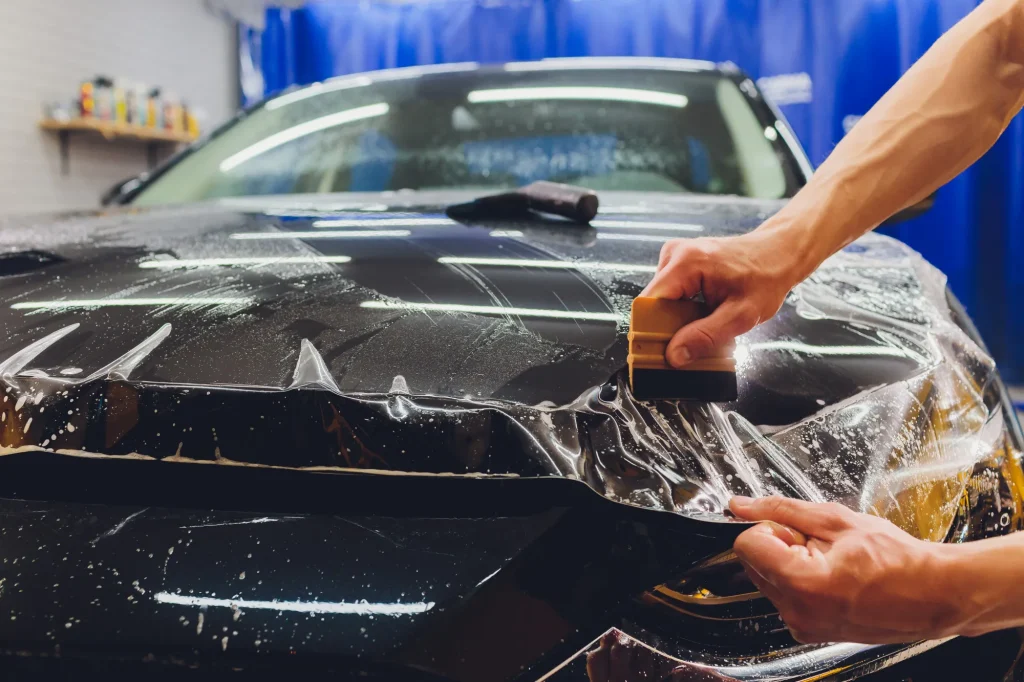
PPF is a transparent protective film applied directly over painted exterior panels. Quality automotive films generally use polyurethane construction combined with an adhesive layer and a protective top surface.
The purpose is straightforward: the PPF receives many of the light scratches, chips and surface abrasions that would otherwise reach the original paint.
Modern films can offer considerably more than simple physical coverage. Depending on the product, they may provide high optical clarity, stain resistance, resistance to weather exposure and self-healing characteristics for minor surface marks.
3M describes its automotive protection film as being designed to protect vulnerable painted surfaces from stone chips, scratches, bug damage, road tar, stains and harsh ultraviolet exposure. Its current Series 150 also incorporates heat-activated self-healing technology and a 10-year consumer warranty, subject to its warranty conditions.
XPEL similarly states that its protection film is designed to provide a nearly invisible barrier against scratches, UV exposure, dust and road debris, with minor surface scratches capable of self-healing.
The important distinction is that PPF does not make a vehicle indestructible. A serious collision, deep cut or heavy impact can penetrate the film. Its strength is in reducing common cosmetic paint damage that accumulates through everyday driving.
What Is Full Body PPF?
Full body PPF means protecting almost every painted exterior panel rather than only the front impact zones.
Coverage normally includes the:
- Front bumper
- Bonnet
- Front and rear fenders
- Doors
- Mirror caps
- Side panels
- Rear bumper
- Boot or tailgate
- Roof, depending on the vehicle and package
- Other painted exterior areas suitable for film application
The objective is to create consistent protection around the entire vehicle.
This solution makes particular sense for expensive factory paint, special colours, luxury vehicles and owners who are highly concerned about preserving the car’s original condition.
Where Full PPF Makes the Biggest Difference
Many owners initially think only the front bumper and bonnet receive damage.
They certainly receive substantial road impact, but other panels suffer different forms of wear.
Doors can collect scratches in parking areas. Rear bumpers can be marked while loading luggage. Side panels can encounter bushes, bags or careless contact. Areas around handles are vulnerable to fingernail and jewellery marks.
Full body PPF protects against a broader range of these everyday situations.
It also provides consistency. When the same type of film covers the complete exterior, gloss and surface characteristics are more uniform than when only selected panels are protected.
What Is Partial PPF?
Partial PPF protects specific high-risk areas instead of the whole vehicle.
A common package focuses on the front bumper, bonnet, front fenders and mirror caps. Other combinations may include door edges, door-handle cups, headlights, rocker panels or a rear loading area.
This approach is based on probability: protect the areas most likely to receive impact.
3M’s own automotive PPF guidance identifies locations such as bumpers, mirror backs and bonnets for protection from flying gravel and road contamination, while rocker panels are vulnerable to sand and stones thrown up by tyres.
Partial protection therefore has a sound practical basis.
Who Should Consider Partial Protection?
Partial PPF can be particularly suitable when:
- Your budget is limited
- The vehicle is primarily a daily commuter
- You want protection from highway stone chips
- The car will be kept for only a few years
- You are mainly concerned about front-end paint damage
- Certain panels have already been repainted
- You want to prioritise protection before considering wider coverage later
A properly selected partial package can deliver a large percentage of the practical value for owners whose main concern is stone-chip damage.
Full Body PPF vs Partial PPF Comparison
| Factor | Full Body PPF | Partial PPF |
|---|---|---|
| Coverage | Almost all painted panels | Selected high-impact panels |
| Stone-Chip Protection | Excellent across covered vehicle | Excellent mainly at front/high-risk zones |
| Scratch Protection | Broad exterior protection | Limited to covered areas |
| Visual Consistency | Most consistent | Protected and unprotected panels may age differently |
| Initial Investment | Higher | Lower |
| Parking-Lot Protection | Better | Depends on panels selected |
| Highway Protection | Excellent | Very good with front-end package |
| Luxury/Sports Cars | Highly suitable | Suitable depending on usage |
| Leased/Daily Vehicles | May be more than necessary | Often practical |
| Long-Term Ownership | Strong choice | Good if coverage matches risk |
| Maintenance | Film-safe care across most of car | Mixed care of film and exposed paint |
Neither option is automatically better.
The best choice depends on the car, its condition, ownership period, mileage, parking environment and how important original paint preservation is to you.
UAE-Specific Driving Conditions That Matter
Choosing PPF in Dubai should involve more than comparing film brands.
Local driving conditions influence which panels deserve protection.
Sand and Fine Road Debris
Dubai roads are generally excellent, but sand and small debris can still be thrown towards a vehicle by traffic ahead.
The front bumper, bonnet, mirrors and forward edges of fenders naturally receive greater exposure.
For someone regularly commuting on Sheikh Zayed Road, Emirates Road or Dubai–Al Ain Road, a well-designed front PPF package can therefore offer meaningful protection.
Highway Mileage
The more motorway kilometres you cover, the greater the accumulated exposure to particles thrown by other vehicles.
Consider two owners with the same new SUV.
Owner A drives 15 kilometres each day through relatively slow city streets.
Owner B drives more than 100 kilometres per day between Dubai and Abu Dhabi.
Owner B has a stronger case for extensive PPF because road exposure increases substantially over time.
This usage-based approach is more useful than simply asking whether a particular car is “expensive enough” for protection.
Intense Sun and Heat
Paint and exterior materials in the UAE experience significant sun exposure.
Premium Car Hub specifically positions its PPF solutions as being designed for Dubai conditions including heat, dust and UV exposure.
The quality of the film matters here. High-grade products are engineered for optical clarity and resistance to environmental exposure, while poorly manufactured products can potentially become more noticeable as they age.
Tight Parking Environments
Dubai car parks introduce another category of damage: light contact.
Door edges, door-handle cups, bumpers and side panels can receive scratches that have nothing to do with highway debris.
If your vehicle frequently spends time in busy shopping-mall, apartment or office parking, full body protection becomes more attractive.
When Full Body PPF Is Worth the Investment
Full coverage is particularly compelling for certain vehicles and ownership profiles.
Brand-New Luxury Cars
Protecting factory paint immediately after delivery can prevent defects from accumulating in the first place.
Performance and Exotic Vehicles
Special paint options and highly finished bodywork can be expensive to repair correctly. Original-paint preservation may also matter greatly to future buyers.
Long-Term Ownership
If you plan to keep a vehicle for five years or longer, the broader protection can make more sense than it would for someone changing cars every 18 months.
High Annual Mileage
Long-distance drivers continuously expose more than just the bonnet to environmental wear.
Owners Who Are Particular About Paint Condition
If small scratches bother you every time you walk toward your vehicle, full protection may provide greater satisfaction than constantly correcting individual defects.
XPEL says properly maintained PPF can typically last around five to ten years depending on film quality, installation, driving conditions, climate and maintenance.
That range also demonstrates why product and installer quality should be evaluated rather than treating every PPF package as interchangeable.
When Partial PPF Makes More Sense
Full coverage isn’t always necessary.
Suppose you have a family SUV used mainly for school runs, weekend activities and occasional highway journeys.
The bonnet and bumper may face genuine stone-chip risk, while the remaining bodywork experiences much less severe exposure.
A front-end PPF package could therefore be the smarter allocation of budget.
Partial protection is also useful when you want to combine different paint-care solutions.
For example, PPF can protect high-impact areas while ceramic coating can be applied as part of a broader appearance and maintenance strategy. Premium Car Hub notes that its ceramic coating services focus on gloss, hydrophobic performance and resistance to environmental contamination, while explaining that ceramic coating does not provide the same defence against heavier physical scratches and impacts.
That distinction matters: ceramic coating and PPF are complementary technologies, not identical substitutes.
Pros and Cons of Full Body PPF
Advantages
Maximum overall coverage: Most painted panels receive physical protection.
Consistent appearance: The exterior receives similar film coverage rather than mixing large exposed areas with protected ones.
Better defence against parking scratches: Side doors and rear panels receive protection as well as the front.
Strong option for expensive paint: Particularly useful for premium, luxury, performance and special-colour vehicles.
Long-term preservation: Owners keeping a car for several years can protect more of the factory finish.
Disadvantages
Higher investment: More material and significantly more installation work are required.
Longer installation process: Full coverage demands careful preparation, fitting, trimming and inspection.
Installation quality becomes critical: More panels mean more edges, curves and complicated surfaces that require installer skill.
Film can still be damaged: Deep cuts and major impacts can penetrate PPF.
Pros and Cons of Partial PPF
Advantages
Lower initial cost: You pay to protect the areas that statistically receive the most road impact.
Excellent front-end protection: A good package can defend the bumper, bonnet, mirrors and fenders from many common chips.
Flexible coverage: Packages can be customised around your car’s usage.
Good value for commuters: Particularly practical for owners who want road protection without full coverage.
Disadvantages
Exposed panels remain vulnerable: Doors, quarter panels and rear surfaces may still scratch.
Possible visual ageing differences: Years later, protected and unprotected surfaces may have experienced different levels of exposure.
Coverage boundaries require careful planning: Poorly chosen stopping points can make edges more noticeable.
What Premium Car Hub Technicians Recommend
The strongest PPF decision begins with inspecting the vehicle rather than selecting a package from a price list.
1. Start With Paint Condition
New vehicles can sometimes still contain light transport marks or dealership polishing defects.
Used vehicles may have swirl marks, scratches, touch-up paint or repainted sections.
Installing PPF over defects does not magically remove them. Surface preparation and any necessary paint correction should be completed first.
Premium Car Hub notes that PPF can also be applied to used vehicles after appropriate paint correction and surface preparation.
2. Match Coverage to Driving Pattern
For mainly urban use, front impact zones may be enough.
For frequent UAE highway driving, technicians may recommend wider protection because of the cumulative exposure to road debris.
For premium vehicles, full coverage often makes sense when preserving original paint is a priority.
3. Do Not Judge Film Only by Thickness
Film thickness matters, but it is only one specification.
Clarity, adhesive behaviour, self-healing characteristics, stain resistance, conformability, warranty terms and installer skill all influence the result.
Avery Dennison, for example, describes its Supreme Defense film as a high-performance polyurethane protection product designed for factory-paint preservation with scratch resistance, optical clarity and self-healing behaviour.
4. Pay Attention to Edges
One of the clearest differences between average and premium installation is often found around edges, curves, sensors, badges and complex bumper sections.
Professional installation should aim for clean alignment, secure adhesion and a finish that does not distract from the vehicle’s design.
5. Maintain the Film Properly
PPF still needs care.
XPEL advises waiting before the first wash after installation, cleaning contaminants promptly and avoiding high-pressure washing close to film edges because excessive pressure can contribute to lifting or damage.
Related Premium Car Hub Services for Better Paint Protection
Professional Paint Protection Film Installation
Premium Car Hub provides transparent, self-healing Paint Protection Film installation for protecting paint from stone chips, scratches, sand, road debris and everyday wear.
Explore Premium Car Hub PPF Services
Add Hydrophobic Paint Protection
For owners focused on easier cleaning, water repellency and enhanced gloss, ceramic coating can complement an exterior-care programme.
Explore Premium Car Hub Ceramic Coating
Explore Complete Car Customisation
Premium Car Hub also offers car wrapping, upholstery, lighting, infotainment, audio and other vehicle customisation services from its Dubai workshop.
Explore Premium Car Hub Services
Authoritative Resources for Understanding PPF Technology
For readers who want additional technical information rather than marketing claims alone, these manufacturer resources provide useful detail.
3M Automotive Paint Protection Film
3M documents the construction, applications, self-healing technology and protection characteristics of its automotive film products.
Read 3M Paint Protection Film Information
XPEL Paint Protection Film
XPEL provides information covering self-healing technology, scratches, removal, durability and film maintenance.
Explore XPEL Paint Protection Film
XPEL Film Care and Maintenance
Proper washing and aftercare directly influence long-term appearance.
Read XPEL Product Care Guidance
Avery Dennison Paint Protection Technology
Avery Dennison publishes technical product information covering polyurethane PPF, self-healing performance, optical clarity and impact resistance.
Explore Avery Dennison Automotive Protection Films
Frequently Asked Questions About Full and Partial PPF
1. Is full body PPF better than partial PPF?
Full body PPF provides more complete physical protection because almost every painted exterior panel is covered. However, partial protection may offer better value if your primary concern is front-end stone chips. The right choice depends on usage, vehicle value, ownership period and budget.
2. Which parts of a car should get PPF first?
The front bumper, bonnet, front fenders and mirrors normally deserve first priority because they face direct road debris. Rocker panels, door edges and rear loading areas can then be added depending on the vehicle and driving pattern.
3. How long does PPF last in Dubai?
There is no single lifespan for every film. Quality, installation, exposure, mileage, parking and maintenance all matter. XPEL states that Paint Protection Film typically lasts around five to ten years depending on such factors.
4. Does Dubai heat damage Paint Protection Film?
Premium automotive films are engineered to handle substantial environmental exposure, but product quality and installation matter greatly. High-quality films include UV and weather-resistance characteristics. Owners should follow the film manufacturer’s specific care recommendations.
5. Does PPF stop stone chips completely?
PPF provides a sacrificial protective layer that can substantially reduce damage from small stones and road debris. However, no film can guarantee protection from every high-speed or severe impact.
6. Will PPF damage original factory paint when removed?
Professional removal of quality film from suitable factory paint should not normally damage the finish. XPEL states that professionally removed film is designed to leave original paint intact, although paint condition, previous repairs and removal technique remain important.
7. Can PPF be installed on a used car?
Yes. The paint should first be inspected and prepared. Existing swirl marks, oxidation or surface defects may require correction before installation. Premium Car Hub specifically states that used cars can receive PPF after appropriate surface preparation.
8. Does self-healing PPF remove every scratch?
No. Self-healing technology is primarily intended for minor surface marks and light scratches. XPEL notes that deeper scratches that penetrate the film may not fully heal and can require film repair or replacement.
9. Should I choose ceramic coating or PPF?
Choose based on the protection needed. PPF provides a thicker physical barrier against stone chips and abrasions. Ceramic coatings primarily improve surface behaviour, gloss, hydrophobic performance and resistance to environmental contamination. Some owners combine both technologies.
10. Is full body PPF worth it for a new luxury car in Dubai?
For an owner who wants to preserve factory paint, expects to keep the vehicle for several years and frequently drives on UAE roads, full coverage can be a sensible investment. Partial coverage may still be sufficient where budget is more important or the vehicle sees limited exposure.
Conclusion: Choose PPF Coverage Around Your Real Driving Life
The debate between full body PPF and partial PPF becomes much easier once you stop thinking about coverage purely as “more versus less.”
Think about risk instead.
Where do you drive? How much motorway mileage do you cover? Where is the car parked? How long will you own it? Is the factory paint expensive or unusual? How much would visible stone chips or scratches bother you?
For many Dubai commuters, partial front-end PPF offers an excellent balance by protecting the panels that receive the majority of direct road impact.
For owners of luxury cars, performance vehicles, new SUVs, expensive factory colours or vehicles intended for long-term ownership, full body PPF offers a much broader defence against the small defects that accumulate across an entire vehicle.
The product is only half of the equation. Preparation, cutting, alignment, edge finishing and installer experience strongly influence how the finished vehicle looks years later.
Premium Car Hub’s approach is therefore to evaluate the vehicle, its paint and the owner’s driving pattern before recommending the appropriate protection strategy.
Rather than paying for unnecessary coverage—or protecting too little—the objective should be installing the right PPF in the right areas and maintaining it correctly.
Contact Premium Car Hub
Premium Car Hub
Location: 20th St – Al Khabaisi – Dubai, United Arab Emirates
Phone: +971 4 570 0353
Email: info@premiumcarhub.com
Website: Premium Car Hub
Premium Car Hub’s current website lists its Al Khabaisi location, +971 4 570 0353 telephone number and professional Paint Protection Film and ceramic-coating services in Dubai.