
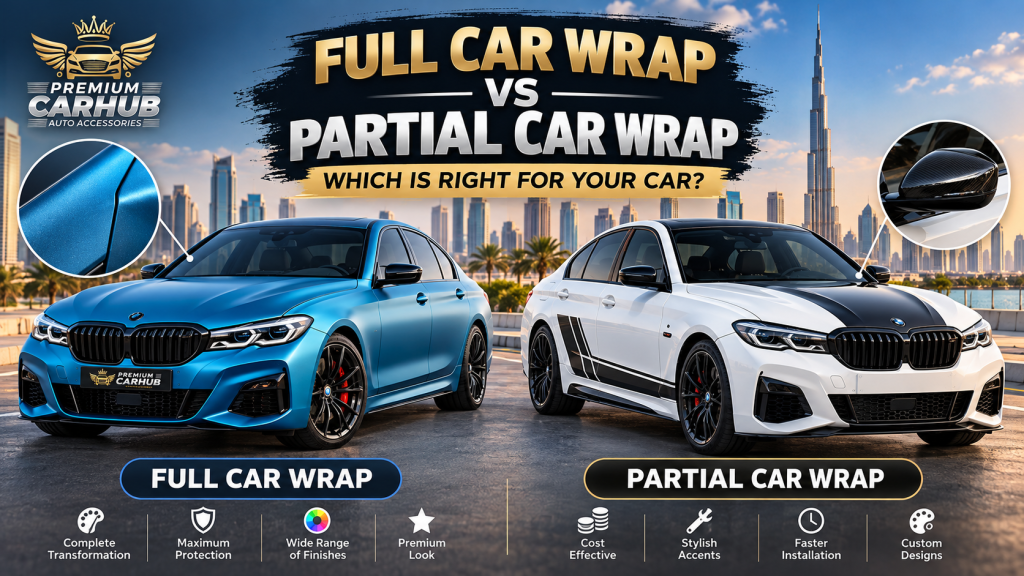
Full Car Wrap vs Partial Car Wrap: Which Is Right for Your Car?
Changing the appearance of a vehicle does not always mean repainting it. A professionally installed Car Wrap can transform the colour, finish and personality of a vehicle while retaining the original paint underneath.
But there is an important decision that is often overlooked: Should you wrap the entire vehicle or only selected panels?
For a Dubai driver, this is more than a question of appearance. The right choice depends on the vehicle’s condition, parking environment, driving habits, desired transformation, maintenance routine, budget and future plans for the car.
A full wrap may make sense when the goal is a complete colour transformation. A partial wrap can be surprisingly effective when the objective is to create contrast, highlight particular body lines or refresh vulnerable or visually important areas without covering the entire vehicle.
At Premium Car Hub in Al Khabaisi, our technicians approach wrapping as a vehicle-specific installation rather than simply applying film panel by panel. The quality of the underlying paint, complexity of the bodywork, film selection, edge finishing and expected use of the vehicle all influence the final result.
This guide explains the practical differences between full and partial wrapping, including considerations that matter particularly in Dubai.
What Is a Car Wrap?
A Car Wrap is an automotive-grade vinyl film applied over painted exterior surfaces. The film is carefully positioned and conformed around curves, contours, recesses and body lines.
Unlike a permanent repaint, wrapping can provide a reversible change in appearance when suitable film is installed over suitable paint and removed professionally.
Modern wrapping films are available in finishes including:
- Gloss
- Matte
- Satin
- Metallic
- Pearl
- Textured
- Carbon-fibre effect
- Colour-shifting finishes
The important point is that wrapping is not simply about changing colour. Coverage determines how complete the visual transformation will be.
For example, wrapping only the roof of a white SUV in gloss black creates a contrasting two-tone appearance. Wrapping the roof, bonnet, mirrors and selected trim can create an even stronger custom appearance without requiring a complete vehicle wrap.
Full Car Wrap Explained
A full wrap covers the majority of the vehicle’s painted exterior surfaces.
Depending on the vehicle and the customer’s requirements, this can include:
- Bonnet
- Front and rear bumpers
- Front and rear fenders
- Doors
- Quarter panels
- Roof
- Boot or tailgate
- Mirrors
- Other selected painted exterior sections
The exact coverage should always be confirmed with the installer because complex bodywork and trim can affect what is included.
When Does a Full Wrap Make Sense?
A full wrap is particularly relevant when you want to make the vehicle look substantially different.
Imagine buying a black Mercedes-Benz and wanting a satin grey appearance. Wrapping only the bonnet and roof would not create the same effect as covering the complete exterior.
Similarly, an owner of a white Range Rover may want a complete transformation to satin black, while a sports-car owner might choose a colour-shifting finish across the entire body.
The more dramatic the colour change, the more important complete coverage becomes.
The Visual Advantage of Full Coverage
One of the strongest benefits of a full wrap is consistency.
The colour and finish continue across the major visible panels rather than stopping at selected boundaries.
This can make the transformation appear closer to a factory colour change, particularly when the installer carefully handles edges and difficult areas.
A full wrap can also allow you to choose a finish that would be difficult or expensive to achieve through conventional paint.
Partial Car Wrap Explained
A partial wrap covers specific areas instead of the entire vehicle.
Common applications include:
- Roof wrapping
- Bonnet wrapping
- Mirror wrapping
- Spoiler wrapping
- Boot or tailgate wrapping
- Pillars
- Selected body accents
- Racing stripes
- Side graphics
- Two-tone colour combinations
- Chrome-delete applications
Partial wrapping is particularly useful when you want visual impact without a complete colour transformation.
For example, a white BMW with a gloss-black roof and mirror caps can achieve a sportier appearance while retaining most of its original body colour.
A black SUV with a satin-black bonnet and roof can create subtle contrast without looking excessively modified.
Full vs Partial Car Wrap: Comparison Table
| Factor | Full Car Wrap | Partial Car Wrap |
|---|---|---|
| Coverage | Most painted exterior panels | Selected panels or areas |
| Visual transformation | Complete | Moderate to dramatic depending on design |
| Colour change | Best for complete colour changes | Best for accents and two-tone designs |
| Initial investment | Generally higher | Generally lower |
| Installation time | Longer | Usually shorter |
| Design flexibility | Very high | Very high for targeted designs |
| Maintenance | Entire wrapped surface requires care | Only wrapped sections require film-specific care |
| Replacement after damage | Individual panels can potentially be replaced | Usually limited to affected section |
| Suitable for complete colour change | Yes | No, unless most visible areas are covered |
| Suitable for styling accents | Yes | Excellent |
| Resale flexibility | Original paint may remain underneath | Most original paint remains exposed |
| Best for | Major transformation | Targeted styling |
The table shows why there is no universal answer. The correct coverage depends on what you actually want the modification to accomplish.
Full Car Wrap: Pros and Cons
Pros of a Full Wrap
1. Complete Transformation
If your objective is to make the vehicle look like a completely different car, full coverage is the obvious approach.
You can move from white to satin black, silver to metallic blue or factory black to a distinctive colour-shifting finish.
2. Consistent Finish
A complete wrap creates a more uniform appearance across the vehicle.
This is particularly important when changing from a light factory colour to a much darker wrap.
3. More Design Freedom
Full coverage gives the designer considerably more freedom to combine colours and finishes.
You could use a satin body with gloss-black roof sections, for example.
4. Original Paint Remains Underneath
When the paint is healthy and the film is correctly installed and removed, the original finish can remain underneath the vinyl.
However, this should not be interpreted as a guarantee. Previous repainting, damaged clear coat, poor repairs and unstable paint can affect removal results.
5. Stronger Overall Visual Identity
For luxury vehicles, performance cars and enthusiast builds, complete coverage often produces a more intentional result than several unrelated partial modifications.
Cons of a Full Wrap
Higher Initial Cost
More film and more labour naturally increase the project cost.
Longer Installation
A full vehicle has significantly more panels, edges, curves and difficult areas to prepare and wrap.
More Surface to Maintain
Every wrapped panel needs appropriate care.
Existing Paint Problems Still Matter
Vinyl does not repair peeling paint, corrosion, deep dents or unstable bodywork.
Quality of Installation Becomes Critical
A poor installation can result in visible seams, lifting edges, excessive stretching or inconsistent finishing.
Partial Car Wrap: Pros and Cons
Pros of a Partial Wrap
Lower Project Cost
Because less material and labour are required, partial wrapping can be a practical way to achieve a customised appearance without paying for complete coverage.
Excellent for Two-Tone Styling
Roof-and-mirror combinations are especially popular because they create contrast without changing the entire vehicle.
Faster Transformation
A roof, bonnet, mirror or spoiler project can generally be completed more quickly than a full-body installation.
Easy Design Experiment
If you are unsure about committing to a dramatic full-body colour, starting with a partial design can be a useful way to test the style.
Targeted Replacement
If one wrapped panel is damaged, only that area may need attention rather than the entire vehicle.
Cons of a Partial Wrap
Colour Matching Can Be Difficult
If the vehicle’s original paint changes over time through UV exposure, the contrast between wrapped and unwrapped areas may become more noticeable.
Boundaries Become Part of the Design
A partial wrap needs deliberate panel boundaries. If the stopping points are poorly selected, the modification can look unfinished.
Not Suitable for Every Colour Change
A dark wrap over a light vehicle can reveal the original colour around uncovered edges and panels.
Inconsistent Ageing
The wrapped and unwrapped sections are exposed differently to sunlight, washing and environmental contamination.
The Most Important Question: What Are You Trying to Achieve?
Instead of asking, “Is a full wrap better than a partial wrap?” ask what result you want.
Choose Full Coverage If:
- You want a complete colour change.
- You want the vehicle to look substantially different.
- You are building a full custom appearance.
- You want one consistent finish across the exterior.
- You are comfortable with the higher installation cost.
- The vehicle has suitable, stable paint.
Consider Partial Coverage If:
- You mainly want visual accents.
- You like two-tone styling.
- You want to change the roof or bonnet.
- You want a lower-cost customisation.
- You are experimenting with a new appearance.
- Most of the factory colour already works with your design.
Dubai-Specific Driving Considerations
Dubai is not an ordinary environment for automotive vinyl.
High temperatures, intense sunlight, dust, sand, outdoor parking, road contamination and frequent vehicle cleaning can all influence how a wrap looks and ages.
Manufacturers such as 3M and Avery Dennison emphasise appropriate cleaning, shade or covered parking and protection from excessive environmental exposure as part of proper wrap care.
1. UV Exposure Matters
A vehicle parked outdoors every day experiences a different environment from one kept in a covered basement.
Horizontal surfaces such as roofs, bonnets and boot lids deserve particular attention because they can receive substantial direct sunlight.
Avery Dennison notes that increased sun exposure makes fade-resistant film selection particularly important.
This creates an interesting consideration for partial wraps.
If you wrap only the roof or bonnet, those areas may have a dramatically different finish from the surrounding factory paint over time.
2. Sand and Dust Change the Washing Routine
Dubai’s fine dust can act as an abrasive contaminant during washing. Car Wrap
The wrong technique—especially rubbing dry dust across the surface—can create unnecessary marks.
Manufacturers recommend rinsing away loose contaminants before washing and using soft, non-abrasive materials.
3. Avoid Aggressive Brush Washing
Both 3M and Avery Dennison advise against conventional brush-based automatic car washes because brushes can scratch film or catch its edges.
For a wrapped vehicle, careful hand washing or an appropriate touchless system is generally a safer approach.
4. Be Careful With High-Pressure Cleaning
High-pressure water directed toward film edges can encourage lifting or curling.
Avery Dennison’s technical guidance provides specific limitations for pressure, distance, temperature and spray angle when pressure washing is used. Car Wrap
The practical lesson is simple: pressure should never be used aggressively around wrap edges.
5. Parking Location Matters
Covered parking is one of the simplest ways to reduce environmental exposure.
3M specifically recommends indoor, shaded or covered storage where possible to help reduce heat and UV exposure.
For Dubai owners who park outdoors most of the day, film selection and maintenance deserve more attention than they might for a garage-kept weekend vehicle. Car Wrap
Full or Partial Wrap: What Do Premium Car Hub Technicians Recommend?
At Premium Car Hub, the decision should start with the vehicle rather than the package price.
Recommendation 1: Inspect the Paint First
Do not wrap over unstable paint simply because the vinyl will hide it temporarily.
Peeling clear coat, damaged paint, corrosion or poorly repaired panels can create complications during installation and removal. Car Wrap
Recommendation 2: Think About the Vehicle’s Colour
Partial wrapping works especially well when the factory colour complements the selected film.
For example:
White vehicle + gloss black roof + black mirrors = intentional two-tone design.
But:
White vehicle + dark partial panels scattered around the body = potentially unfinished appearance.
Design matters as much as coverage. Car Wrap
Recommendation 3: Consider Panel Complexity
A large, simple roof is very different from a bumper filled with vents, recesses and sharp transitions.
Complex bodywork increases installation time and requires more precise workmanship.
Recommendation 4: Do Not Confuse Vinyl With PPF
A vinyl colour-change wrap and Paint Protection Film solve different problems.
PPF is primarily designed for physical paint protection, including exposure to road debris and stone chips. A colour-change vinyl wrap is primarily a styling solution.
Premium Car Hub’s PPF service information similarly distinguishes physical paint protection from appearance-focused vehicle modification.
If protection is your priority, discuss PPF rather than assuming a colour-change wrap will provide equivalent impact protection. Car Wrap
Recommendation 5: Choose the Film Around Your Lifestyle
A dramatic matte finish may look exceptional, but it requires appropriate cleaning and maintenance.
If your vehicle is a daily driver and regularly exposed to Dubai’s dust, heat and outdoor parking, the maintenance requirements should be discussed before installation.
How Much Does Full vs Partial Wrapping Cost in Dubai?
There is no single price because vehicle size, film, finish, coverage and installation complexity all influence the quotation.
A partial project such as a roof or bonnet obviously requires less material than wrapping an entire SUV.
A full wrap can become considerably more expensive when the vehicle has:
- Large dimensions
- Complex bumpers
- Wide fenders
- Multiple vents
- Body kits
- Difficult curves
- Speciality film
- Colour-shifting finishes
- Extensive preparation requirements
Premium Car Hub’s Dubai pricing guide also notes that vehicle size, film quality, finish, coverage and installation complexity all influence the final quotation. Car Wrap
The cheapest quote is therefore not necessarily a like-for-like comparison.
When comparing workshops, ask:
- Which film manufacturer and product line are being used?
- What areas are included?
- Are edges being properly finished?
- Is trim removal included where necessary?
- Is surface preparation included?
- What workmanship warranty is provided?
- What aftercare instructions will you receive?
Maintenance After Your Car Wrap
Good maintenance is particularly important in Dubai.
Avery Dennison recommends waiting before the first wash after installation and advises hand washing, soft cleaning materials and suitable detergents.
3M similarly recommends hand washing where possible and avoiding brush car washes.
A practical routine includes:
- Keep the vehicle clean.
- Remove bird droppings and other contaminants promptly.
- Avoid abrasive cloths.
- Avoid aggressive pressure washing.
- Park under cover where possible.
- Use products compatible with the specific film.
- Inspect edges periodically.
- Follow the film manufacturer’s care instructions.
The exact maintenance routine should depend on the film manufacturer’s specifications rather than generic internet advice.
Related Premium Car Hub Guides
For readers planning a wider vehicle-customisation project, these resources provide useful next steps:
Complete Guide to Car Wrapping in Dubai
Understand film types, installation factors, Dubai conditions and the fundamentals of professional vehicle wrapping.
How to Maintain a Wrapped Car in Dubai
A practical guide to cleaning, parking, contamination and long-term wrap care.
How Long Does a Car Wrap Last in Dubai?
Learn how material, installation, sunlight, parking and maintenance can affect wrap longevity.
Car Paint Protection Film in Dubai
Useful if your primary objective is protecting paint against physical road damage rather than changing its colour. Car Wrap
Authoritative Resources for Vehicle Wrap Owners
For technical aftercare information, it is worth going directly to the film manufacturers rather than relying only on workshop advice.
3M Vehicle Wrap Care
3M provides manufacturer guidance covering washing, pressure cleaning, fuel spills, storage and other aspects of wrap maintenance.
Avery Dennison Wrap Maintenance
Avery Dennison publishes technical instructions covering cleaning methods, pressure washing, chemicals and film maintenance.
Dubai RTA Vehicle Modification Information
If a modification involves an official vehicle colour change, Dubai RTA provides information about the procedure for changing a licensed vehicle’s colour.
This is particularly important when a full wrap changes the vehicle’s registered colour. Owners should confirm the current requirements applicable to their vehicle before completing a significant colour change.
Authoritative Resources for Vinyl Care and UAE Compliance
Owners who want to confirm product specifications or vehicle-colour requirements should consult authoritative sources:
- 3M Wrap Film Series 2080 provides manufacturer information about film construction and potential vertical durability.
- 3M Vehicle Wrap Care Guidance explains routine cleaning, brushless washing and professional removal.
- The Abu Dhabi Government vehicle-colour service explains how a registered vehicle colour can be changed in Abu Dhabi.
- The UAE National Center of Meteorology provides official weather information that can help owners understand extreme heat and environmental exposure. Car Wrap
Frequently Asked Questions
1. Is a full Car Wrap better than a partial wrap?
Neither option is automatically better. A full wrap is more appropriate for a complete colour or finish transformation, while a partial wrap is often more suitable for roofs, bonnets, mirrors, spoilers and two-tone designs.
2. Is a partial wrap cheaper than a full wrap in Dubai?
Generally, yes, because it uses less material and requires less installation time. However, the final price depends on the vehicle, film, design complexity and preparation required.
3. How long does a full Car Wrap take?
The time depends on vehicle size, body complexity, film and installation standard. Premium Car Hub states that wrapping typically takes around 1–3 days depending on vehicle size and complexity.
4. Can I wrap only the roof of my car?
Yes. Roof wrapping is one of the most common partial-wrap applications and can create a strong two-tone appearance when matched with the vehicle’s factory colour.
5. Does a Car Wrap protect the original paint?
A wrap can cover the paint and may help shield the surface from some environmental exposure, but it should not be treated as equivalent to a dedicated paint-protection system. PPF is designed specifically for stronger physical paint protection.
6. Can I remove a Car Wrap later?
Generally, professionally installed vinyl can be removed. However, the result depends on film age, installation, paint condition, previous repairs and the condition of the underlying surface. Car Wrap
7. Is vinyl wrapping suitable for Dubai’s hot climate?
Quality automotive films are designed for outdoor vehicle use, but Dubai’s intense sunlight and heat make material selection, installation quality, parking and maintenance particularly important. Film manufacturers specifically recommend reducing prolonged exposure where possible.
8. Can I take a wrapped car through an automatic car wash?
Brush-based automatic washes are generally not recommended by major film manufacturers because brushes can scratch the film or catch its edges. Hand washing or an appropriate touchless system is preferable.
9. Should I choose a full wrap or PPF?
It depends on the objective. Choose a colour-change wrap when appearance and customisation are the priority. Consider PPF when physical paint protection from road debris and stone chips is the primary concern. Car Wrap
10. Does changing my car’s colour through wrapping require any official action in Dubai?
Dubai RTA provides a procedure for changing the colour of a licensed vehicle, including obtaining the relevant permit. Because regulations and procedures can change, vehicle owners should verify the current requirements with the relevant authorities before undertaking a significant colour change. Car Wrap Car Wrap
Final Verdict: Think in Terms of Purpose, Not Coverage
The full-versus-partial decision becomes much easier when you stop looking at wrapping as a package and start looking at it as a design and ownership decision.
A full Car Wrap makes sense when you want a genuine transformation: a different colour, a different finish and a consistent appearance across the vehicle.
A partial Car Wrap makes more sense when the original paint already works with your design and you want targeted visual changes such as a contrasting roof, bonnet, mirrors, spoiler or selected accents.
For Dubai drivers, there is another layer to the decision: sunlight, heat, dust, parking and maintenance. A wrap that looks perfect immediately after installation still needs the right material, professional application and sensible aftercare to remain attractive.
The best installation is therefore not necessarily the one with the most film. It is the one where coverage, material, design, vehicle condition and ownership habits all work together. Car Wrap
If you are uncertain, a professional inspection before choosing the coverage can prevent an expensive design mistake. At Premium Car Hub, the practical starting point is to examine the vehicle, understand the owner’s objective and then recommend the appropriate wrapping approach.
Premium Car Hub — Dubai
Location: 20th St – Al Khabaisi – Dubai, United Arab Emirates
Phone: +971 4 570 0353
Email: info@premiumcarhub.com
Website: https://premiumcarhub.com/
For a full or partial vehicle transformation, discuss the vehicle model, existing paint condition, preferred finish and intended coverage with the Premium Car Hub team before installation.