
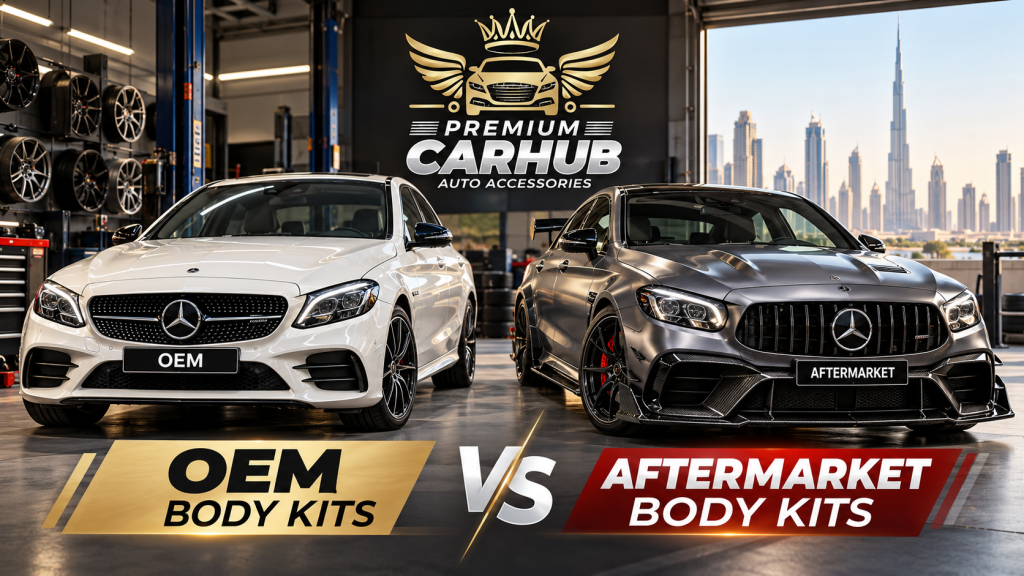
OEM vs Aftermarket Body Kits: Which Is Better for Your Car in Dubai?
Installing Body Kits can completely change the character of a vehicle. A standard luxury sedan can gain the visual presence of a performance model, while a sports car can appear lower, wider and more purposeful with carefully selected exterior components.
The difficult part is not deciding whether a body kit looks attractive. The real decision is choosing between an OEM kit and an aftermarket alternative.
For Dubai drivers, that choice deserves more thought than simply comparing prices.
Extreme summer temperatures, strong sunlight, sand, highway speeds, parking ramps, speed humps and tight underground parking areas can expose weaknesses in poor-quality exterior modifications very quickly. Fitment also affects parking sensors, radar systems, cooling airflow and the practicality of using the car every day.
At Premium Car Hub, our technicians recommend evaluating Body Kits as engineered vehicle components rather than decorative accessories. Material quality, mounting points, panel alignment, paint preparation and professional installation often matter more than the badge printed on the packaging.
This guide explains the practical differences between OEM and aftermarket options so UAE car owners can make a more informed decision.
What Are Body Kits?
Body Kits are collections of exterior components designed to modify the appearance, aerodynamics or visual proportions of a vehicle.
A complete kit may include:
- Front bumper or front lip
- Rear bumper
- Side skirts
- Front splitter
- Rear diffuser
- Fender extensions
- Spoilers
- Bonnet components
- Grille upgrades
- Canards or aerodynamic extensions
Some packages completely replace factory panels, while others attach to the existing bumpers and bodywork.
There is also an important difference between a genuine performance package engineered for a particular vehicle and a universal cosmetic kit adapted to fit multiple models.
That distinction becomes especially important when comparing OEM and aftermarket products.
What Does OEM Body Kit Mean?
OEM stands for Original Equipment Manufacturer.
OEM Body Kits are produced or officially approved for a specific vehicle manufacturer or model. They may be supplied as factory options, dealer accessories or genuine replacement parts.
For example, manufacturers sometimes offer sport-design bumpers, spoilers, side skirts or aerodynamic accessories specifically engineered around particular vehicle platforms.
Toyota’s official accessory catalogue demonstrates how manufacturers offer model-specific exterior accessories, while some genuine exterior components are designed around the original vehicle’s mounting and body geometry.
The main attraction of OEM components is predictability.
Because the component has been designed around a particular vehicle, mounting locations, body lines and surrounding components are usually closely matched.
However, OEM does not automatically mean that every kit will be suitable for every owner’s expectations. Factory styling options can be relatively subtle, and genuine components can sometimes cost considerably more than third-party alternatives.
What Are Aftermarket Body Kits?
Aftermarket Body Kits are manufactured by companies other than the original vehicle manufacturer.
The aftermarket market is enormous.
Products range from inexpensive fiberglass bumpers sold online to premium carbon-fibre aerodynamic systems developed specifically for exotic and performance vehicles.
This means the term “aftermarket” should never automatically be interpreted as either poor quality or better quality.
There can be a huge difference between a precision-engineered premium aftermarket kit and an inexpensive replica.
High-quality aftermarket companies may use:
- ABS plastic
- Polypropylene
- Polyurethane
- Fiberglass composites
- FRP
- Carbon fibre
- Hybrid composite materials
They may also offer designs that manufacturers never provide from the factory.
That creative freedom is one of the biggest reasons enthusiasts choose aftermarket Body Kits.
OEM vs Aftermarket Body Kits: Detailed Comparison
| Factor | OEM Body Kits | Aftermarket Body Kits |
|---|---|---|
| Fitment | Usually highly model-specific | Depends heavily on manufacturer quality |
| Design | Factory-inspired and restrained | Much wider styling selection |
| Material consistency | Generally predictable | Ranges from basic to premium |
| Installation | Usually straightforward | May require adjustment or fabrication |
| Price | Usually higher | Available across many price levels |
| Customization | Limited | Excellent |
| Replacement parts | Often easier through manufacturer channels | Depends on brand availability |
| Resale friendliness | Generally strong | Depends on design and installation |
| Aggressive styling | Limited | Wide variety |
| Carbon-fibre options | Model dependent | Widely available in premium ranges |
The table makes OEM components appear like the safer choice, but the real-world answer is more complicated.
A premium aftermarket kit professionally installed can outperform a poorly chosen OEM-style conversion in appearance and personalization.
Likewise, a cheap replica can create years of fitment problems.
The Biggest Advantage of OEM: Factory-Level Integration
When customers ask Premium Car Hub technicians about OEM Body Kits, fitment is usually the first advantage discussed.
Modern vehicles have surprisingly complex bumper assemblies.
Behind what appears to be a simple plastic bumper may be:
- Parking sensors
- Radar modules
- Cameras
- Air ducts
- Crash structures
- Wiring harnesses
- Headlamp washers
- Cooling channels
- Tow hook access
- Active aerodynamic components
A well-designed OEM component is normally created with these systems in mind.
Proper integration becomes even more important on newer Mercedes-Benz, BMW, Audi, Porsche, Range Rover, Lexus and other technology-heavy vehicles.
Panel Gaps Matter More Than Most Owners Realize
A kit can look excellent from five metres away and still be poorly installed.
Inspect it closely.
The gap between the bumper and fender should remain consistent. Headlight edges should align correctly. Side skirts should follow the sill line. Rear diffusers should sit symmetrically.
Uneven gaps immediately make expensive cars look poorly repaired.
This is why professional test fitting should happen before final painting.
Why Aftermarket Body Kits Remain Extremely Popular
If OEM fitment is so convenient, why do so many enthusiasts choose aftermarket options?
Because customization is about individuality.
OEM manufacturers must design products that appeal to thousands of customers. Aftermarket manufacturers can design for specific enthusiast tastes.
You might want:
- A wider stance
- Deeper side skirts
- An aggressive splitter
- Larger air openings
- Motorsport-inspired styling
- Exposed carbon fibre
- A performance-model conversion
- Wide-body styling
Aftermarket Body Kits provide far greater creative freedom.
For cars already common on Dubai roads, this can make a major difference.
A standard Mercedes, BMW, Porsche or Range Rover may already look premium. A carefully selected aftermarket exterior package can give the vehicle its own identity without requiring a completely different car.
Materials: What Should Dubai Car Owners Choose?
Material selection matters considerably in the UAE.
Dubai’s climate introduces intense heat and UV exposure while frequent highway driving exposes exterior components to road debris and vibration.
ABS Plastic
ABS is widely used for automotive exterior parts because it provides a useful balance between flexibility, finish quality and durability.
Quality ABS Body Kits can work particularly well for daily-driven vehicles.
Polypropylene and Polyurethane
Flexible plastics can tolerate minor impacts better than brittle composite materials.
They can therefore make sense for cars frequently driven through urban environments, parking ramps and areas with speed humps.
Genuine manufacturers also use plastics such as polypropylene in exterior aerodynamic components; Mercedes-Benz, for example, lists polypropylene for specific AMG exterior aerodynamic accessories.
Fiberglass
Fiberglass can create complex shapes at relatively affordable prices.
Its disadvantages appear when manufacturing quality is poor.
Cheap fiberglass components may require substantial:
- Sanding
- Filling
- Reshaping
- Reinforcement
- Mounting adjustment
It can also crack more easily than flexible plastics when subjected to impact.
Carbon Fibre
Carbon fibre is especially popular on sports cars and supercars.
A properly manufactured carbon component can deliver excellent strength with low weight while providing the distinctive exposed-weave appearance enthusiasts want.
However, carbon should be purchased for quality rather than appearance alone.
Low-quality cosmetic carbon overlays and poorly cured components should not be confused with professionally manufactured carbon-fibre parts.
UAE-Specific Considerations Before Installing Body Kits
A design that works beautifully in Europe may not necessarily suit everyday life in Dubai.
Premium Car Hub technicians recommend checking the following points before installation.
1. Ground Clearance
This is one of the most overlooked problems.
An aggressive front splitter may look spectacular in photographs but become inconvenient when entering:
- Basement parking
- Hotel entrances
- Shopping mall ramps
- Residential buildings
- Speed-hump areas
Before installing low Body Kits, measure the current clearance and calculate how much the new component will reduce it.
A daily driver needs a different setup from a weekend show car.
2. Cooling Airflow
Never select a front bumper purely by appearance.
Dubai summers place significant thermal demands on vehicles.
Bumper openings should not unnecessarily restrict airflow toward:
- Radiators
- Intercoolers
- Oil coolers
- Brake ducts
- Air-conditioning condensers
A dramatic bumper design that compromises cooling is not a worthwhile upgrade.
3. Heat Resistance
Poor plastics, adhesives and finishing materials can react badly to repeated temperature cycles.
Heat may contribute to:
- Warping
- Adhesive failure
- Edge lifting
- Paint deterioration
- Panel distortion
Quality material and preparation are therefore especially important for Body Kits used in the UAE.
4. Parking Sensors and ADAS
Modern vehicles may place radar and sensor equipment behind or within bumpers.
A replacement bumper must preserve the required position and operating environment of these systems.
After installation, sensor operation should be checked carefully.
Do not assume that simply creating a hole in a new bumper guarantees correct sensor operation.
5. Sand and Road Debris
Front splitters and low bumper extensions face continuous exposure to sand and small stones.
Paint protection film may therefore be useful on vulnerable painted or carbon surfaces.
6. Vehicle Inspection and Modification Requirements
Dubai vehicle owners should verify regulatory requirements before making substantial exterior changes.
RTA states that vehicles with modified bodies can be transferred to its Technical Inspection Committee, while its guidance distinguishes substantial body modifications from routine vehicle work. UAE federal traffic regulations also address inspection following substantial changes to a vehicle’s engine, chassis or colour.
The practical lesson is simple: do not assume every exterior modification is treated identically.
Before undertaking a major conversion, particularly one involving structural or significant body changes, verify the current requirements with the relevant authority.
OEM Body Kits: Pros and Cons
Pros
Better model-specific fitment:
Mounting points and vehicle geometry are usually carefully matched.
Factory-style appearance:
Ideal for owners who want a subtle performance look rather than an extreme conversion.
Integration with vehicle systems:
OEM components are more likely to account for existing sensors, ducts and trim.
Predictable quality:
Material and manufacturing standards are generally consistent.
Resale appeal:
Buyers often feel more comfortable with genuine, reversible factory upgrades.
Cons
Higher cost:
Genuine exterior parts can carry a substantial price premium.
Limited styling choice:
Factory designers normally remain conservative.
Not always available:
Certain models may have few genuine exterior upgrades.
Expensive replacement components:
Damage to a genuine bumper, splitter or diffuser can be costly.
Aftermarket Body Kits: Pros and Cons
Pros
Much greater design freedom:
Owners can choose anything from subtle OEM-plus styling to wide-body transformations.
More price options:
Products exist across entry-level, mid-range and premium categories.
Premium materials:
Carbon fibre and lightweight composites are widely available.
Unique appearance:
Aftermarket Body Kits can differentiate a car from similar vehicles on Dubai roads.
Performance-inspired choices:
Specialist manufacturers often develop aerodynamic styling for enthusiast vehicles.
Cons
Quality varies dramatically:
Two visually similar kits may have completely different manufacturing standards.
Fitment may require adjustment:
Poor moulds can result in uneven panel alignment.
Installation costs can increase:
A cheap kit that requires extensive bodywork may eventually cost more than a better product.
Replacement availability varies:
If one component is damaged later, matching pieces may be difficult to source.
The Hidden Cost of Cheap Body Kits
One lesson repeatedly seen in customization workshops is that purchase price does not represent total project cost.
Imagine two front bumpers.
The first costs considerably less but arrives with uneven moulding.
It requires several hours of:
- Reshaping
- Filling
- Sanding
- Bracket fabrication
- Sensor adjustment
The second costs more but fits correctly during the initial test installation.
After labour and preparation, the “cheap” bumper may no longer be cheaper.
This is why Premium Car Hub technicians recommend asking for an estimated finished installed cost, not simply the price of the kit.
Professional Installation Matters as Much as the Kit
Even premium Body Kits can look poor when installed incorrectly.
A professional installation should typically include:
Initial Vehicle Inspection
Existing accident damage, previous repairs and panel alignment should be checked before customization begins.
Dry/Test Fit
Parts should be positioned before paint.
This reveals issues with:
- Mounting points
- Panel gaps
- Sensor positions
- Wheel clearance
- Headlight alignment
Surface Preparation
Preparation determines paint durability and finish.
Paint Matching
Matching metallic and pearl colours can be especially demanding.
Lighting conditions should be considered because a panel that matches indoors may look noticeably different under Dubai sunlight.
Final Assembly
Correct fasteners and secure mounting methods should be used.
Double-sided tape should not become a substitute for proper mechanical mounting where structural attachment is required.
Quality Inspection
Check:
- Panel symmetry
- Sensor operation
- Ground clearance
- Wheel movement
- Paint finish
- Fastener security
- Vibration
- Road noise
For a deeper explanation of professional installation, see Premium Car Hub’s detailed guide: Body Kit Installation Process in Dubai.
OEM vs Aftermarket: Which Should You Choose?
There is no universal winner.
Instead, match the kit to the purpose of the vehicle.
Choose OEM When:
You want a near-factory appearance, straightforward fitment, strong compatibility and a conservative modification.
This is particularly suitable for:
- New luxury vehicles
- Daily drivers
- Leased or financed vehicles where permitted
- Owners concerned about resale
- Subtle performance-model conversions
Consider Premium Aftermarket When:
You want greater customization and are prepared to invest in professional fitting.
It can make sense for:
- Sports cars
- Supercars
- Enthusiast builds
- Show vehicles
- Unique luxury-car projects
- Carbon-fibre upgrades
Avoid Buying on Appearance Alone
A useful decision rule from workshop experience is:
Fitment first, material second, design third.
Most buyers instinctively reverse that order.
They see the design first and investigate construction later.
Doing the opposite usually produces better long-term results.
Premium Car Hub Technician Recommendations
Based on practical exterior customization work, Premium Car Hub technicians recommend following five principles.
1. Decide how the vehicle will actually be used.
Daily commuters need more practical clearance than weekend cars.
2. Inspect sample fitment whenever possible.
Photos cannot reveal panel-gap quality.
3. Ask what material the kit is manufactured from.
“Premium quality” is marketing language. Material specifications provide more useful information.
4. Test-fit before painting.
Discovering fitment problems after an expensive paint job can lead to unnecessary rework.
5. Think about reversibility.
Preserving original components is often worthwhile on valuable luxury and performance vehicles.
Continue Planning Your Dubai Car Customization
Before choosing Body Kits, these Premium Car Hub guides can help you understand the wider customization process.
For an overview of exterior, interior and performance upgrades, read Car Customization Dubai – Complete Expert Guide.
Sports-car owners should also review Sports Car Body Kit Ideas for Dubai Cars, which discusses ground clearance, proportions and UAE usability.
For owners considering multiple upgrades together, see Complete Car Customization in the UAE.
You can also explore the broader Car Body Kits in UAE Guide for additional selection and installation considerations.
Official and Technical References for UAE Car Owners
For regulatory questions involving vehicle inspection or significant modifications, owners can consult the Dubai Roads and Transport Authority Vehicle Technical Inspection Service. RTA notes that vehicles with modified bodies may be referred to its Technical Inspection Committee.
The UAE Ministry of Interior also publishes the country’s traffic regulations, including provisions concerning substantial vehicle changes and technical checks. UAE Ministry of Interior Traffic Regulations
For examples of manufacturer-engineered accessories, car owners can also review Toyota Genuine Accessories and official OEM component catalogues. Toyota describes its genuine accessories as vehicle-specific products and publishes applicable warranty terms for genuine accessories.
Mercedes-Benz’s official accessory catalogue likewise illustrates how manufacturer-developed exterior aerodynamic components can be individually tailored to particular vehicle applications. Mercedes-Benz AMG Exterior Accessories
Frequently Asked Questions About Body Kits
1. Are OEM Body Kits better than aftermarket Body Kits?
OEM kits generally provide predictable fitment and factory-style integration, while high-quality aftermarket products offer greater styling freedom. The better choice depends on your car, budget, desired appearance and intended use. A premium aftermarket product can be excellent, while a cheap replica can create significant fitment problems.
2. Do Body Kits affect a car’s resale value?
They can. Tasteful, professionally installed and reversible modifications are generally easier for future buyers to accept than extreme permanent changes. Keeping original components can make returning the vehicle to factory specification easier.
3. What material is best for a body kit in Dubai?
For daily-driven vehicles, quality ABS, polypropylene or polyurethane components can provide a good balance between durability and flexibility. Carbon fibre can suit premium and performance applications. Material quality and manufacturing standards matter more than simply choosing a material by name.
4. Can Body Kits affect parking sensors?
Yes. Replacement bumpers may affect parking sensors, cameras or radar equipment if mounting locations or surrounding materials change. These systems should be checked after installation.
5. Can a body kit make my car overheat?
A properly designed kit should preserve necessary airflow. However, a poorly designed front bumper that restricts radiator, intercooler or condenser airflow may create problems, particularly in UAE summer conditions. Cooling requirements should therefore be considered before installation.
6. Are aftermarket Body Kits legal in Dubai?
The answer depends on the nature and extent of the modification. Minor accessories and substantial body modifications should not automatically be treated as the same category. Dubai RTA states that vehicles with modified bodies may be referred to its Technical Inspection Committee, so significant projects should be checked with the relevant authority before work begins.
7. Do Body Kits improve aerodynamics?
Some properly engineered aerodynamic components can influence airflow, lift or stability, but a cosmetic kit should not automatically be assumed to improve performance. Manufacturers themselves spend considerable engineering effort optimizing vehicle aerodynamics.
For a road car, correct fitment and safe everyday operation should remain priorities.
8. How long does body kit installation take?
Installation time depends on whether components fit directly or require preparation, fabrication, painting and curing. A simple lip installation is very different from a complete bumper, side-skirt and diffuser conversion. The workshop should inspect the vehicle and kit before giving a realistic schedule.
9. Should a body kit be painted before installation?
Final painting should generally occur after initial test fitting. Test fitting allows alignment and mounting problems to be corrected before the finished surface is applied.
10. Are expensive Body Kits always better?
No.
Price may reflect material, engineering, branding and manufacturing quality, but cost alone does not guarantee correct fitment.
Look for accurate model compatibility, material specifications, good mould quality, secure mounting points and experienced installation.
Conclusion
The OEM-versus-aftermarket debate becomes much easier when you stop asking, “Which type is always better?” and start asking, “Which kit is better for this particular vehicle and how it will be driven?”
OEM Body Kits are attractive for owners who value predictable fitment, factory integration and restrained styling.
Premium aftermarket options are ideal for drivers who want greater individuality, carbon-fibre components, more aggressive proportions or a design unavailable through the manufacturer.
The biggest mistake is assuming that all aftermarket parts are the same.
They are not.
A precisely manufactured aftermarket component professionally installed can produce an outstanding result. A poorly moulded replica may require extensive adjustment and can make even an expensive vehicle look unfinished.
Dubai adds another layer to the decision. Ground clearance, heat resistance, cooling airflow, sensor compatibility, steep parking ramps and regulatory considerations must all be part of the planning process.
The most successful Body Kits are therefore not simply the most dramatic ones. They are the kits that look intentional, fit accurately, survive UAE conditions and remain practical every time the vehicle leaves the workshop.
For Premium Car Hub technicians, the goal is not to make every vehicle look heavily modified. It is to make the finished car look as though every exterior component belongs there.
Contact Premium Car Hub
For professional body kit selection, test fitting, painting, installation and complete vehicle customization in Dubai, contact Premium Car Hub.
Location: 20th St – Al Khabaisi – Dubai, United Arab Emirates
Phone: +971 4 570 0353
Email: info@premiumcarhub.com
Website: Premium Car Hub