
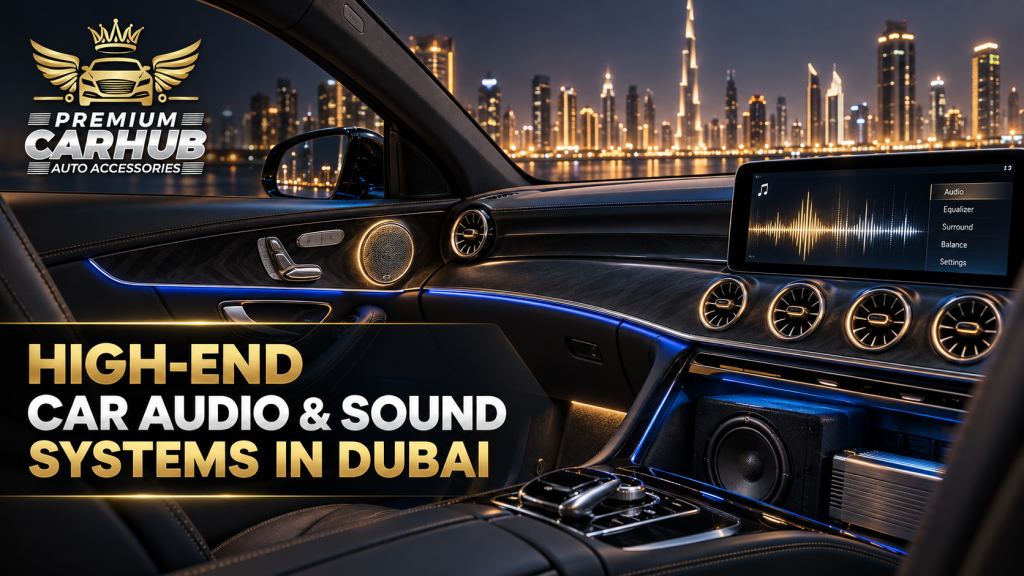
High-End Car Audio & Sound Systems in Dubai
A premium vehicle can be beautifully engineered yet still have an audio system that sounds flat, harsh or unfocused. Factory systems must accommodate production costs, limited amplifier power, standardized speaker locations and a sound profile intended to satisfy a broad audience. Drivers who want realistic vocals, controlled bass and accurate instrument separation frequently need a properly designed upgrade.
High-end Car Audio & Sound Systems are not simply louder versions of factory stereos. A well-designed system combines compatible speakers, clean amplification, digital signal processing, acoustic treatment and precise installation. Each component must work with the vehicle’s cabin, factory electronics and the owner’s listening preferences.
This distinction is particularly important in Dubai. Extreme heat, frequent highway travel, heavy air-conditioning use, road noise and long periods of outdoor parking create conditions that ordinary home-audio thinking does not address. This guide explains how to plan an upgrade that sounds refined, protects the vehicle and remains practical in the UAE.
Contact Premium Car Hub for Car Audio & Sound Systems Service
What Makes a Car Audio System Truly High-End?
An expensive list of components does not automatically create premium sound. The defining characteristic of high-end Car Audio & Sound Systems is integration. Speakers, amplifiers, crossovers and processors must operate as one calibrated system.
A professionally planned installation should deliver:
- Natural vocals positioned near the dashboard rather than the doors
- Clear midrange without nasal or hollow coloration
- Detailed treble that does not become sharp at higher volumes
- Deep, controlled bass without excessive panel vibration
- Consistent sound across different music genres
- Low background hiss and electrical interference
- Sufficient output without audible distortion
- Secure, discreet installation that respects the original interior
A common mistake is replacing factory speakers while retaining insufficient power and poor factory equalization. New speakers may be technically superior, but they cannot perform properly if the original signal is heavily processed or the factory amplifier cannot drive them efficiently.
Sound Quality Is More Important Than Maximum Volume
Power ratings attract attention, but volume is not the best measure of audio quality. Premium performance is heard in smaller details: the texture of a singer’s voice, the position of instruments, the impact of a kick drum and the quiet space between notes.
High-quality Car Audio & Sound Systems remain balanced at moderate listening levels. This is especially useful during long commutes, when an aggressive system can quickly cause listening fatigue.
Contact Premium Car Hub for Car Audio & Sound Systems Service
The Core Components of a Premium Car Audio Upgrade
Component Speakers
Component systems separate the woofer, midrange driver and tweeter, allowing each unit to reproduce the frequencies it handles best. Separate positioning also helps create a convincing soundstage.
Two-way component systems are suitable for many daily-driven vehicles. Three-way systems add a dedicated midrange driver and can produce better vocal presence and instrument separation, but they require more installation space and careful tuning.
Speaker size alone does not determine performance. Cone material, sensitivity, impedance, mounting depth and compatibility with the amplifier are equally important.
Contact Premium Car Hub for Car Audio & Sound Systems Service
Digital Signal Processor
A digital signal processor, or DSP, is the control centre of many modern Car Audio & Sound Systems. It corrects frequency imbalances and compensates for the fact that a driver sits closer to some speakers than others.
Professional DSP tuning can adjust:
- Time alignment
- Crossover points
- Equalization
- Output levels
- Phase relationships
- Factory signal correction
- Subwoofer integration
Time alignment delays the nearest speakers by tiny amounts so that sound from different locations reaches the listener together. When calibrated correctly, vocals appear in front of the driver instead of pulling toward the nearest door.
Contact Premium Car Hub for Car Audio & Sound Systems Service
Multi-Channel Amplifier
An amplifier provides the stable power required for clean dynamics and low distortion. Its RMS output should be matched to the speakers’ continuous power requirements. Peak or “maximum” numbers are much less useful when designing a system.
Compact Class D amplifiers are popular in modern vehicles because they offer efficient power delivery in a relatively small package. Efficiency also matters in Dubai, where heat management is a genuine installation consideration.
Contact Premium Car Hub for Car Audio & Sound Systems Service
Subwoofer
A subwoofer reproduces frequencies that door speakers cannot deliver efficiently. Its purpose is not necessarily to shake the vehicle. In a refined installation, the subwoofer adds depth and weight while appearing to blend with the front speakers.
Options include:
- Compact under-seat subwoofers
- Custom side-panel enclosures
- Spare-wheel-well installations
- Sealed boot enclosures
- Ported enclosures for higher output
The best configuration depends on available space, desired bass output and whether the owner regularly carries luggage.
Contact Premium Car Hub for Car Audio & Sound Systems Service
Sound-Deadening Materials
Road noise masks musical detail. Drivers sometimes respond by increasing the volume, which creates more distortion and listening fatigue. Treating selected doors, panels and the boot can reduce resonance and improve speaker performance.
Effective acoustic treatment is strategic. Covering every surface adds weight and cost that may not produce proportional benefits. Experienced installers identify panels that vibrate, seal unsuitable openings and reinforce speaker mounting areas.
Contact Premium Car Hub for Car Audio & Sound Systems Service
Comparison of Car Audio Upgrade Packages
| Feature | Speaker Upgrade | Balanced DSP System | Full High-End System |
|---|---|---|---|
| Typical components | Front and rear speakers | Speakers, DSP and amplifier | Three-way speakers, DSP, amplifiers, subwoofer and sound treatment |
| Sound improvement | Noticeable | Significant and well controlled | Reference-level when correctly tuned |
| Bass performance | Limited to speaker capability | Improved control | Deep, extended and adjustable |
| Soundstage | Moderate | Wide and accurately positioned | Highly immersive |
| Factory integration | Usually retained | Advanced integration | Fully engineered integration |
| Installation complexity | Low to moderate | Moderate to high | High |
| Space requirement | Minimal | Small amplifier location needed | Depends on subwoofer and equipment |
| Best suited to | Practical daily upgrade | Luxury daily drivers | Enthusiasts and audiophiles |
| Tuning requirement | Basic | Essential | Extensive |
| Relative investment | Entry level | Mid-to-premium | Premium |
For many luxury-car owners, the balanced DSP system offers the strongest value. It improves clarity, imaging and bass control without requiring a large boot enclosure or obvious interior modifications.
Contact Premium Car Hub for Car Audio & Sound Systems Service
How to Choose the Right System for Your Vehicle
The ideal design begins with three questions: What do you listen to? Where do you drive? How much original space and functionality must be preserved?
A driver who mainly listens to podcasts, acoustic music and vocals may prioritize midrange clarity and front soundstage. Someone who enjoys electronic music may want stronger sub-bass, greater amplifier headroom and more extensive door treatment. A family SUV needs even sound coverage, while a sports car may require compact equipment and focused noise control.
Match the Equipment to the Cabin
Vehicle cabins behave differently. A large SUV has more air volume and may require stronger low-frequency output. A coupe has fewer mounting locations and less separation between the listener and rear speakers. Convertibles introduce wind noise that changes how the system is perceived with the roof open.
Luxury vehicles may also contain factory fibre-optic networks, active noise control, centre speakers, warning chimes and multiple amplified channels. Upgrading Car Audio & Sound Systems in these vehicles requires integration equipment and vehicle-specific knowledge.
Contact Premium Car Hub for Car Audio & Sound Systems Service
Keep the Factory Interface When It Works Well
Owners do not always need to replace the original screen or head unit. Retaining the factory interface preserves steering-wheel controls, parking cameras, navigation displays and the appearance of the dashboard.
A specialist can often extract and correct the factory signal before sending it to a DSP and aftermarket amplifiers. This approach combines original functionality with substantially improved sound.
Ask for a Listening Profile, Not Just a Brand
Two premium speaker brands can have noticeably different sound signatures. One may emphasize warmth and smoothness, while another may sound highly detailed and forward.
Before approving an installation, explain whether you prefer soft treble, strong vocals, tight bass or a more energetic presentation. Car Audio & Sound Systems should be tuned for the owner rather than according to a single universal preset.
Contact Premium Car Hub for Car Audio & Sound Systems Service
UAE-Specific Driving Considerations
Extreme Cabin Temperatures
A parked vehicle in the UAE can become extremely hot. Heat affects adhesives, speaker surrounds, wiring insulation, amplifiers and processors. Equipment should be automotive-grade, and amplifiers need ventilation rather than being sealed into an unventilated compartment.
Technicians should use heat-resistant wiring, secure terminals and suitable mounting materials. Amplifiers must not be placed where luggage can block airflow or where moisture may accumulate.
Contact Premium Car Hub for Car Audio & Sound Systems Service
Dust and Sand
Fine dust can enter door cavities, boots and ventilation paths. Connections should be protected, speaker adapters must fit securely and exposed equipment should not be installed where it attracts contamination.
Regular interior cleaning is helpful, but high-pressure air should not be directed into speaker grilles because it can force debris toward delicate components.
Long Highway Journeys
Driving between Dubai, Abu Dhabi, Sharjah and other emirates exposes passengers to continuous tyre and wind noise. Instead of designing only for high output, a good system improves intelligibility and tonal balance at comfortable levels.
Contact Premium Car Hub for Car Audio & Sound Systems Service
Noise reduction, low-distortion amplification and careful tuning are particularly valuable for highway drivers. They allow podcasts, navigation prompts and music to remain clear without excessive volume.
Traffic, Navigation and Safety Alerts
Modern vehicles use speakers for indicators, parking sensors, collision warnings and navigation instructions. These functions must be tested after any installation. Car Audio & Sound Systems should enhance entertainment without weakening important alerts.
Drivers should also maintain safe listening levels. The World Health Organization’s safe-listening guidance explains that both sound level and listening duration affect hearing risk.
Contact Premium Car Hub for Car Audio & Sound Systems Service
Local Modification and Inspection Requirements
Any substantial electrical or structural modification should respect applicable UAE rules and manufacturer requirements. Owners can consult the Dubai Roads and Transport Authority for current transport and vehicle guidance.
A professional installation should avoid unsafe wiring, interference with airbags and irreversible cutting wherever a vehicle-specific solution is available.
Professional Installation Versus DIY Installation
Modern luxury vehicles are not ideal candidates for trial-and-error wiring. Door panels can contain airbags, control modules, sensors and delicate clips. Incorrect polarity, poor grounding or unsuitable cable routing may cause noise, faults or component damage.
Professional installation normally includes vehicle inspection, signal testing, safe panel removal, custom mounting, protected power distribution, DSP calibration and post-installation checks.
DIY work may be reasonable for someone with automotive electrical knowledge and the correct documentation. For complex factory-amplified systems, however, specialist integration is usually the safer choice.
Contact Premium Car Hub for Car Audio & Sound Systems Service
Pros and Cons of High-End Car Audio & Sound Systems
Advantages
- Greater vocal clarity and instrument separation
- Controlled bass with less distortion
- Better sound at comfortable listening levels
- System tuning matched to the vehicle and driver
- Improved enjoyment during commutes and road trips
- Retention of factory controls with correct integration
- Expandability for future upgrades
- Discreet installation with a factory-style appearance
- Reduced rattles when acoustic treatment is included
Considerations
- Higher initial cost than a basic speaker replacement
- Additional tuning time may be required
- Poor installation can affect factory electronics
- Amplifiers and subwoofers may consume storage space
- Added equipment introduces some extra weight
- Modifications may need to be considered when reviewing vehicle warranty terms
- Very high volume can distract the driver and damage hearing
The disadvantages are generally manageable when the system is planned around the vehicle instead of assembled as a collection of unrelated components.
Contact Premium Car Hub for Car Audio & Sound Systems Service
Expert Recommendations from Premium Car Hub Technicians
Premium Car Hub technicians recommend diagnosing the factory system before selecting new equipment. Listening tests and signal measurements can reveal whether the main limitation is the speakers, insufficient power, factory equalization, road noise or a combination of factors.
Start with the Front Soundstage
Most musical information should come from the front. Spending the budget evenly across every speaker is not always the best approach. High-quality front components, correct amplification and DSP tuning often produce a larger improvement than installing expensive rear speakers.
Rear speakers can provide subtle ambience for passengers, but they should not pull vocals behind the driver.
Contact Premium Car Hub for Car Audio & Sound Systems Service
Build the System in Logical Stages
A practical staged upgrade may begin with front speakers, door treatment, a DSP amplifier and professional tuning. A subwoofer can be added later if more low-frequency extension is required.
Planning future expansion at the beginning prevents duplicated labour and incompatible purchases. It also ensures that wiring, amplifier channels and processor outputs are available for the next stage.
Contact Premium Car Hub for Car Audio & Sound Systems Service
Protect the Vehicle’s Electrical System
Amplifier power cables require appropriate fusing close to the power source. Cable gauge must suit current demand and installation length. Ground connections should be clean, mechanically secure and placed at an approved point.
In vehicles with intelligent battery management, start-stop systems or hybrid powertrains, electrical integration needs special attention.
Tune with Measurement and Listening
Measurement microphones help identify peaks, dips and timing problems, but graphs alone do not create enjoyable sound. Final tuning should combine objective measurement with critical listening from the actual driving position.
Premium Car Hub technicians recommend saving at least two DSP profiles where suitable: one optimized for the driver and another offering broader balance for multiple occupants.
Do Not Chase Bass Before Fixing the Doors
When doors resonate or speaker mounts flex, additional bass power may only produce more vibration. Reinforcing the mounting surface and applying targeted acoustic treatment can make existing speakers sound tighter before a larger subwoofer is considered.
Explore Related Premium Car Hub Services
A complete cabin upgrade may involve more than audio equipment. These Premium Car Hub resources can help owners plan compatible improvements:
- Learn how modern infotainment can improve connectivity in the guide to car Android displays for luxury vehicles.
- Compare premium speaker configurations in the best car speakers in Dubai guide.
- Understand why calibration matters with these car audio tuning tips.
- Reduce exterior noise and panel resonance with this guide to car soundproofing in Dubai.
- Explore complementary technology through premium car accessories in Dubai.
Trusted Resources for Audio, Connectivity and Road Use
Owners researching Car Audio & Sound Systems may also find these authoritative resources useful:
- World Health Organization: Safe Listening — guidance on managing sound intensity and exposure duration.
- Dubai Roads and Transport Authority — official Dubai transport and vehicle information.
- Apple CarPlay — official compatibility and functionality information for Apple’s in-car platform.
- Android Auto — official information about Android connectivity, navigation and media features.
- SAE International — automotive engineering standards, research and technical resources.
Frequently Asked Questions
1. How much does a high-end car audio system cost in Dubai?
The price depends on the vehicle, speaker configuration, amplifier channels, DSP, subwoofer, acoustic treatment and installation complexity. A speaker-only upgrade costs less than a fully active three-way system. The most reliable approach is to inspect the vehicle and prepare an itemized proposal rather than choosing a universal package.
Contact Premium Car Hub for Car Audio & Sound Systems Service
2. Can I upgrade the audio without replacing the factory screen?
Yes. Many Car Audio & Sound Systems can integrate with the original screen and controls. A DSP interface can accept the factory signal, correct its processing and route it to aftermarket amplifiers. Compatibility must be confirmed for the specific model and factory audio option.
3. Do premium speakers need an amplifier?
Some efficient speakers can operate from factory power, but dedicated amplification generally provides better dynamics, bass control and clarity. The amplifier’s RMS output and impedance compatibility must match the speakers. More power is useful only when it is clean, controlled and correctly configured.
4. Is a DSP necessary for a car sound system?
A DSP is strongly recommended when factory processing is complex or when accurate imaging is important. It allows installers to correct frequency response, set crossovers and compensate for unequal speaker distances. Even excellent speakers may sound unfocused without calibration.
5. Will an audio upgrade void my vehicle warranty?
Aftermarket equipment does not automatically determine the status of an entire vehicle warranty, but policies and circumstances differ. Owners should ask their dealer or manufacturer how a proposed modification could affect related electrical coverage. Reversible, vehicle-specific integration helps minimize unnecessary changes.
Contact Premium Car Hub for Car Audio & Sound Systems Service
6. How long does installation take?
A straightforward speaker upgrade may be completed within several hours. Car Audio & Sound Systems involving multiple amplifiers, a DSP, custom fabrication, sound treatment and detailed tuning can require one or more working days. Rushing panel preparation or calibration can compromise the result.
7. Can a subwoofer be installed without losing boot space?
Yes. Compact under-seat units, side-panel enclosures and spare-wheel-well solutions can preserve most usable storage. The appropriate option depends on the vehicle and the expected bass output. A compact enclosure usually prioritizes practicality, while a larger enclosure offers greater low-frequency capability.
8. Why does my upgraded system still sound distorted?
Possible causes include clipped factory signals, incorrect gain settings, insufficient amplifier power, unsuitable crossover points, damaged speakers or poor source material. Panel rattles can also be mistaken for speaker distortion. A technician should test the signal chain instead of replacing components without diagnosis.
9. Are high-end systems suitable for electric and hybrid cars?
Yes, but energy use, electrical integration, active noise systems and vehicle-specific safety procedures must be considered. Efficient amplifiers and non-invasive installation methods are particularly useful. Work involving high-voltage vehicle systems should only be handled by appropriately qualified technicians.
10. How can I protect my audio equipment from Dubai’s heat?
Use automotive-grade equipment, maintain ventilation around amplifiers, avoid blocking cooling surfaces and have electrical connections installed with heat-resistant materials. Ceramic window tint, shaded parking and routine inspection may also help reduce cabin heat exposure. Never cover an amplifier with luggage or carpeting that traps heat.
Conclusion: Build for Balance, Not Specifications
The best Car Audio & Sound Systems in Dubai are designed around the vehicle, listener and local environment. Premium sound comes from balanced component selection, stable power, acoustic preparation and careful calibration—not from the largest amplifier or the highest advertised wattage.
For most owners, the smartest route is a factory-integrated system with strong front speakers, targeted door treatment, a DSP amplifier and professional tuning. A correctly blended subwoofer can then add depth without dominating the cabin. This configuration preserves everyday practicality while delivering the clarity and emotional impact expected from a luxury audio upgrade.
Premium Car Hub can assess the factory system, discuss your listening preferences and recommend an installation suited to your vehicle. Whether you want cleaner calls and podcasts, realistic vocals or a complete audiophile system, the aim should remain the same: natural sound, safe integration and dependable performance on UAE roads.
Contact Premium Car Hub
Location: 20th St – Al Khabaisi – Dubai, United Arab Emirates
Phone: +971 4 570 0353
Email: info@premiumcarhub.com
Website: https://premiumcarhub.com/