
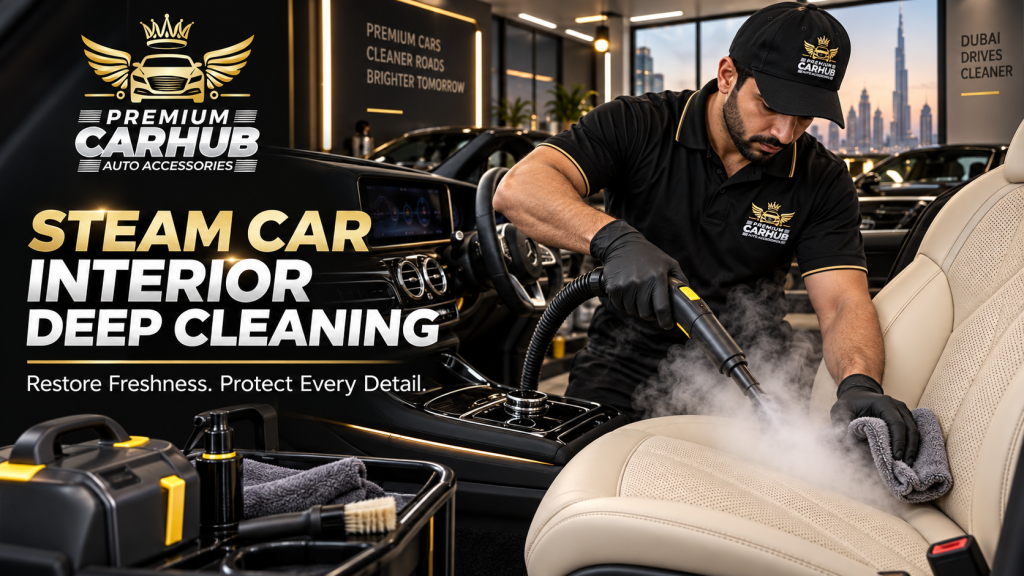
Steam Car Interior Deep Cleaning: A Complete Guide for Dubai Drivers
A vehicle can look clean after a quick vacuum and dashboard wipe while still holding sand, food residue, body oils and unpleasant odours beneath the visible surfaces. Professional Car Interior Deep Cleaning addresses the areas an ordinary car wash cannot reach, including seat seams, carpet fibres, air vents, cup holders and the narrow spaces around the centre console.
Steam is especially useful because controlled water vapour can loosen stubborn contamination without flooding the cabin. However, steam is not automatically safe for every material. Leather, Alcantara, fabric, roof linings, plastics and electronic controls must be treated differently.
For vehicles driven in the UAE, the method used is particularly important. Fine desert dust enters through footwear and open doors, extreme heat affects upholstery and adhesives, and constant air-conditioning can circulate dust throughout the cabin. A professional service should therefore be based on inspection and material knowledge, not simply on using the highest temperature available.
This guide explains what steam Car Interior Deep Cleaning involves, how it compares with shampooing, which materials require special care and what Premium Car Hub technicians recommend for Dubai motorists.
Contact Premium Car Hub for Car Interior Deep Cleaning service
What Is Steam Car Interior Deep Cleaning?
Steam Car Interior Deep Cleaning is a professional detailing process that uses heated water vapour to soften dirt, grease, dried spills and other deposits. A technician directs controlled steam through a suitable attachment and immediately removes the loosened contamination with microfiber towels, brushes or extraction equipment.
Steam is only one part of a thorough interior service. A reliable process normally includes:
- Interior inspection
- Identification of upholstery materials
- Dry vacuuming
- Stain assessment and pre-treatment
- Controlled steam application
- Fabric or carpet extraction where required
- Cleaning of detailed cabin areas
- Moisture removal and drying
- Final inspection and surface protection
Moving a steam nozzle over seats for a few minutes does not qualify as complete Car Interior Deep Cleaning. The visible result may initially look acceptable, but dirt can remain in seat foam, carpet underlay and inaccessible corners.
Contact Premium Car Hub for Car Interior Deep Cleaning service
Steam cleaning is not the same as soaking
Professional vapour equipment produces hot steam with relatively low water content. The objective is to transfer enough heat to release contamination while keeping residual moisture under control.
When fabric seats or carpets are soaked unnecessarily, drying takes longer and moisture can remain in the padding. This may create a stale smell or contribute to microbial growth. Effective extraction and controlled drying are therefore just as important as the steam-cleaning stage.
Why Dubai Vehicles Need More Than Routine Vacuuming
Dubai’s climate creates a distinctive combination of interior problems. Fine sand reaches carpet fibres and seat rails even when drivers keep their windows closed. Heat softens sunscreen, cosmetics, food residue and skin oils, helping these substances bond with leather, steering wheels and armrests.
Air-conditioning is used for much of the year, which means cabin air is regularly recirculated. If vents, filters and interior surfaces contain dust, the cabin can become dusty again soon after a basic cleaning.
Contact Premium Car Hub for Car Interior Deep Cleaning service
Periodic Car Interior Deep Cleaning is particularly useful for:
- Family SUVs used for school journeys
- Daily commuter vehicles
- Chauffeur-driven and corporate cars
- Vehicles used by smokers
- Cars that regularly carry pets
- Pre-owned vehicles with an unknown cleaning history
- Luxury cars with light-coloured interiors
- Vehicles being prepared for resale
Routine vacuuming removes loose particles, but it cannot fully extract compacted sand, dried drinks or oily deposits embedded in textured materials.
UAE-Specific Interior Cleaning Considerations
Fine desert sand
Desert sand is not limited to visible floor areas. Small particles collect beneath mats, between seat cushions, along stitching and inside seat tracks. Brushing without vacuum extraction can simply move the dust from one area to another.
Professional Car Interior Deep Cleaning begins with detailed dry removal. Steam should only be introduced after loose sand and grit have been extracted. Otherwise, moisture can turn dust into a residue that becomes more difficult to remove.
Extreme cabin temperatures
A closed vehicle parked in direct sunlight can become dangerously hot. Heat can also accelerate the deterioration of leather coatings, adhesive-backed trim and soft-touch plastics.
Technicians should allow an overheated cabin to cool before treatment. Applying steam to an already hot or heat-sensitive surface increases unnecessary risk. Drivers should never leave children or pets unattended in parked vehicles, even for a short period.
Contact Premium Car Hub for Car Interior Deep Cleaning service
Heavy air-conditioning use
Steam cleaning the visible vent grilles can improve their appearance, but it does not replace cabin-filter inspection or evaporator cleaning. If a smell appears only when the AC is operating, the source may be within the climate-control system rather than the seats or carpet.
Humidity and moisture control
Humidity and condensation can make a damp interior take longer to dry. After Car Interior Deep Cleaning, doors should not simply be closed while seats remain moist. Air movers, effective extraction and proper ventilation may be needed.
Premium cabin materials
Dubai has a high concentration of vehicles fitted with Nappa leather, Alcantara, natural wood, piano-black trim and digital displays. These surfaces require a more conservative approach than ordinary commercial fabric. A technician should identify every material before selecting steam pressure or cleaning chemicals.
Contact Premium Car Hub for Car Interior Deep Cleaning service
The Professional Steam Cleaning Process
1. Inspection and documentation
Before beginning, the technician should inspect stains, tears, loose trim, worn leather, damaged stitching and malfunctioning controls. Photographing pre-existing damage protects both the customer and service provider.
This inspection also sets realistic expectations. Cleaning may remove contamination, but it cannot reverse fading, cigarette burns, cracked leather or permanent dye damage.
Contact Premium Car Hub for Car Interior Deep Cleaning service
2. Removal of personal items and mats
Personal belongings, child seats and removable mats are taken out. Mats are assessed separately because rubber, carpet and premium textile mats require different treatment.
Technicians should also inspect under the seats and inside storage compartments rather than cleaning only the immediately visible areas.
3. Detailed dry vacuuming
Powerful vacuum equipment, soft brushes and compressed air are used to remove sand, crumbs, hair and loose debris. Special attention is given to:
- Seat seams
- Carpet edges
- Pedal areas
- Seat rails
- Door pockets
- Centre-console gaps
- Child-seat anchor points
- Luggage compartments
This stage establishes the foundation for successful Car Interior Deep Cleaning. Applying steam before completing dry extraction can make loose contamination harder to manage.
4. Stain identification and pre-treatment
Coffee, milk, grease, ink, make-up and sugary drinks do not respond to the same cleaner. Professionals evaluate the likely stain type and test an appropriate product in an inconspicuous area.
A milk spill, for example, may travel through seat fabric into the foam. Cleaning only the surface can leave the odour source behind. Extraction may be necessary to remove the affected residue from deeper layers.
Contact Premium Car Hub for Car Interior Deep Cleaning service
5. Controlled steam application
Steam is applied in small, manageable sections. A microfiber-wrapped attachment may be used on broader surfaces, while a precision nozzle helps clean seams and narrow crevices.
The nozzle should remain in motion. Holding concentrated steam in one place can overheat a surface, weaken adhesive or affect a protective coating. Released dirt is wiped away immediately rather than being allowed to settle again.
6. Extraction where necessary
Steam loosens contamination but does not automatically pull everything from deep upholstery. Fabric seats and carpets with embedded soil may require rinse extraction.
This is why experienced technicians combine methods. Steam works well around detailed areas, while extraction physically removes dissolved soil and moisture from porous materials.
7. Controlled drying
Clean microfiber towels, wet-extraction equipment and air movers are used to remove residual moisture. The car should be checked before handover to ensure that carpets, seats and hidden edges are dry.
The US Environmental Protection Agency emphasises that moisture control is central to reducing mould growth. Its general guidance recommends drying wet materials promptly, typically within 24–48 hours. In automotive detailing, the practical goal should be to remove moisture much sooner whenever possible.
8. Protection and final inspection
Once the interior is clean and dry, compatible leather conditioner or fabric protection may be applied. Controls, windows, mirrors, storage compartments and under-seat areas should receive a final check.
A good inspection should identify streaking, remaining residue, transferred dirt or damp sections before the customer collects the vehicle.
Contact Premium Car Hub for Car Interior Deep Cleaning service
How Different Interior Materials Should Be Cleaned
Fabric seats and carpets
Fabric usually responds well to steam Car Interior Deep Cleaning because vapour can loosen dirt trapped between fibres. However, steam alone may not remove contamination that has soaked into seat foam or carpet padding.
Technicians should use controlled agitation and extraction instead of repeatedly applying more steam. Old stains can sometimes leave permanent colour changes even after the original contamination has been removed.
Leather upholstery
Leather requires careful temperature control. Excessive heat, aggressive brushes and unsuitable alkaline cleaners can affect its protective coating or leave the surface dry.
For leather Car Interior Deep Cleaning, professionals may apply steam indirectly through a microfiber towel rather than directing the nozzle onto the seat. The leather should then be cleaned with a compatible product and protected after it has cooled and dried.
Leather should not be left unnaturally shiny or greasy. A clean, low-sheen appearance is generally more appropriate and less likely to transfer residue onto clothing.
Alcantara and suede-like materials
Alcantara can develop tide marks, uneven texture or flattened fibres when it is soaked or scrubbed aggressively. It should not be treated like ordinary upholstery.
The official Alcantara maintenance guidance recommends gentle material-appropriate care. Technicians should test products first, use limited moisture and carefully restore the material’s nap after cleaning.
Contact Premium Car Hub for Car Interior Deep Cleaning service
Headliners
A headliner is normally made from fabric bonded to a backing with adhesive. Direct heat and excess moisture can weaken this bond, causing the material to sag.
Headliners should be spot-cleaned conservatively with indirect treatment. Heavy steaming does not indicate a better service; it indicates poor risk control.
Screens and electronic controls
Steam should not be directed into switches, charging ports, speakers, infotainment screens or electronic modules. These areas require suitable microfiber towels and products applied to the towel rather than sprayed onto the component.
Modern interiors contain increasingly complex electronics, making precision an essential part of professional Car Interior Deep Cleaning.
Steam Cleaning vs Shampooing vs Basic Interior Cleaning
| Factor | Steam Deep Cleaning | Traditional Shampooing | Basic Interior Cleaning |
|---|---|---|---|
| Main purpose | Loosens embedded dirt and cleans detailed areas | Washes heavily soiled carpets and fabric | Removes visible dust and loose debris |
| Water consumption | Low when controlled correctly | Moderate to high | Very low |
| Drying requirement | Usually shorter | Often longer | Minimal |
| Seat seams and crevices | Excellent access | Limited access | Surface-level result |
| Deep liquid spills | May need additional extraction | Effective with proper extraction | Usually insufficient |
| Heat-sensitive materials | Requires careful control | Avoids steam heat but may over-wet | Generally low risk |
| Chemical residue | Can be reduced | Depends on rinsing quality | Depends on products used |
| Best use | Detailed, low-moisture interior restoration | Heavily soiled washable textiles | Frequent maintenance cleaning |
The most effective Car Interior Deep Cleaning may combine several of these methods. A technician should select the method according to the material, contamination and desired result rather than applying one technique across the entire vehicle.
Contact Premium Car Hub for Car Interior Deep Cleaning service
Pros and Cons of Steam Interior Cleaning
Advantages
- Steam reaches narrow seams, seat rails and textured areas.
- It uses relatively little water when correctly controlled.
- Heat helps soften sticky residue and greasy deposits.
- Less aggressive scrubbing may be required.
- It can reduce reliance on heavily fragranced chemicals.
- Drying may be faster than saturated shampoo cleaning.
- Steam works well alongside vacuuming and extraction.
- It can refresh frequently touched surfaces without leaving a greasy finish.
Limitations
- Excessive heat can damage leather finishes and adhesives.
- Steam cannot repair faded, torn or cracked upholstery.
- Deep spills may still require wet extraction.
- Electronics must be protected from moisture.
- Incorrect technique can spread loosened contamination.
- The cabin can develop a musty smell if it is not dried properly.
- Some delicate materials require indirect treatment or alternative methods.
- Old chemical or dye damage may remain visible after cleaning.
These limitations are why professional Car Interior Deep Cleaning should focus on controlled treatment instead of dramatic clouds of steam.
Contact Premium Car Hub for Car Interior Deep Cleaning service
When Does Your Car Need Deep Cleaning?
Visible dirt is only one indicator. Consider booking a professional service if:
- The cabin retains an unpleasant smell after vacuuming
- Seats feel sticky or oily
- Sand is visible between seat sections
- Carpets have become darker in high-traffic areas
- Dust returns soon after routine cleaning
- Food or milk has spilled inside the vehicle
- Pet hair is embedded in upholstery
- A floor mat feels damp underneath
- The car has recently been purchased used
- You are preparing the vehicle for sale
A persistent smell deserves investigation rather than perfume. The source could be beneath the carpet, inside seat foam, around a cabin filter or within the AC system.
Contact Premium Car Hub for Car Interior Deep Cleaning service
Premium Car Hub Technicians’ Expert Recommendations
Premium Car Hub technicians recommend scheduling Car Interior Deep Cleaning according to the way the vehicle is used. A lightly driven weekend car may need treatment once a year, while a family SUV, chauffeur vehicle or daily commuter may benefit every four to six months.
Treat spills immediately
Blot fresh liquid with a clean absorbent towel. Do not rub aggressively, as this can spread the spill and push it deeper into the fibres. Milk, coffee with cream and sweetened drinks should be assessed quickly because heat can intensify the resulting odour.
Request material-specific treatment
Ask the detailer how leather, Alcantara, fabric and electronic surfaces will be handled. A provider using the same chemical and brush on every surface is unlikely to deliver safe Car Interior Deep Cleaning.
Avoid glossy dashboard dressings
Heavy silicone dressings can create glare on the windscreen and attract dust. A clean, natural or low-sheen finish is more suitable for most dashboards and supports clearer visibility.
Inspect the cabin filter
Cleaning visible vents will not correct smells caused by a dirty cabin filter or AC drainage problem. Have the filter inspected according to the vehicle manufacturer’s maintenance schedule, particularly when driving regularly in dusty UAE conditions.
Prioritise complete drying
Never cover damp seats with plastic or leave a wet vehicle closed for an extended period. Before collection, ask whether the carpet and seat padding have been checked for moisture.
Protect the result
Use fitted mats, empty rubbish regularly, vacuum loose sand and clean spills before they dry. A windscreen sunshade and shaded parking can also reduce heat exposure, although children and pets must never be left unattended in a parked car.
Contact Premium Car Hub for Car Interior Deep Cleaning service
Helpful Premium Car Hub Services for Complete Vehicle Care
Interior cleanliness forms one part of protecting a vehicle’s appearance and value. These Premium Car Hub resources provide additional guidance and services:
- Explore custom car interior upholstery in Dubai when leather, fabric or interior panels require repair, replacement or a complete upgrade.
- Read Premium Car Hub’s guide to professional car interior deep cleaning in Dubai for more advice on restoring a neglected cabin.
- Discover how professional car polishing can improve exterior paint clarity after the interior has been detailed.
- Visit Premium Car Hub to explore detailing, protection and vehicle customisation services in Dubai.
Trusted Resources for Safer Vehicle Care
The following resources offer reliable guidance that supports responsible interior maintenance:
- The Dubai Roads and Transport Authority provides official road-safety and seasonal vehicle-maintenance guidance for UAE motorists.
- The US Environmental Protection Agency’s moisture and mould guide explains the importance of moisture control and prompt drying.
- The official Alcantara cleaning and maintenance guide provides material-specific care recommendations.
- The US Centers for Disease Control and Prevention warns that parked cars can reach dangerous temperatures quickly and that children should never be left inside.
Frequently Asked Questions
1. Is steam cleaning safe for every car interior?
No. It can be safely used on many surfaces when the heat, distance and exposure time are controlled, but not every material should receive direct steam. Leather, Alcantara, loose headliners, natural wood and electronic components need specialised handling. A technician should inspect and patch-test delicate materials before treatment.
2. Can steam cleaning remove every stain from car seats?
Steam can loosen many food, drink and oil-based deposits, but it cannot reverse permanent material damage. Bleach marks, faded dye, ink that has chemically bonded with fibres and old stains previously treated with aggressive products may remain. Honest Car Interior Deep Cleaning focuses on achieving the safest possible improvement.
3. Does steam cleaning remove cigarette smell?
It can remove smoke residue from many accessible surfaces, but cigarette smoke may also contaminate the headliner, air-conditioning system and seat foam. Severe cases may need repeated cleaning, cabin-filter replacement or specialist odour treatment. Applying fragrance alone does not remove the source.
4. How often should I deep-clean my car interior in Dubai?
For most privately owned vehicles, every six to twelve months is reasonable. Vehicles used by families, smokers, pet owners or professional drivers may require more frequent cleaning. Immediate treatment of spills and regular vacuuming can help extend the interval.
5. How long does the interior take to dry?
Drying time depends on the vehicle size, upholstery thickness, amount of moisture used, humidity and extraction quality. Low-moisture steam work may dry quickly, while extracted seats and carpets can take several hours. The vehicle should only be returned when treated surfaces are properly dry.
6. Is steam Car Interior Deep Cleaning safe for leather seats?
It can be safe when undertaken by an experienced technician using indirect, controlled application. Concentrated steam should not be held against leather. After cleaning, an appropriate conditioner or protectant may be applied according to the leather type and manufacturer guidance.
7. Can steam damage vehicle electronics?
Yes, if vapour is directed into switches, ports, infotainment displays or electronic modules. Professional technicians isolate these areas and use minimally damp tools. Owners should avoid DIY steaming around digital consoles and electrically adjustable seat controls.
8. Does the service include AC cleaning?
Cleaning visible vent grilles may be included, but evaporator treatment, duct cleaning and cabin-filter replacement are often separate services. Ask exactly what the selected package covers, especially if an odour becomes noticeable only when the AC is switched on.
9. Can I perform steam interior cleaning at home?
Durable areas may be cleaned carefully with appropriate equipment, but DIY treatment involves risks such as burns, over-wetting, adhesive failure and damage to leather coatings. Luxury upholstery, headliners, Alcantara and electronic-heavy interiors are better handled by trained professionals.
10. Is Car Interior Deep Cleaning worthwhile before selling a vehicle?
Yes. A clean cabin creates a better first impression and allows potential buyers to inspect the vehicle without being distracted by stains or odours. It cannot hide damage, but it can present the car honestly and demonstrate that it has received proper care.
Conclusion: Cleanliness Depends on Control, Not Maximum Steam
Successful Car Interior Deep Cleaning is a precise process rather than an aggressive blast of heat. The best results come from inspecting every material, removing dry contamination first, treating stains individually, controlling temperature and extracting moisture thoroughly.
This method is particularly valuable in Dubai, where sand, high cabin temperatures and constant air-conditioning place unusual pressure on vehicle interiors. It can restore fabric, refresh detailed areas and remove residue that routine cleaning leaves behind. However, the technician must understand when steam should be reduced, applied indirectly or replaced with another method.
Premium Car Hub combines interior assessment with material-specific detailing techniques. Whether you are restoring a daily commuter, refreshing a family SUV or preparing a luxury vehicle for sale, professional Car Interior Deep Cleaning can deliver a cleaner and more comfortable cabin while protecting its valuable finishes.
Contact Premium Car Hub
Contact Premium Car Hub to arrange an interior inspection and receive recommendations based on your vehicle’s condition, materials and daily use.
Location: 20th St – Al Khabaisi – Dubai, United Arab Emirates
Phone: +971 4 570 0353
Email: info@premiumcarhub.com
Website: https://premiumcarhub.com/